News

Smallholders Representation Working Group Update – December 2019

The Smallholders Representation Working Group has agreed to propose the new main characteristics for potential representatives of GPSNR smallholders as below:

Smallholder: individual natural rubber farmers with all following characteristics:

  • The primary source of income for the smallholder is the farm (not only Natural Rubber); 
  • The Natural Rubber production unit size is less than 50ha (although the farm may be larger);
  • Profits from the farm accrue primarily to the owner of the farm and their family.

The new definition combines the qualitative and quantitative aspects with the intention to offer a pragmatic and standardized definition. The working group members understand that average farm size differs from country to country, hence having a universal threshold in farm size might not guarantee that the farmer is a small grower in that particular country. However, a quantitative indicator should be in place in order to give an objective and clear understanding to all audiences. The threshold of 50 hectares is established as an interim quantitative indicator based on the discussion in the working group that more than 80% of natural rubber supply comes from the farm which is smaller than 50 hectares.

The Country Champion is collecting application form from the smallholders that have been nominated durinng GPSNR Smallholder Workshop.  While membership fee is waived to smallholder member, funding to participate the General Assembly in March 2020 in Singapore is limited to 20 seats. The Working Group will further look at the profile of the smallholders  to design the criteria for funding mechanism.

Read More »
News

Strategy and Objectives Working Group Update – December 2019

The final version of Desired State V1-0 and Theory of Change will be submitted to the Executive Committee in view of approval at the General Assembly on 31st March 2020.  The Strategy & Objectives Working group is also preparing a concept of Equity working sub-group. GPSNR calls for members who wish to support in preparing the concept note for the equity sub-group, to please state your interest to GPSNR secretariat. 

Strategy 1 ‘Policy Toolbox’ Working Group drafters proposed the first draft of the policy elements and KPIs to the working members, which have now been mapped out against GPSNR 12 principles and desired state.  In order to collect the comments in a written form, members are asked to provide their comments online by January 3rd 2020. After the working group members agree on the final version of policy components, it will be submitted to the Executive Committee for comments and approval.

Strategy 2 ‘Capacity Building’ Working Group has completed a validation of their strategy against the Theory of Change.  The Working Group realizes that the situation in each country varies, so the capacity building strategy needs to be customized in its approach.  A list of stakeholders conducting capacity building activities in rubber producing countries has been finalised. The next step will be to collect inputs from the identified stakeholders in order to design GPSNR capacity building strategies.  In order to have a standardized information, the interviews will be conducted by GPSNR members in January 2020, and the result of the interview will be consolidated by GPSNR secretariat.

Strategy 3 ‘Traceability and Transparency’ Working Group – Some of the tools that the members are using for natural rubber traceability and transparency were presented during the first calls.  The next step is to start looking at Theory of Change, what are the underlying cause of lack of transparency and traceability, and how increasing transparency will contribute to the desired state.

GPSNR members can see the discussion and the minutes of each working grouop on GPSNR discussion forum. Please contact nigel@gpsnr.org for your log-in credentials.

Read More »
News

Secretariat Update – December 2019

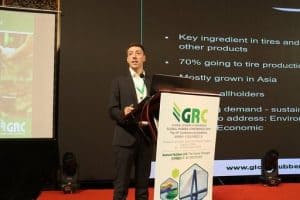
What does it take to revive the Natural Rubber economy? Could the Natural Rubber 2.0 be the ultimate game changer for the new NR economy? These were some of the difficult questions discussed at the 15th Global Rubber Conference.

Hosted in Hainan, China from 12-14 December, with a theme on ‘Natural Rubber 2.0: The Game Changer’, the conference represented a very exciting event and opportunity for networking and knowledge sharing for Natural Rubber professionals in Asia, and in the rubber industry globally.

GPSNR Director Stefano Savi participated in the conference as a speaker and panel discussion member, to share updates with the industry participants about the progress of the Platform and its working groups. “Sustainability should not be seen as a threat by producers, but an opportunity to place natural Rubber as a leader in the global commodities landscape, best placed to deliver on the UN SDGs and the 2030 agenda.” said Stefano during his remarks, adding that “GPSNR is here to support smallholders in this journey, and ensure that the cost of this sustainable shift will not be borne by farmers, but supported by the industry through the Global Platform.”

Amidst the current backdrop of the fourth industrial revolution, the conference was a good opportunity to discuss the convergence of artificial intelligence and data technology as new solutions to address innovation gaps and current low demand for NR across the globe. It is obvious that from drones to satellite images and sensor technology, the natural rubber industry is poised for a radical change. So, what role will sustainability play in this desired and required industry shift? Will the natural rubber industry take advantage of this opportunity to improve its practices, maximise its positive impact, and reposition itself as a leader in innova

Read More »
News

Secretariat Update – November 2019

About BCSD Singapore Ltd

Since its inception, GPSNR was in the need of a host and BCSD Singapore Ltd. was chosen because its mission is very much aligned with that of GPSNR. From October 2018, BCSD Singapore Ltd. acted as the legal entity under which GPSNR operations were conducted. This role was formalised with the approval of GPSNR’s Statutes in March 2019. The services provided to GPSRN were about all administrative aspects of the platform which include but not limited to invoicing, accounting, procurement, and HR services. 

About WBCSD Asia Pacific Ltd

WBCSD Asia Pacific Ltd. has been established as a non-profit legal entity in Singapore in January 2019. This entity is an affiliate of WBCSD and its purpose is to support more effectively global WBCSD Members and projects in the region. With a regional office in Singapore, WBCSD is in a better position to understand regional and national specificities, business priorities and practices, political and regulatory landscape and learn from cultural diversity and perspectives of local communities.

What will change ? 

  • This transition will not result in any changes of the day to day activities of GPSNR. 
  • The organizational and governance structure of the platform remains the same as decided in the last General Assembly.  
  • Future incoming and recurring GPSNR membership would be invoiced through WBCSD Asia Pacific Ltd (instead of BCSD Singapore Ltd) as of 1st December, 2019.
  • WBCSD Asia Pacific Ltd would act as the legal entity and host for the Global Platform for Sustainable Natural Rubber (GPSNR) as of 1st December, 2019 until the platform decides to change hosting or create its own legal entity.

If you have any questions on the transition, please contact GPSNR Director, Stefano Savi (stefano.savi@gpsnr.org). 

Read More »
News

Smallholders Representation Working Group Update – November 2019

With the input from the workshop in Indonesia, Thailand, Brazil (and soon Cote d’Ivoire and Vietnam), the smallholders representation working group is finalizing the definition of ‘smallholders’ which will be needed to open up a new category of membership. Recognizing the experience and effort that IRSG/SNRi had already invested in this work, Smallholders Representation Working Group invited IRSG to discuss the definition of ‘smallholders’.  

While many countries have their own definition of ‘smallholders’ based on the size of their land, the Smallholders representation Working Group agreed other characteristics of smallholders (such as income provenance, level of dependency on family labour, economic constraints, etc) should also be considered. 

As the definition of ‘smallholders’ are affiliated to the work scope Strategy 2 – Capacity Building Working Group, the Smallholders Representation Working Group members are working closely with Strategy 2 – Capacity Building Working Group members to ensure that there is alignment in definition between smallholders in the natural rubber supply chain and smallholders that will become GPSNR member.

In the meantime, a successful third workshop in Brazil concluded this week, with a series of learnings for GPSNR on the organisation of farmers in the region, and their expectations from the future collaboration with the Platform. The workshop also achieved good progress on the identification of potential candidates for membership in GPSNR, both by single farmers and producers associations.

Read More »
News

Strategy and Objectives Working Group Update – November 2019

Desired state V1-0 and Theory of Change documents were circulated among Strategy & Objectives Working Group in November. Comments from the members were consolidated and will be responded to in the next version.  Theory of Change will be finalized and submitted to the Executive Committee in order to be approved at the General Assembly in March 2020.

Strategy 1 ‘Policy Toolbox’ Working Group primarily agreed on the scope of work. The desired state V1-0 serves as a baseline document which will be cross referenced with Accountability Framework initiative in order to come up with policy framework that will be applicable to GPSNR members.  The drafters volunteers will present the first draft of a policy framework to the working group members in December 2019.

Strategy 2 ‘Capacity Building’ Working Group members worked on defining priority geographical areas based on current production volume and emerging trend of natural rubber production.  The existing stakeholders and capacity building activities in those countries are being identified in order to design the plan for GPSNR on capacity building.

Strategy 3 ‘Traceability and Transparency’ Working Group members were requested to list down traceability tools that are currently in use and/or traceability tools that could be potentially used for natural rubber supply chain.  In December they will analyze the attributes of each tool to see the compatibility and applicability for transparency and risk assessment.

All the 3 working groups including Strategy & Objectives and Smallholders Representation Working Group members are given access to GPSNR discussion forum which aims to increase transparency and synergy among the working groups. You will be able to see the discussions and the documents of all the working groups but will be able to contribute only to the groups you signed up for.  Please contact nigel@gpsnr.org for your log-in credentials.

Read More »
News

Strategy and Objectives Working Group Update – October 2019

Strategy 1 – A team led by Liza Murphy with the support of Proforest has been selected to lead the work on the Assurance Models study, which is expected to be finalised in January 2020 for review by the working group before Executive Committee approval, prior to the General Assembly in March. The working group is now fully staffed with members volunteers looking into identifying co-chairs for the group.

Strategy 2 – After the first working group call, the Capacity Building working group will start working on identifying the priority countries and capacity gaps needed, a work expected to be completed in the months of October – November.  Following that, the action plan will be developed and consulted before being submitted to the Executive Committee in March 2020.  

Strategy 3 – Enhancing Transparency and Traceability working group composition is currently being finalized to ensure balance amongst the different categories of ordinary members with the expectation to kick-off the first call in November. 

All three working groups will be reporting directly to the Executive Committee while keeping regular contact with the Strategy & Objectives working Group to ensure the consistency of work. The Strategy & Objectives working group remains active to review the desired state to include the identified impact metrics, finalise the theory of change, and look at the financial model for GPSNR in coordination with the Strategy 1 – Policy Toolbox working group.

All minutes of the working groups will be available in the members section of the GPSNR website www.gpsnr.org

Read More »
News

Smallholders Representation Working Group Update – October 2019

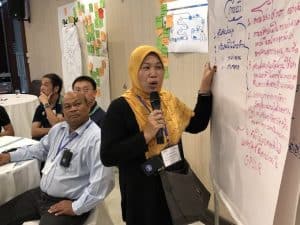
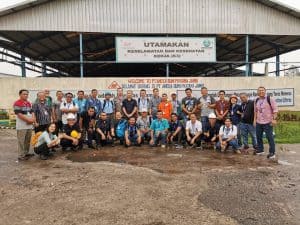
Several challenges of sustainable natural rubber production were brought up and discussed among rubber farmers and GPSNR members, but front and foremost was the issue of livelihoods and future of labour. After the field visit and 3 days workshop, the rubber farmers both in Indonesia and Thailand agreed that to solve such issues, smallholders should be put at the center of the solution.  They agreed that including smallholders’ representatives in the new governance model is the way forward to achieve this.  As for the criteria of the organizations, apart from having a personnel with extensive knowledge around rubber from cultivation, transportation to processing, the farmers also said that it is important that any representing organization should have a democratic governance. The smallholders also pointed out to a few farmers from different regions that could directly represent smallholders in GPSNR.  A few organization names were also proposed which will then be followed up by Smallholders representation working group to ensure active engagement for further collaboration.

“I am happy to hear that the downstream of natural rubber users like tire makers wish to establish a direct relationship with the upstream natural rubber producers like us. Personally I believe that sustainable supply chain will work only when every actor in the chain work together to find potential solutions together.” said one rubber smallholder in Thailand. Smallholders also emphasised on the importance for engagement to be long term if results are to be achieved.

The dates for the last 3 smallholder workshops have been confirmed and will be held in Brazil (20 – 21 Nov), Cote d’Ivoire (26 – 28 Nov) and Vietnam (16 – 18 Dec) respectively. The aim of the workshops is to gain a better understanding of smallholders, how smallholders can be meaningfully represented within GPSNR and to further explore the future of sustainable natural rubber production from a smallholders perspective at local level.

We will keep you posted on our progress in our upcoming newsletters. Stay tuned !

Read More »
News

Secretariat Update – October 2019

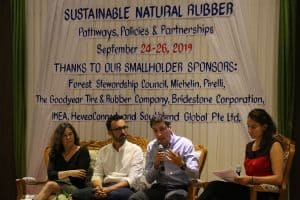
In attendance were farmers, processors, tire companies, apparel and footwear brands, NGOs and governmental representatives, all together over 100 participants. 

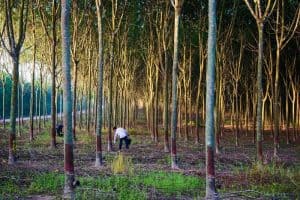
 The event offered a space for the diverse set of attendees to discuss the challenges and opportunities experienced by the rubber sector in the adoption and implementation of individual and global commitments to sustainable and ethical rubber with a focus on solutions. What set the workshop apart from the regular workshop we all know, was the addition of a field-excursion to two rubber-plantations operating under differing production models: a farm applying agro-forestry with a mix of native hardwoods and rubber trees and one fully developed diversified community agro-forestry farm. Additionally, instead of solely focusing on NGOs, companies and governmental representation (as the regular workshop often does), delegations from a number of farmer associations representing various countries also attended and provided key input to inform discussions from the farmer’s perspective.

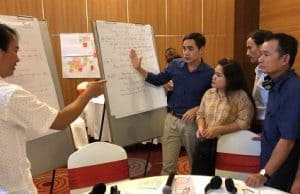
Days 2 and 3 of the workshop were focused on forming partnerships and generating solutions to begin working towards a transformed natural rubber supply chain which delivers value to all actors from the farm to the end user.  Break out groups comprised of farmers, processors, brands, NGOs, tire companies and government representatives discussed topics such as traceability, policy implementation and capacity building for smallholders. Each break out group then categorized their discussions into short term actions, long term actions, barriers and learning curves which will be summarized into a collective call to action by the organizing team.  One of the most powerful outcomes was an overall agreement amongst all stakeholders in attendance that to truly bring about positive transformation we must all work together towards a shared vision.

A public summary of the event will be shared in the coming days, please contact Samantha Morrissey (smorrissey@ra.org) or Margaret Kran-Annexstein (margaret@mightyearth.org) with any questions.

Read More »
News

Smallholders Representation Working Group Update – September 2019

In the August newsletter we have informed you that we will organize smallholders workshop in 5 different countries with the primary objectives of:

  1. Understanding the local needs and motivations of the smallholder farmers;
  2. Understanding and recommending solutions to the barriers for smallholders and their representative organizations to join and actively participate in the GPSNR;
  3. Observing and explaining the interaction and chemistry between farmers and representative organizations.

Now we are proud to tell you that we are ready to launch the first smallholders workshop in Jambi, Indonesia on October 7th – 9th. 20 smallholders and smallholder representative organizations that have been nominated by several local partners on the ground such as SNV, WWF Indonesia, Kirana Megatara, etc. will meet up in Jambi with various categories of GPSNR working group members to further explore the future of sustainable natural rubber production.  The participants from GPSNR side is limited to 6 persons to ensure the discussions are organically contributed by smallholders.

The 3 days workshop will start with self introduction, understanding each other, understanding the current and future trends of rubber market.  It will spread out to what the platform is and how the platform can work for and with smallholders to create a win-win solution.

Four more workshops to be organized this year after Indonesia will be held in Thailand, Vietnam, Cote d’Ivoire and Brazil.  After the 5 workshops are finished, we will recommend the smallholder representations to the Executive Committee during the General Assembly in March 2020.

Stay tuned for the dates and venues of the upcoming workshops. For more information please contact kobrat@gpsnr.org.

Read More »
Scroll to Top