
Secretariat Update – December 2019

GPSNR shares vision of Sustainable Natural Rubber future at 15th Global Rubber Conference in Hainan, China

Share This Post

What does it take to revive the Natural Rubber economy? Could the Natural Rubber 2.0 be the ultimate game changer for the new NR economy? These were some of the difficult questions discussed at the 15th Global Rubber Conference.

Hosted in Hainan, China from 12-14 December, with a theme on ‘Natural Rubber 2.0: The Game Changer’, the conference represented a very exciting event and opportunity for networking and knowledge sharing for Natural Rubber professionals in Asia, and in the rubber industry globally.

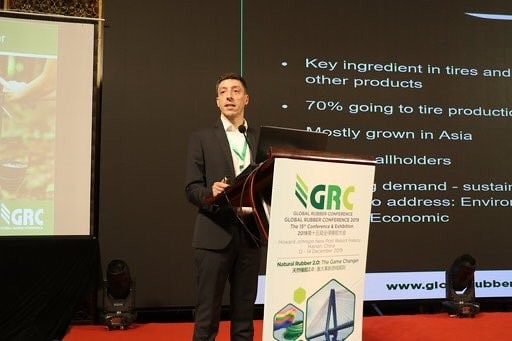
GPSNR Director Stefano Savi participated in the conference as a speaker and panel discussion member, to share updates with the industry participants about the progress of the Platform and its working groups. “Sustainability should not be seen as a threat by producers, but an opportunity to place natural Rubber as a leader in the global commodities landscape, best placed to deliver on the UN SDGs and the 2030 agenda.” said Stefano during his remarks, adding that “GPSNR is here to support smallholders in this journey, and ensure that the cost of this sustainable shift will not be borne by farmers, but supported by the industry through the Global Platform.”

Amidst the current backdrop of the fourth industrial revolution, the conference was a good opportunity to discuss the convergence of artificial intelligence and data technology as new solutions to address innovation gaps and current low demand for NR across the globe. It is obvious that from drones to satellite images and sensor technology, the natural rubber industry is poised for a radical change. So, what role will sustainability play in this desired and required industry shift? Will the natural rubber industry take advantage of this opportunity to improve its practices, maximise its positive impact, and reposition itself as a leader in innova

More To Explore

News

GPSNR Working Groups Update: May 2023

Strategy and Objectives Working Group: The consortium of Agridence and Koltiva have initiated field trials for the Risk Subgroup Traceability Pilot. The Risk Subgroup is also planning the next steps for the deliverable from ASI regarding the Risk Assessment Framework, including internal piloting and cross-walking with GPSNR commissioned studies to identify any gaps. 

Additionally, the Risk Subgroup and Basel Institution are in preliminary discussions for a potential collaboration to investigate corruption risk in the supply chain. The Assurance Model Task force will convene to receive updates on KPI alignments, the due diligence system, and the progress model of its members.

Smallholders Representation and Capacity Building (SCB) Working Group: The SCB WG has formally endorsed the Terms of Reference (TORs) on April 27, and the Smallholders Policy-Equivalent (SPE) Taskforce is currently working towards securing the SCB WG’s endorsement for the final recommendations presented in their report.

The Thailand National Subgroup recently announced a tender for GAP Coaching on May 4, with a proposal submission deadline of June 30, 2023. Meanwhile, the Agroforestry-Income Diversification Taskforce is working on finalising the workshop schedule for the years 2023-2024. Lastly, the SCB WG will continue to oversee all projects taking place in Indonesia and Thailand.

 Policy Toolbox Working Group: The working group has chosen consultant Petra Westerlaan to propose a quantitative approach for the reporting matrix, including a crosswalk with other reporting frameworks (CDP Forest, GRI, and ZSL-SPOTT), aiming to facilitate data aggregation and simplify the evaluation of annual progress. They will evaluate and decide on the consultant’s proposed revisions to the reporting framework, and make recommendations to improve the reporting process and timelines.

The Policy Toolbox WG has to agree on the TRR, update Reporting Guidance to reflect the proposed changes, and finalize the Compliance Panel TOR and operational guidance based on the Assurance Model. The WG is currently conducting meetings that will continue during the in-person meetings. 

Shared Responsibility Working Group: The face-to-face meeting included a presentation on governance and guiding principles, and manufacturers to submit a revised document. The WG is currently awaiting the outcomes of discussions on shared investment principles at the manufacturers’ category level before proceeding with their work. Once the proposal from the manufacturers is available, the WG will revamp the discussions on data sharing and value transfer.

News

Maintaining Alignment in GPSNR’s Strategic Outlook

As the mid-year mark approaches, our Working Groups continue to make progress in their respective areas of focus. In spite of the setbacks brought about by the COVID-19 pandemic, group calls and discussions remain as scheduled, with every intention to have deliverables ready for approval or presentation at the General Assembly 2020.

Final text for the proposed policy components and baseline reporting requirements, developed by the Policy Toolbox Working Group, have been proposed. The documents are being circulated for approval within the Working Group before being submitted to the Executive Committee. A pilot testing phase for the reporting requirements will be launched shortly after. More details on this will be released soon.

Along with the finalization of the Terms of References for the two pilot proposals, the Traceability and Transparency Working Group is also developing a budget and timeline for these pilot proposals, to be submitted to the Executive Committee for approval.   

While there have been efforts between Working Groups revolving around calibration and aligning, the importance of alignment with all Working Groups is increasingly being recognized as important. Moving forward, the Strategy and Objectives Working Group will undertake a more coordinating role. This will see a Platform-wide effort to directly engage and align with the other Working Groups  to better bring forward their strategies into the Theory of Change, understand their project plans and how to interact, and bring together input from all the Working Groups to support the development of Platform Key Performance Indicators (KPIs).

Within the Strategy and Objectives Working Group itself, work on filling out the Theory of Change continues. The Working Group is also liaising closely with consultant James Griffiths on his study on social risks following the presentation of a first draft to the Working Group for review.

Scroll to Top