


Stakeholders launch Global Platform for Sustainable Natural Rubber

Today, natural rubber stakeholders convened for the ceremonial launch of an independent platform to lead improvements in the socio-economic and environmental performance of the natural rubber value chain.

Share This Post

Stakeholders including tire manufacturers, other rubber users, suppliers and processors, vehicle makers and NGOs, contributed to the development of the Global Platform for Sustainable Natural Rubber (GPSNR). This included alignment on a wide-reaching set of priorities for the natural rubber supply chain. The GPSNR will work to harmonize standards to improve respect for human rights, prevent land-grabbing and deforestation, protect biodiversity and water resources, improve yields, and increase supply chain transparency and traceability.

Development of the platform was initiated by the CEOs of the World Business Council for Sustainable Development (WBCSD) Tire Industry Project (TIP) in November 2017 and has since been led by a Working Group of TIP member companies. TIP members continue to work to ensure the sustainable production and supply of natural rubber, and in joining the platform they commit to be able to demonstrate the integration of principles for sustainable natural rubber into their purchasing and/or operational activities. The GPSNR is open to applications for membership from other natural rubber stakeholders.

Speaking at the launch Peter Bakker, President and CEO of WBCSD said “The tire industry consumes around 70 percent of natural rubber and demand is growing. This throws into sharp relief the social, economic and environmental opportunities associated with this important commodity. The GPSNR will consider the people, communities and natural resources touched by natural rubber production and supply – they all stand to benefit from the creation and adoption of sustainable and responsible practices.”

The ceremonial launch included the signing of a GPSNR Member Statement by the 11 members of TIP, and Ford Motor Company, Halcyon Agri Corporation Limited, ITOCHU Corporation, Kirana Megatara, SIPEF, The Socfin Group, and Southland Global PTE Ltd.

Bakker praised the efforts of founding and prospective GPSNR members in bringing the platform to launch, adding “This spirit of collaboration will define the actions of the platform going forward – there is strength in diversity, and the various interests and expertise within the GPSNR can deliver a truly sustainable natural rubber supply chain.”

The WBCSD’s TIP spearheaded development of the GPSNR and will financially support the platform during start-up and its first two years of operation – a level of support necessary to ensure basic operations while a paying membership base is established. Despite industry backing the GPSNR will maintain its independence, underlined Anne-Cécile Remont, Director WBCSD TIP– “Once officially launched, the platform will be independently managed, with governance and decision making overseen by a representative group of stakeholders.”

Building upon past work, in developing the platform, a review of comparable supply chain sustainability initiatives, including natural rubber, revealed that meaningful change was best achieved through the mainstreaming of good practices and this was central to discussions around the GPSNR’s governance structure, explained Remont. “Successful mainstreaming requires actionable commitment from the entire supply chain. Best results are found where the various contributions of stakeholder groups are relative to their ownership of supply chain opportunities, their relevant expertise and their capacity to implement meaningful change,” she said.

To be headquartered in Singapore, a dedicated GPSNR secretariat will kick-off operations in March 2019 with an inaugural GPSNR General Assembly.

More To Explore

News

Secretariat Update – September 2019

This update was prepared by Assel Mussagaliyeva, Industry Relations and Academic Projects Manager, Essec Asia Pacific.

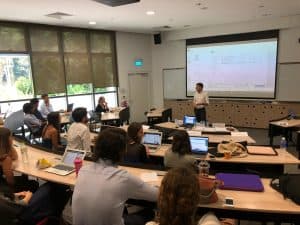
ESSEC Asia Pacific partnered with the Global Platform for Sustainable Natural Rubber for their first Global Manager in Asia (GMA) project. The GMA Project included diverse multinational companies and startups with strong Asian core: International Finance Corporation (IFC Fintech Group), Grab for Business, ACT Genomics, Creatella Ventures and GPSNR. Involving 148 ESSEC Master in Management students, the Project took place on 1 July – 11 September 2019, followed by the Final Jury.

The project results were in line with GPSNR priorities in the three Asian markets. The 6 student teams under the close guidance of Stefano Savi and Kobrat Sawasdivorn explored the challenges of the smallholder farmers affecting equity of the rubber supply chain in Thailand, China and Indonesia. The results of the student research will be presented to the GPSNR Working Groups.

Assel Mussagaliyeva, Industry Relations and Academic Projects Manager, said it was a good project both from a teaching perspective as well as practical experience for the students. Firstly, it was hands on experience challenging students to think ‘out of the box’ as it involved multiple layers: a variety of stakeholders, unfamiliar context, lack of industry knowledge and limited country data. Secondly, it was a great chance for the students to work on a big picture issue, especially in today’s world of climate change challenges. The project itself was well focused and narrow enough for the students to have an opportunity to make a tangible difference.

“ESSEC Asia Pacific is grateful to GPSNR for our collaboration on multiple levels,” said Mussagaliyeva. In March 2019, GPSNR participated at the ESSEC APAC Talent Day and offered internship for the Global BBA student Tanmay Daga. Following that, Stefano Savi participated in the first ESSEC APAC student-led TedX event as an invited speaker on sustainability. Soon after, the GMA Project scope was discussed.

“We look forward to working with GPSNR in the future,” said Mussagaliyeva. The mission of ESSEC Business School is to create and disseminate cutting-edge knowledge, to train and develop bold pioneers and influential leaders for both the business world and society. We encourage the students and programme participants to anticipate – and meet – the economic, managerial, social, environmental and ethical challenges of an increasingly uncertain world. These values align with GPSNR mission as sustainability is an integral part of responsible innovation. 

The Secretariat has also published the executive summary of minutes of each working group in the “News and Publications” section of the website. All members of the platform can login to the website to view the documents under the Members Only section. There are currently 2 working groups, the Strategy & Objectives working group chaired by James Laimos of Goodyear and the Smallholders Representation working group chaired by Ulrich Antoni of Pirelli. The executive summary of each working group will be updated on a bi-weekly basis. If you have any issues accessing the website, please send us an email at info@gpsnr.org.

Natural Rubber Supply Chain urges European Parliament not to amend essence of EUDR

PRESS RELEASE

Natural Rubber Supply Chain urges European Parliament not to amend essence of EUDR 


Singapore, 13 November 2024: As Members of the European Parliament (MEPs) convene to vote on 14th November on the proposed amendments to the EUDR, the Global Platform for Sustainable Natural Rubber (GPSNR) urges them to provide legal certainty around the implementation timeline and not re-open the regulatory text.

Along with the European Tire and Rubber Manufacturers Association, GPSNR has written to the European Parliament earlier this month to ask MEPs to use the proposal for amendments solely to create certainty about the timeline and not change the substance of the regulation. 

GPSNR members represent almost 60% of the global NR demand and include OEMs, manufacturers of rubber products, producers and traders of natural rubber, smallholder farmers, and civil society. All these stakeholders have worked tirelessly and swiftly to comply with the regulation, whose original date of implementation is weeks away. 

Notwithstanding this, GPSNR believes MEPs have a key role in ensuring the European Commission uses the proposed additional 12 months for implementation to resolve the remaining issues, particularly the functioning of the information system and the necessary secondary legislation, including on the benchmarking system as well as completing the planned review of the relevant products in Annex I by June 2025. 

The natural rubber industry strongly supports the vision of the EUDR and GPSNR members have been working on committing to and implementing strong environmental and human rights related principles in their operations for a long time. These efforts need the support of a fair and transparent regulatory environment that can help the industry move further ahead on their efforts on deforestation and human rights. 


END

About GPSNR: 

GPSNR is an international membership driven platform set up to define sustainability for the natural rubber value chain. It brings together various stakeholders to a common ground based on fairness, equity and environmental sustainability. More on sustainablenaturalrubber.org


For more information, please contact:

Bani Bains

Communications Director

Email: bani.bains@gpsnr.org

Ph: +65 97268165


Scroll to Top