
Rubber, representation and reform – What smallholders bring to the sustainability conversation

Share This Post

By Febrius Wibisana, GPSNR Executive Committee Member & Co-Chair, GPSNR Smallholder Inclusion Working Group

For those who do not know me yet, my name is Febrius Wibisana and I have been a rubber smallholder in Indonesia for over 25 years. At GPSNR, I represent the smallholder category at the Executive Committee level. I am also the co-chair of the Smallholders Representation working group.

In June 2022, I was invited by the Partnership for Forests or P4F to the P4F Forum with their partners and projects from across the world. They wanted me to speak about my experience at GPSNR on smallholder inclusion in the sustainability conversation in natural rubber. The experience gave me the opportunity to put some thought into our work over the last three years – the challenges, the successes and carving the path forward.

I am writing this to share some of those reflections with my fellow GPSNR members.

Reflection 1: It is impossible to have holistic sustainability solutions in natural rubber without smallholder participation
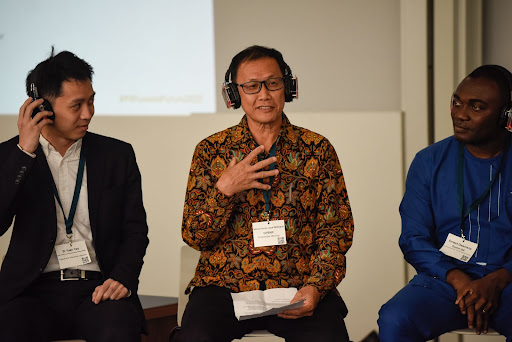
GPSNR Impacts & Assurance Associate Si Yuan and myself at the P4F Forum in London

We live in a world where 6 million smallholder farmers produce almost 90% of the world’s natural rubber. In such a world, any conversation on change in this supply chain has to include smallholders. 

In its second General Assembly in 2020, GPSNR members passed a resolution to include smallholders as a category within the membership. We started with 28 odd smallholders, including myself, engaging in conversations on sustainability, capacity building and the meaning of true inclusion and having the smallholder voice heard at various decision making levels. Today, I represent over 130 smallholders across 10 countries in the GPSNR Executive Committee. 

To bring smallholders into each conversation, we work closely with country level champions and local government entities for outreach and engagement. Interpretation facilities and key documents being translated to smallholder languages are some small but significant steps we take at GPSNR to further facilitate smallholder participation.

Reflection 2: Membership does not guarantee active participation

While many of our smallholder members are actively engaged in core decision making and at the working group level, many find it difficult to do so. The digital divide, language barriers and a skewed equation of structural power could be some key reasons for this. Some smallholders simply may not have the time for it. 

Yet, as we embark on transforming the entire supply chain, we need active smallholder voices to join and remain in the GPSNR fold. To this end, the smallholder representation working group has put forward a resolution with proposed changes in smallholder membership structure, where smallholders will have to participate in the General Assembly to take up ordinary membership. All others will be classified as affiliate members by default. You can take a look at the resolution here

Reflection 3: Making a supply chain sustainable requires thorough capacity building at all levels

There are more than 2 million smallholders in Indonesia. Yet, despite being the largest producer, it has the lowest productivity in the world. This is because of diseases and poor planting materials. Many other rubber producing nations face similar problems. 

If we are to make this supply chain sustainable, equitable and fair, and achieve the desired state that the GPSNR Theory of Change spells out, smallholders have to be equipped with the skills and resources. The capacity building working group has already kicked-off the first such projects in Indonesia with SNV-Proforest and Koltiva. GPSNR has also received funding pledges from Renault, Goodyear, Michelin and Pirelli for other projects, but scaling them requires more. Funding information is available here for any one in the natural rubber industry. 

Capacity building will also equip smallholders to participate further in GPSNR decision making and other processes. 

As we move forward, I am energised by the progress GPSNR has made so far on smallholder participation. In our attempt to move towards more active engagement, we need the support of all our members. Our ability to meet in person will further strengthen this support, and I look forward to working with all of you to transform the supply chain. 
More To Explore

Members

GPSNR Working Groups Update: December 2020 (Members Version)

GPSNR Members Webinar: Recording and Slide Deck

GPSNR members who missed the Executive Committee and Working Groups Update webinar that was held on 2 December can view the recording of the webinar or download the slide deck for reference.

View webinar recording or download slide deck

Strategy and Objectives Working Group

The Working Group has received several bids in response to the Request for Proposal (RFP) for a study on environmental impacts, and risks, in the natural rubber value chain that was published in November. The Working Group has shortlisted three candidates and, as part of the evaluation process, will be conducting with these candidates in January 2021 before awarding the bid to the successful candidate. 

The Working Group is also starting on the Theory of Change document update, an exercise which will involve all other Working Groups. This will take place in January 2021. The Equity sub-Group is preparing summary documents for the living income studies and is planning to present the studies to GPSNR members in early 2021.

‘Policy Toolbox’ Working Group

The Working Group has finalized the Baseline Reporting Requirements and these will go to the Executive Committee for review. The Working Group is also developing a Request for Proposal for a consultant to work on the implementation guidance and reporting requirements.

‘Capacity Building’ Working Group

Since the last update, the Good Agricultural Practices (GAP) Task Force has had their first kickoff call and is beginning the work to identify and/or refine guiding principles for GAPs appropriate for the sustainable production of natural rubber.

The Working Group is also engaging the Executive Committee on their comments regarding the proposed capacity building strategies for four focus countries.

‘Traceability and Transparency’ Working Group

In early December, the Working Group onboarded smallholders from Indonesia and Côte d’Ivoire into the group, with the smallholders participating in their first meeting on 10 December. 

Aside from reviewing the Working Group’s Terms of Reference (ToR) and its objectives moving forward, the Working Group will also be starting to develop recommendations for members on traceability and transparency tools in early 2021.

Smallholder Representation Working Group

The revised ToR for the Working Group is undergoing a final review, following which it will be sent to the Executive Committee for approval. 

The Working Group has also formalised a document that defines the role and key tasks of a Country Champion. So far, Country Champions have been actively involved in organizing and arranging national calls, supporting smallholder engagement, and providing technical and linguistic assistance.   

As part of the Working Group’s revamp, it will be undergoing a membership refresh. Part of this will also involve smallholders being onboarded into the Working Group in 2021.  The Working Group is also looking into onboarding smallholders from Cambodia. Any GPSNR members who have operations in Cambodia or partners working in Cambodia who can help to identify potential smallholders for an onboarding workshop are welcome to reach out to the Working Group’s Co-Chairs, Ulrich Antoni and Julian Oram.

News

Secretariat Update – January 2020

We can draw parallels to the coffee industry, which similarly comprises small plantation owners and more profitable downstream actors. In his recent sustainability report on the coffee industry, economist Jeffrey Sachs’ proposal for a global fund to fill the financial gaps for sustainability investments in coffee producing regions garnered vivid discussion.  

Currently, low and unpredictable rubber prices are a constraint to smallholders who produce the bulk of global rubber output. Transparency is critical in the purchasing process, and this kind of disruption typically comes hand in hand with embracing new strategies. 

Under the purview of the Strategy & Objectives Working Group, capacity building and extension services have been identified as potential measures to mitigate the root causes of the social and environmental impact from the natural rubber supply market. Implementing these at scale for the whole industry will require considerable financial investment.   

With the above considerations in mind, GPSNR is exploring new approaches to funding that would not be borne by a single segment of the industry, but in a manner incorporating the spirit of our shared responsibility. 

Enterprise Singapore organized an industry meeting on 14 January 2020, and invited GPSNR and Singapore Exchange to better understand the available options of an e-trading platform that could contribute to our funds. The meeting also discussed what could be the options, through GPSNR, to increase the uptake of the e-trading platform.

Tapping the vast potential of digitalization could present an exciting avenue of possibilities for GPSNR to better advance our vision of a fair, equitable and environmentally sound rubber value chain.      

The meeting was initiated by representatives from Enterprise Singapore, and panel speakers comprised representatives from GPSNR, Singapore Exchange and HeveaConnect. Participants included GPSNR members as well as other Natural Rubber buyers, producers, processors and traders .

Scroll to Top