
Press Release: GPSNR General Assembly 2022

Share This Post

PRESS RELEASE


Global Rubber Industry kickstarts a plan for equitable distribution of costs and benefits of sustainability in their supply chain


Singapore, 14 July 2022: Members of the Global Platform for Sustainable Natural Rubber (GPSNR), who represent 55% of the rubber value chain, convened their annual General Assembly yesterday, where they defined and charted out a path for a concept they call shared responsibility. This concept acknowledges the lack of equity in the natural rubber supply chain and charts out a mechanism where the costs and benefits of the platform’s sustainability initiatives will be equitably distributed across all actors within the supply chain.


To this end, GPSNR members passed a resolution that binds them to a shared responsibility framework with 3 pillars – Shared Investments, Value Transfer & Target setting, and Knowledge & Data sharing – which will help share the costs and benefits across all actors in the value chain. Each stakeholder group has a different role to play to contribute to a sustainable natural rubber sector and within the three pillars. By the third quarter of 2023, each of the three pillars will be in the testing, implementation or pilot stage of their specific goals.


According to GPSNR director Stefano Savi, “Systemic change does not happen overnight. While we have been putting together pillars on the sustainability side of our vision, this is our first pillar that also requires commitment to an equitable supply chain. With this shared responsibility framework, parties from across the natural rubber value chain are agreeing to take accountability for sustainability in an equitable and fair manner. As we work to translate this to actionable outcomes, I hope more stakeholders will join us, and existing ones will be inspired to accelerate the process of changing our supply chain.’’


In addition to voting on resolutions like the shared responsibility framework, GPSNR members also voted in a guidance for implementation of the policy framework that they all abide by, which includes some stringent commitments on deforestation and human rights. They also voted on some procedural resolutions on their statutes and elected representatives to the 2022-2023 Executive Committee, which comprises representatives from each of the membership categories.

Access the Shared Responsibility Framework here.

END

About GPSNR: 

GPSNR is an international membership driven platform set up to define sustainability for the natural rubber value chain. It brings together various stakeholders to a common ground based on fairness, equity and environmental sustainability. More on sustainablenaturalrubber.org

For more information, please contact:

Bani Bains

Communications Manager

Email: bani.bains@gpsnr.org

Ph: +65 97268165
 

More To Explore

News

Getting to Know You: GPSNR’s First Smallholder International Call

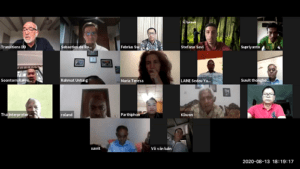
13 August 2020 – Kliwon is a natural rubber smallholder from Jambi Province, Indonesia, whose work with natural rubber started in the 80s. This evening, however, he’s doing something quite different from his usual rubber farming activities. Dressed in a light brown shirt of traditional Indonesian batik, Kliwon’s wiry frame and distinct head of white hair is visible on the computer and mobile phone screens of over 20 other natural rubber smallholders from around the world. He is one of the participants in GPSNR’s first international call for smallholder members to prepare them for the upcoming General Assembly.

At 68, Kliwon is one of the more experienced smallholder members in GPSNR. Today, he is being joined by other smallholders. Some, like H Nasoro Nie, a fresh-faced young lady from Vietnamese province of Dak Lak, are as young as 24, almost one third Kliwon’s age. Despite the difference in years, these smallholders all have something in common. They recognize the increasing importance of a sustainable global natural rubber value chain, and are actively participating in efforts to transform the industry.

It is the first time that the smallholders are meeting each other on an international level. Prior to this, they have been engaged in national level calls, making their presentations to their fellow natural rubber farmers from the same country. More than 20 natural rubber smallholders are present on the call – a handful are unable to join as they live in remote locations where access to the internet is not always a given. Unfortunately, the four smallholders from Myanmar are unable to connect due to heavy flooding in the areas where they live.

As with any meet-and-greet, communication is of paramount importance, and this includes being able to understand and be understood regardless of the language you speak. Here, five foreign languages come into play: Bahasa Indonesia, French, Myanmar, Thai and Vietnamese. Using Zoom’s in-built interpretation feature, the smallholders are able to access special audio channels within the meeting, where they can hear everything that is said, interpreted into their local language. Thanks to sustained funding from Partnerships for Forests (P4F), a UK aid funded program, GPSNR was able to engage interpreters to perform this simultaneous interpretation remotely. The funds were also channeled to the appointment of Transitions, a sustainable development consultancy agency, who is facilitating the international sessions with smallholders.

The call begins with opening remarks by GPSNR Director Stefano Savi, followed by a quick runthrough of the agenda and an overview of the global natural rubber market. 

Then, the smallholders start to introduce themselves. We hear from those from Indonesia, then Thailand, Vietnam, Côte d’Ivoire, Ghana and Brazil. They share about the size of their natural rubber plantations, their activities around rubber farming. Many of them are actively involved in the natural rubber scene in their country, from Baroan Roland, who is the Chairman of the Association of Natural Rubber Producers of Côte d’Ivoire (APROCANCI) to Thailand’s Soontorn Rakrong, who has been involved in initiating dialogue with the Thai government for policy development around fair tenure and land use rights. As one smallholder speaks in their native language, the interpreter interprets, in real-time, their words into English for the rest of the participants. The other interpreters, picking up the English interpretation, convey it to the other smallholders in their respective native languages.

All too soon, two hours fly by. There is just enough time for a short Question and Answer segment. At the end of the night, it’s clear that the smallholders are excited to have more opportunities to get to know each other and further discuss the issues around natural rubber that they all similarly share regardless of geography. —

The 2nd GPSNR Smallholder International Call will take place on 27 August 2020.

Members

GPSNR Working Groups Update: January 2021 (Members Version)

Strategy and Objectives Working Group

In our December update, we reported that the Working Group would be conducting interviews with the shortlisted candidates who had responded to the Request for Proposal for a study on environmental impacts, and risks, in the natural rubber value chain. The Working Group has since completed their interviews and will soon be making a decision on who to award the contract to.

The refinement of GPSNR’s Theory of Change is also underway, with a planning call having taken place on Monday this week. The call involved nominated representatives  from across all GPSNR’s Working Groups, working to chart the plan for a collaborative effort to refine the Platform’s Theory of Change.

In other news, several Thai smallholders have been onboarded into the Working Group and, after an introductory call with the Co-Chairs,  are now participating in the Working Group calls.

As the Equity Sub-Group prepares to present the living income studies to GPSNR members, more details will be conveyed to members nearer the date. 

‘Policy Toolbox’ Working Group

Following the approval of the GPSNR Policy Framework, the Policy Toolbox Working Group will develop Implementation Guidance and future Reporting Requirements as they pertain to the specific policy components in the framework.  

In order to achieve this, a Request for Proposal (RFP) has been posted for a fixed term consultancy to facilitate the development of the Implementation Guidance and Reporting Requirements for each of the three stakeholder categories: natural rubber producers/processors and traders, tire makers and other natural rubber product manufacturers, and auto makers and other end users.  GPSNR members are invited to circulate the RFP to any relevant contacts who might be interested in submitting proposals for this work. The deadline for submission of proposals is 5 February 2021.

The Implementation Guidance and Reporting Requirements will vary depending on where a member company sits within the natural rubber supply chain. As such, GPSNR will invite the creation of category focus groups to enable broader participation of members from the three stakeholder categories (although focus groups can also include members from other stakeholder categories). The details on recruitment for these focus groups will be announced sometime next month.

Apart from facilitating the development of category-specific Implementation Guidance by reviewing guidance and requirements from other initiatives, the consultant will also facilitate discussion sessions with the focus groups to finalize the implementation guidance for each stakeholder category.

‘Capacity Building’ Working Group

In 2020, the Working Group proposed national capacity building strategies for four countries as a starting point. Following the Executive Committee’s endorsement of the strategies, the Working Group is embarking on the next step of putting these plans into action on-the-ground. The Working Group is looking for interested members to form National Sub-Groups mandated to oversee, guide and implement the strategies. The Working Group will conduct a webinar on 17 February to share the strategies with GPSNR members. Check out our article, ‘From Strategy to Implementation: Next Steps for Capacity Building’ for more on this story.

‘Traceability and Transparency’ Working Group

The two studies around traceability and transparency tools and technology commissioned in 2020 by the Working Group are ready to be shared with GPSNR members. Read our article, ‘Seeing Through to a Solution: Traceability and Transparency Tools and Technology Studies’ for more on this topic.

Smallholder Representation Working Group

The Working Group’s revised Terms of Reference (ToR) was approved by the Executive Committee during its monthly call in January. Under the revised ToR, the Smallholder Representation Working Group has identified two main objectives for its work moving forward: the first, to support the creation of an active smallholder community within GPSNR and the second, to extend the on-boarding of smallholders from rubber producing countries. The Working Group will be planning its activities for the year head, ensuring that they support and contribute towards achieving these new objectives. 

As a start, the Working Group will be looking to onboard smallholder members into the group, as well as facilitate the organization of the next Smallholder Category Call.

Scroll to Top