
Secretariat Update – January 2020

GPSNR recognizes the need to work towards economic sustainability within the natural rubber industry, ensuring that the earnings of millions of smallholders and farmworkers are enough for them to enjoy a decent standard of living. This is why ensuring equity along the value chain is one of our 12 principles critical to achieving a desired, sustainable state of the natural rubber industry. 

Share This Post

We can draw parallels to the coffee industry, which similarly comprises small plantation owners and more profitable downstream actors. In his recent sustainability report on the coffee industry, economist Jeffrey Sachs’ proposal for a global fund to fill the financial gaps for sustainability investments in coffee producing regions garnered vivid discussion.  

Currently, low and unpredictable rubber prices are a constraint to smallholders who produce the bulk of global rubber output. Transparency is critical in the purchasing process, and this kind of disruption typically comes hand in hand with embracing new strategies. 

Under the purview of the Strategy & Objectives Working Group, capacity building and extension services have been identified as potential measures to mitigate the root causes of the social and environmental impact from the natural rubber supply market. Implementing these at scale for the whole industry will require considerable financial investment.   

With the above considerations in mind, GPSNR is exploring new approaches to funding that would not be borne by a single segment of the industry, but in a manner incorporating the spirit of our shared responsibility. 

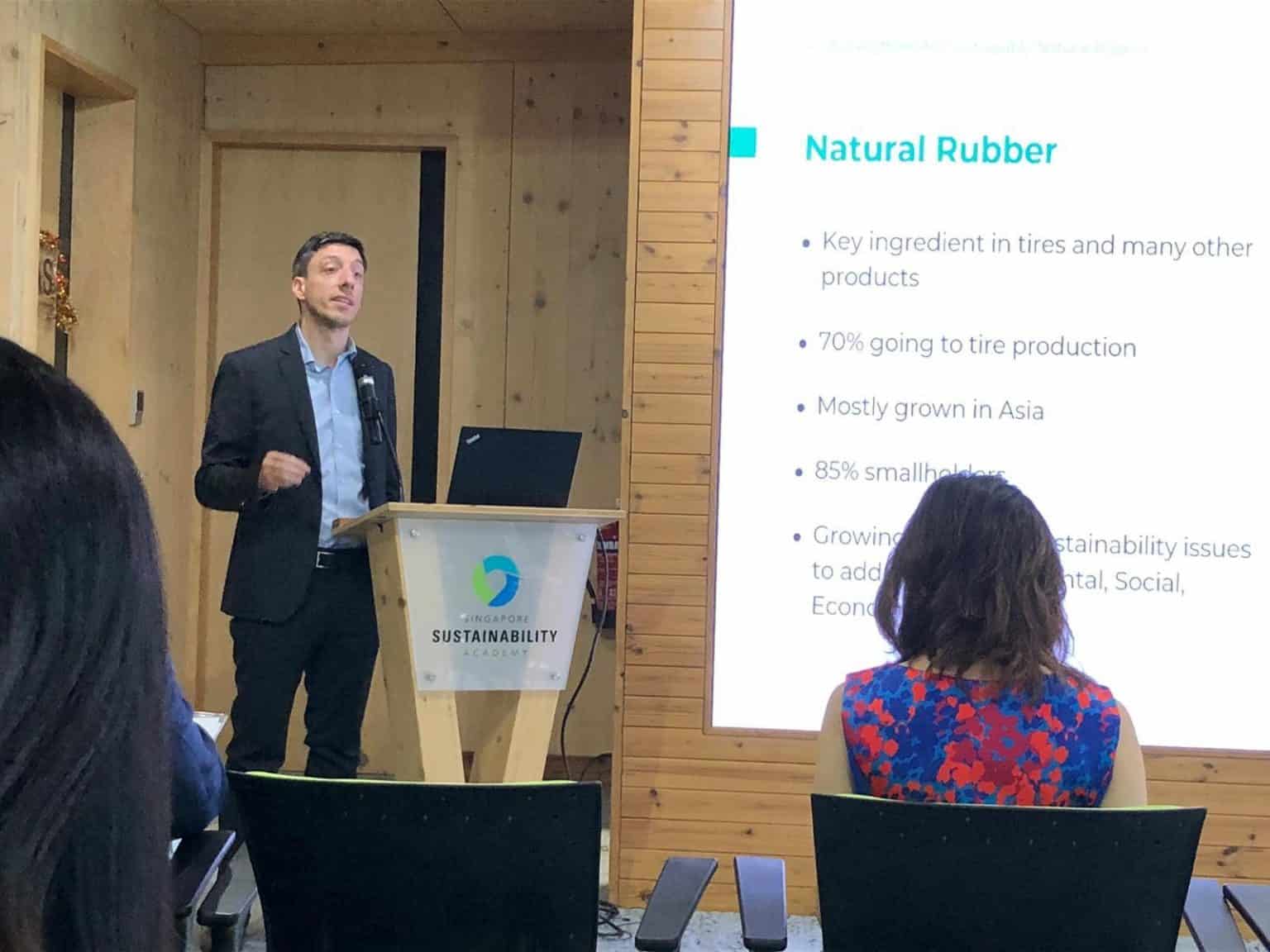
Enterprise Singapore organized an industry meeting on 14 January 2020, and invited GPSNR and Singapore Exchange to better understand the available options of an e-trading platform that could contribute to our funds. The meeting also discussed what could be the options, through GPSNR, to increase the uptake of the e-trading platform.

Tapping the vast potential of digitalization could present an exciting avenue of possibilities for GPSNR to better advance our vision of a fair, equitable and environmentally sound rubber value chain.      

The meeting was initiated by representatives from Enterprise Singapore, and panel speakers comprised representatives from GPSNR, Singapore Exchange and HeveaConnect. Participants included GPSNR members as well as other Natural Rubber buyers, producers, processors and traders .
More To Explore

News

From Strategy to Implementation: Next Steps for Capacity Building

One of the key strategies identified by GPSNR to achieve our vision of a fair, equitable and environmentally sound natural rubber value chain is to ensure that there is capacity amongst smallholders and industrial plantations to adopt best practices in natural rubber production.  

In 2020, the Capacity Building Working Group, through various stakeholder interviews and Working Group discussions, proposed a set of country-specific capacity building activities for four countries as a start: Côte d’Ivoire, Indonesia, Myanmar and Thailand. In developing these strategies, the Working Group sought to first identify threats to the sustainable production of natural rubber within the different local contexts, as well as the underlying causes for these threats. From this initial research, the working group developed proposed capacity building actions, along with main objectives and rationales for each chosen action. The approach adopted by the Working Group in designing these actions is to allow for immediate engagement and implementation on the ground. 

Following the Executive Committee’s endorsement of the Working Group’s capacity building proposals, the Working Group will be conducting a sharing session for all GPSNR members, during which more details about each national capacity building strategy will be presented.

Recruiting Members to Capacity Building National Sub-Groups

Now that the capacity building strategies are in place, the Working Group is inviting interested GPSNR members to join the soon-to-be-created National Sub-Groups that will be mandated to oversee, guide and implement the national capacity building strategies and to promote GPSNR policies and initiatives.  

The development of the National Sub-Groups recognizes existing local capacity building initiatives in the rubber sector and their independence of GPSNR and aims to cooperate with local efforts and stakeholders to achieve mutually agreed outcomes.

Members

GPSNR Company Self Assessment Form: Aligning Your Company’s Policy with the GPSNR Policy Framework

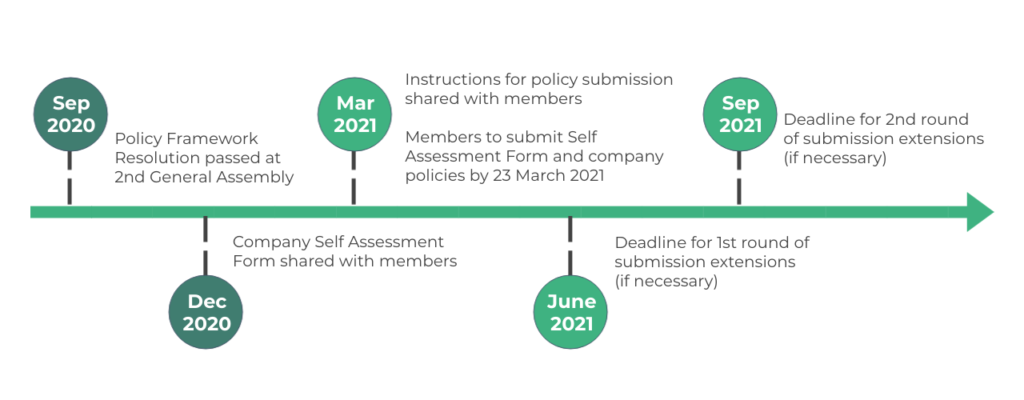
The Policy Framework was approved and adopted via a membership vote at the 2nd GPSNR General Assembly on 23 September. As part of the resolution, companies were given 6 months to align their public policies to include all the components of GPSNR’s Policy Framework, with the possibility of two extensions if evidence of progress is shown. Based on this timeline, companies will have until 23 March 2021 to submit their public policies for evaluation by GPSNR’s Compliance Panel. Full instructions on how companies should submit their public policies and other public documents will be provided in early 2021. 

The Self Assessment Form is a tool designed to help companies evaluate and track the degree of alignment between their public policies and other public documents and GPSNR’s Policy Framework. Conducting a self-assessment using this form does not constitute GPSNR approval of a company’s policies, and companies should avoid making public claims about approval of the policies before final assessment by GPSNR. Compliance with this requirement can only be confirmed by the GPSNR Compliance Panel and this will only be possible after member companies submit to GPSNR their policies or other public documents that reflect conformance with GPSNR’s Policy Framework in March 2021.

A summary timeline of the company policy approval process is depicted below:

Compliance Panel

In early 2021, the Policy Toolbox and Implementation Guidance Working Group will share the terms of reference for the three members of the Compliance Panel. GPSNR members will then be invited to nominate individuals to serve on the Compliance Panel. An Extra-ordinary General Assembly will be called in February 2021 for GPSNR members to vote on the candidates and three candidates will be voted to form the Compliance Panel. The panel will then assess the policies submitted by GPSNR member companies and determine if they are in compliance with GPSNR’s Policy Framework. More details on this will be shared with members once they are available.

Click here to download the GPSNR Company Self Assessment Form

Scroll to Top