

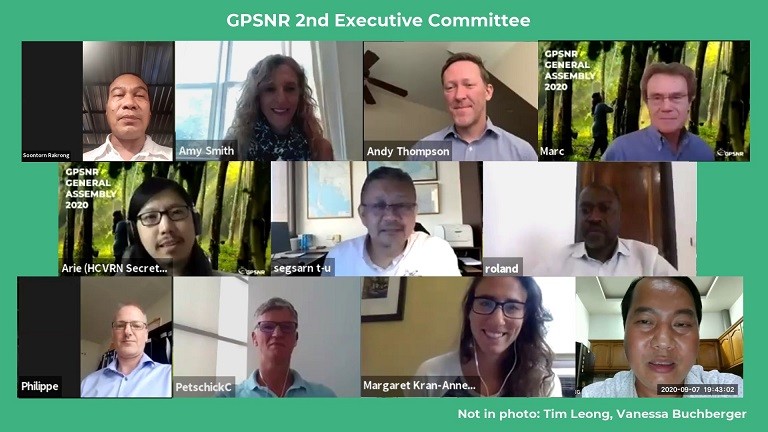
A First Look at GPSNR’s second Executive Committee

Share This Post

GPSNR’s Executive Committee comprises Ordinary Member representatives of each membership category, according to the newly approved allocation proposed in the resolution for a standalone category for natural rubber smallholder producers. Each membership category is allocated a total of three seats in the Executive Committee, with representatives chosen by elections within the category.

The Executive Committee serves as a center for overarching ideas of the Platform, and Executive Committee members bear the responsibility of raising awareness of emerging issues to their respective categories, initiating consultation sessions, and encouraging active participation in GPSNR’s Working Groups and activities.

The members of the second GPSNR Executive Committee, according to category, are as follows:

Producers, Processors & Traders

SIPH – represented by Marc Genot (Managing Director, Societe Africaine des  Plantations  d’Heveas SA)

Socfin – represented by Philippe De Groote (Head of Agronomy – Rubber)

Southland Global – represented by Tim Leong (Associate Director)

Tire Makers and Other Natural Rubber Product Makers

Bridgestone Corporation – represented by Andy Thompson (Global Director, Sustainability Strategy, Policy & Integration) 

Continental AG – represented by Claus Petschick (Head of Sustainability)

Michelin – represented by Segsarn Trai-Ukos (Managing Director, Société des Matières Premières Tropicales Pte Ltd)

Car Makers, Other Downstream Users, and Financial Institutions

BMW Group – represented by Vanessa Buchberger (Purchasing and Supplier Network, Sustainability, Innovation Management, Cooperations)

Civil Society

HCV Resource Network – represented by Arie Soetjiadi (SEA Representative)

Mighty Earth – represented by Margaret Kran-Annexstein (Campaign Director)

WWF – represented by Amy Smith (Deputy Director, Forest Sector Transformation)

Smallholder Producers

Baroan Roland – Côte d’Ivoire

Dang Quoc Thong – Vietnam 

Soontorn Rakrong – Thailand

The Executive Committee holds a monthly conference call to discuss proposals put forth by the Working Groups, and other issues pertinent to the Platform.
More To Explore

News

Secretariat Update – July 2019

This full-time educational program enrolls a talented pool of diverse students from across the globe and includes academic courses such as Geopolitics, Economics, Asian Cultures and International Business in Asia. For the course ‘Company Project’, which is aimed at giving the participants broad practical knowledge, students interact and work closely with corporate companies and organizations. For the 2019 course, students had the option of choosing from a list of 5 unique partner companies/organisations, which ranged from the likes of International Finance Corporation (IFC) and South East Asia based mobility service provider Grab, and which were involved in different types of sectors including NGOs, FinTech, Healthcare, Mobility. 30 Students who were interested in working with non-profit organizations in Asia were selected to work with GPSNR as their host organization.

As a partner organization for the program, GPSNR was given the responsibility of assigning a research project to the selected group of highly motivated students, who will work on the given topic for a duration of two and a half months. After discussions with the strategy and objective Working Group, ‘Equity in the Natural Rubber supply chain’ in Asia, with main focus on China, Thailand and Indonesia, was concluded to be the chosen main topic of research for the participants. The research will focus on better understanding the cost benefit analysis at different levels of the supply chain, including social and environmental externalities. Students will work on this research project, the findings of which will be submitted to the platform by 12 September 2019.  

Increasing engagement with research organizations and academic institutions such as ESSEC Business School in Singapore, to ensure a science based approach to sustainability in the rubber industry, will remain a key objective for the Platform.

News

GPSNR Working Groups Update: July 2021

As every month seems to be busier than the last, these monthly updates encapsulate all the details that are important for members to know. Here is the snapshot for the month of July 2021:

Strategy and Objectives Working Group

After a busy few months of putting together the Environmental Risk Study and the Theory of Change, this group is preparing to present these two important pieces of work to the rest of the membership before publishing them on public domains.

While the Environmental Risk Study webinar is scheduled for 29 July, the Theory of Change is still being finalised and will be worked on through a workshop planned for September or October.

The group is also continuing to work on refining the platform external partnerships approval process. 

Smallholder Representation Working Group

After an onboarding workshop for Indonesian smallholders this month, the group is planning its next onboarding for Sri Lankan smallholders in September. While COVID-19 has caused a delay in similar workshops for Cambodia and India, the group has begun planning outreach for Liberia and Malaysia and Colombia. 

They are also developing participants lists from workshops to onboard more smallholders from Vietnam, Thailand, Ivory Coast, and Ghana, which already have some amount of representation at GPSNR.

Policy Toolbox Working Group

This working group has completed the initial reviews of two significant aspects of the GPSNR assurance model: the Implementation Guidance and the Reporting Requirements. The WG will also embark on a review of the Compliance Panel Guidance in August. As they take each of these bodies of work forward in the next few months, please reach out to the secretariat for any questions around these documents and how they impact your work. 

Capacity Building Working Group

The group rolled out a call for funding from all rubber industry players (both GPSNR members and non-members) for capacity building work in Indonesia, Thailand and Ivory Coast, while also finalising BMZ funding for projects in Indonesia and Ivory Coast in 2021-22. 

In the next month or so, the group is working on identifying suitable locations for capacity building programmes in Indonesia across five key rubber-producing regions, and advancing implementation plans for Ivory Coast.

They are also finalising Good Agricultural Practices, developing systems for monitoring and evaluating capacity building activities and putting mechanisms in place to ensure national implementation subgroups remain aligned with GPSNR.

Traceability and Transparency Working Group

This working group is currently finalising the definition and acceptable levels of traceability for GPSNR and developing data collection and reporting standards together with the Policy Toolbox working group.

Shared Responsibility Working Group

The group is drafting activities and framework for Shared Responsibility for integration into other processes such as the Implementation Guidance. 

Scroll to Top