

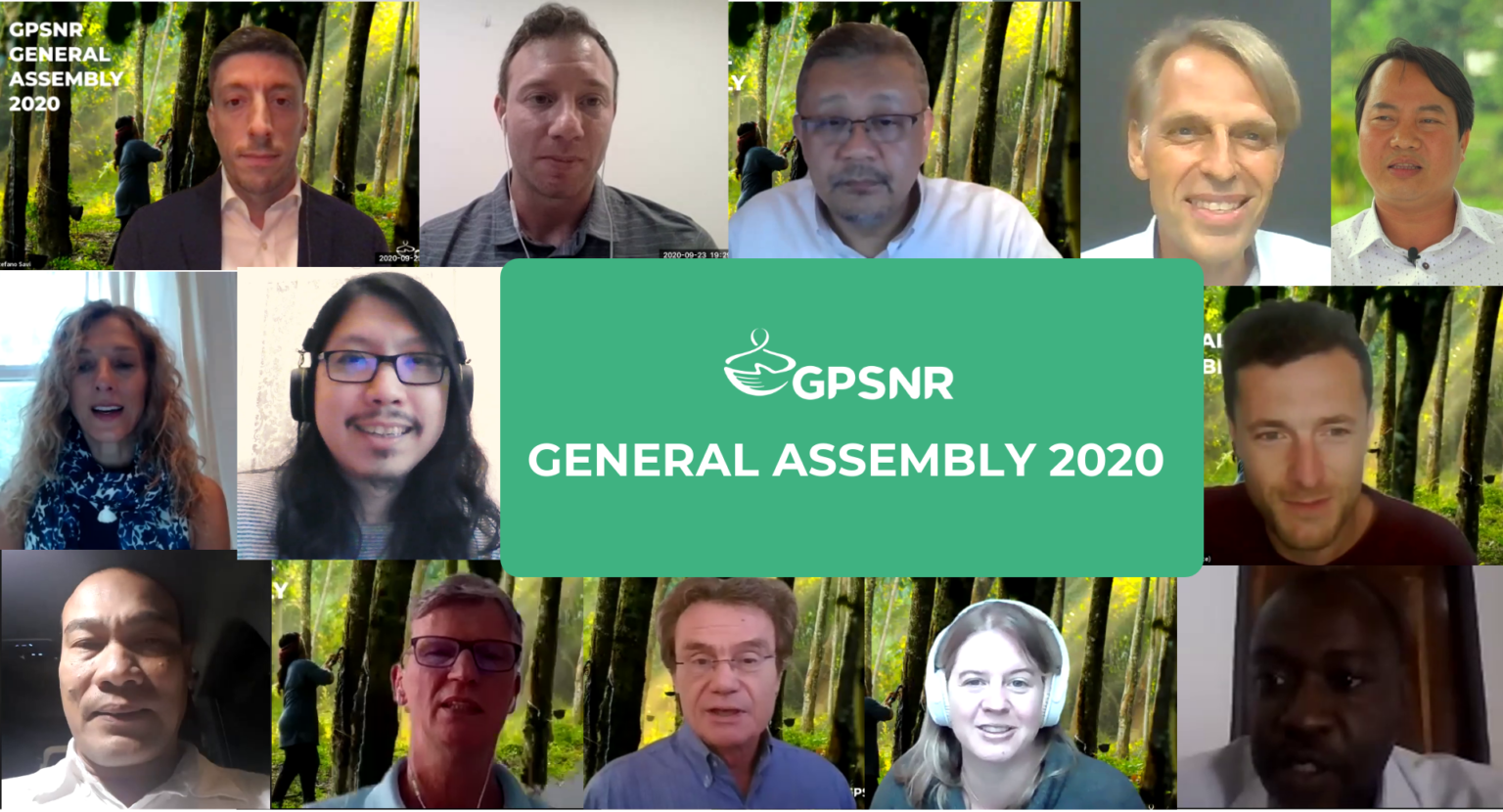
Highlights from General Assembly 2020

Share This Post

GPSNR’s second General Assembly was opened by Director Stefano Savi, who wished everyone a warm welcome to the virtual event. 

Next on the agenda was a message from Dr Gerd Müller, the German Federal Minister for Economic Cooperation and Development. The message was delivered via video by Sebastian Lesch, Head of Unit – International Agricultural Policy, Agriculture, Innovation, from the German Federal Ministry for Economic Cooperation and Development (BMZ). In his message, Dr Müller underscored BMZ’s support for GPSNR as a member and donor. He also urged all links in the natural rubber supply chain to continue to work towards comprehensive sustainability. 

Stefano also took the opportunity to acknowledge and thank BMZ and other donor partners such as Partnerships for Forests (P4F), a UK aid funded program, for their continued support, as well as WBCSD and the Tire Industry Project for their support in the Platform’s launch phase.

The opening remarks were delivered by Segsarn Trai-Ukos, Chair of the GPSNR Executive Committee. In his remarks, Segsarn summarized the achievements of the Platform over the past 18 months, recognising the dedication and effort put in by members of the Working Groups and the Executive Committee despite the global pandemic. “We have accomplished much in our first 18 months, and I’m excited to see our continued progress as we move forward.” he concluded.

After the opening remarks, Stefano gave a Secretariat Update, showing how GPSNR has grown since the first General Assembly. Membership has almost tripled, and engagement remains high. On the Communications front, GPSNR maintains a global outreach with its website, and has seen an increase in social media followers, along with mentions and features by numerous media outlets. Stefano also touched upon GPSNR’s financial status, which he described as healthy. 

The various Co-Chairs of the respective Working Groups then proceeded to give a brief update on what they have achieved so far, as well as the next steps. For a more detailed look at what comes next for our Working Groups, check out the article ‘The Road Ahead for GPSNR’s Working Groups’.

And finally, the moment everyone had been waiting for – the results of the voting. 

The verdict for each resolution was revealed one at a time, with the number of votes for, against and abstained, displayed for each resolution. All proposed resolutions were passed with overwhelming majorities.

Up next to be revealed were the results of the Executive Committee elections. These were announced by category, with the elected representatives giving a short speech after being introduced. For a look at GPSNR’s second Executive Committee, check out our article ‘A First Look at GPSNR’s second Executive Committee’.

Lastly, Co-Chair of the GPSNR Executive Committee, Amy Smith, delivered some heartfelt words as part of her closing remarks. “We all have the responsibility to drive sustainability in the global marketplace because our forests, wildlife, climate, communities and businesses depend on it,” she said. “And GPSNR has the ability to effect that transformational change.”
More To Explore

News

Global Platform for Sustainable Natural Rubber holds inaugural General Assembly, appoints Executive Committee

Singapore, 21 March 2019: Today, natural rubber stakeholders convened for the inaugural General Assembly of the Global Platform for Sustainable Natural Rubber (GPSNR) – an independent platform that will lead improvements in the socio-economic and environmental performance of the natural rubber value chain.

Development of the GPSNR was initiated by the CEOs of the World Business Council for Sustainable Development (WBCSD) Tire Industry Project (TIP) in November 2017.

Members of the platform include tire manufacturers, rubber suppliers and processors, vehicle makers and NGOs. Representatives from each of these stakeholder groups have contributed to the development of the Singapore-based platform and the wide-reaching set of priorities that will define GPSNR strategy and objectives.

Following a ceremonial launch in October 2018 interest in the GPSNR has seen membership grow to 39 Founding Members including recruitment of the platform’s first civil society members. The GPSNR remains open to membership applications from all natural rubber stakeholders.

The General Assembly saw the approval of organizational Statutes and Code of Conduct, and the formation of an Executive Committee that has the mandate of overseeing the strategic and operational activities of the GPSNR. As required by the Statutes, the Executive Committee comprises representatives from each of the four GPSNR membership categories – 1. Rubber producers, processors and traders; 2. Car makers, Other downstream users of natural rubber, and financial institutions; 3. Tire makers and other natural rubber makers/buyers ; and, 4. Civil society organizations.

Reacting to the formation of the Executive Committee, GPSNR Director Stefano Savi, said “The appointment of the Executive Committee is a critical piece to a landmark achievement. It has taken considerable effort from all stakeholders to bring us to this point. We know that the real hard work lies ahead, but today from Singapore we send a clear message – the GPSNR is open for business.”

The platform is working to finalize its operational strategy, guided by the stakeholder-agreed GPSNR priorities of harmonizing standards to improve respect for human rights, preventing land-grabbing and deforestation, protecting biodiversity and water resources, improving yields, and increasing supply chain transparency and traceability.

Following proceedings from Geneva, Peter Bakker, WBCSD’s President and CEO said “We are enormously proud to see the GPSNR take this important step. The commitment of TIP members to achieve sustainable natural rubber has been a crucial driving force in taking the GPSNR from concept to reality. Today, our members are joined by a growing and increasingly well-balanced GPSNR membership of rubber value chain and civil society members – the actors are in place, and the foundations for transformative action along the natural rubber value chain have been laid. Now the real work can begin.”

For membership enquiries and more information on the GPSNR, please contact info@gpsnr.org

GPSNR Founding Members at the time of the platform’s inaugural General Assembly, March 2019, per GPSNR membership category, alphabetical order:

Producers, processors and traders:

Halcyon Agri Corporation, ITOCHU Corporation, Kirana Megatara, MARDEC, PRASIDHA, SIPEF, SIPH, Socfin Group, Southland Global, Thai Eastern

Car Makers, Other Downstream Users, and Financial Institutions:

BMW Group, Ford Motor Company, General Motors

Tire Makers and Other Natural Rubber Makers/Buyers:

Bridgestone Corporation, Continental AG, Cooper Tire & Rubber Company, The Goodyear Tire & Rubber Company, Hankook Tire Co., Ltd., Kumho Tire Company Inc., Michelin, Nokian Tyres, Pirelli & C. S.p.A., Sumitomo Rubber Industries, Ltd., Toyo Tire Corporation, The Yokohama Rubber Co., Ltd.

Civil Society organizations:

BirdLife International, Conservation International, HCV Resource Network, FSC, Mighty Earth, PEFC, Rainforest Alliance, RESOURCETRUST NETWORK, SNV, World Resources Institute, WWF

Affiliate Member Organizations:

Tanintharyi Region Rubber Planters and Producers Association (TRRPPA), ProForest, Control Union

For membership enquiries and more information on the GPSNR, please contact info@gpsnr.org

News

Embracing our Shared Responsibility: GPSNR’s newest Working Group

Before the second General Assembly on 23 September 2020, the GPSNR Executive Committee had approved the creation of a Shared Responsibility Working Group that would be tasked to define the principles of shared responsibility for GPSNR.

The term ‘shared responsibility’ is relatively new to the sustainability scene, and as such, there is currently no commonly accepted definition for it. In general, shared responsibility is a value-driven concept which recognizes that supply chains are structurally imbalanced in terms of value and benefit, risk, burden of compliance, climate change impacts, power of negotiation, and access to information and resources. A shared responsibility approach strives for value, benefits, risks and improvement investments to be equitably distributed across all actors within the supply chain.​

In order to establish the foundational work that would enable the creation of the Shared Responsibility Working Group, the Executive Committee formed a Task Force comprising several of its members. Over a series of weekly calls, the Task Force has developed a Terms of Reference (ToR) and a set of Guiding Principles to inform the work of the new Shared Responsibility Working Group.

It is envisioned that the Shared Responsibility Working Group will draw from the Guiding Principles for Shared Responsibility (currently being developed by the Executive Committee’s Shared Responsibility Task Force), as well as the GPSNR Equity Definition and the studies launched by the Equity Working Group, to develop an implementation framework for the platform with respect to shared responsibility.

Scroll to Top