

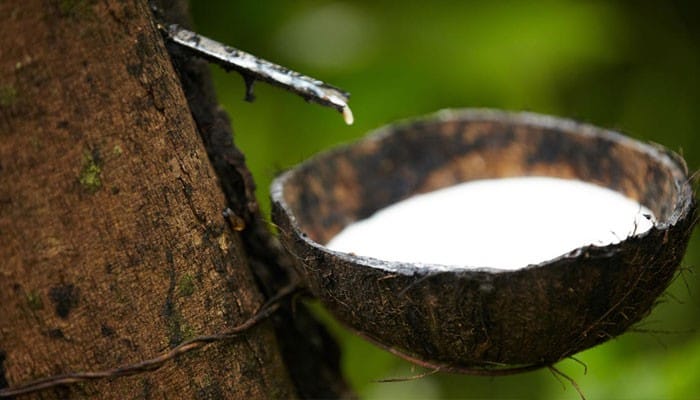
Stakeholders launch Global Platform for Sustainable Natural Rubber

Today, natural rubber stakeholders convened for the ceremonial launch of an independent platform to lead improvements in the socio-economic and environmental performance of the natural rubber value chain.

Share This Post

Stakeholders including tire manufacturers, other rubber users, suppliers and processors, vehicle makers and NGOs, contributed to the development of the Global Platform for Sustainable Natural Rubber (GPSNR). This included alignment on a wide-reaching set of priorities for the natural rubber supply chain. The GPSNR will work to harmonize standards to improve respect for human rights, prevent land-grabbing and deforestation, protect biodiversity and water resources, improve yields, and increase supply chain transparency and traceability.

Development of the platform was initiated by the CEOs of the World Business Council for Sustainable Development (WBCSD) Tire Industry Project (TIP) in November 2017 and has since been led by a Working Group of TIP member companies. TIP members continue to work to ensure the sustainable production and supply of natural rubber, and in joining the platform they commit to be able to demonstrate the integration of principles for sustainable natural rubber into their purchasing and/or operational activities. The GPSNR is open to applications for membership from other natural rubber stakeholders.

Speaking at the launch Peter Bakker, President and CEO of WBCSD said “The tire industry consumes around 70 percent of natural rubber and demand is growing. This throws into sharp relief the social, economic and environmental opportunities associated with this important commodity. The GPSNR will consider the people, communities and natural resources touched by natural rubber production and supply – they all stand to benefit from the creation and adoption of sustainable and responsible practices.”

The ceremonial launch included the signing of a GPSNR Member Statement by the 11 members of TIP, and Ford Motor Company, Halcyon Agri Corporation Limited, ITOCHU Corporation, Kirana Megatara, SIPEF, The Socfin Group, and Southland Global PTE Ltd.

Bakker praised the efforts of founding and prospective GPSNR members in bringing the platform to launch, adding “This spirit of collaboration will define the actions of the platform going forward – there is strength in diversity, and the various interests and expertise within the GPSNR can deliver a truly sustainable natural rubber supply chain.”

The WBCSD’s TIP spearheaded development of the GPSNR and will financially support the platform during start-up and its first two years of operation – a level of support necessary to ensure basic operations while a paying membership base is established. Despite industry backing the GPSNR will maintain its independence, underlined Anne-Cécile Remont, Director WBCSD TIP– “Once officially launched, the platform will be independently managed, with governance and decision making overseen by a representative group of stakeholders.”

Building upon past work, in developing the platform, a review of comparable supply chain sustainability initiatives, including natural rubber, revealed that meaningful change was best achieved through the mainstreaming of good practices and this was central to discussions around the GPSNR’s governance structure, explained Remont. “Successful mainstreaming requires actionable commitment from the entire supply chain. Best results are found where the various contributions of stakeholder groups are relative to their ownership of supply chain opportunities, their relevant expertise and their capacity to implement meaningful change,” she said.

To be headquartered in Singapore, a dedicated GPSNR secretariat will kick-off operations in March 2019 with an inaugural GPSNR General Assembly.

More To Explore

News

GPSNR Working Groups Update: December 2020

Strategy and Objectives Working Group

The Working Group has received several bids in response to the Request for Proposal (RFP) for a study on environmental impacts, and risks, in the natural rubber value chain that was published in November. The Working Group has shortlisted three candidates and, as part of the evaluation process, will be conducting with these candidates in January 2021 before awarding the bid to the successful candidate. 

The Working Group is also starting on the Theory of Change document update, an exercise which will involve all other Working Groups. This will take place in January 2021. The Equity sub-Group is preparing summary documents for the living income studies and is planning to present the studies to GPSNR members in early 2021.

‘Policy Toolbox’ Working Group

The Working Group has finalized the Baseline Reporting Requirements and these will go to the Executive Committee for review. The Working Group is also developing a Request for Proposal for a consultant to work on the implementation guidance and reporting requirements.

‘Capacity Building’ Working Group

Since the last update, the Good Agricultural Practices (GAP) Task Force has had their first kickoff call and is beginning the work to identify and/or refine guiding principles for GAPs appropriate for the sustainable production of natural rubber.

The Working Group is also engaging the Executive Committee on their comments regarding the proposed capacity building strategies for four focus countries.

‘Traceability and Transparency’ Working Group

In early December, the Working Group onboarded smallholders from Indonesia and Côte d’Ivoire into the group, with the smallholders participating in their first meeting on 10 December. 

Aside from reviewing the Working Group’s Terms of Reference (ToR) and its objectives moving forward, the Working Group will also be starting to develop recommendations for members on traceability and transparency tools in early 2021.

Smallholder Representation Working Group

The revised ToR for the Working Group is undergoing a final review, following which it will be sent to the Executive Committee for approval. 

The Working Group has also formalised a document that defines the role and key tasks of a Country Champion. So far, Country Champions have been actively involved in organizing and arranging national calls, supporting smallholder engagement, and providing technical and linguistic assistance.   

As part of the Working Group’s revamp, it will be undergoing a membership refresh. Part of this will also involve smallholders being onboarded into the Working Group in 2021.  The Working Group is also looking into onboarding smallholders from Cambodia. Any GPSNR members who have operations in Cambodia or partners working in Cambodia who can help to identify potential smallholders for an onboarding workshop are welcome to reach out to the Working Group’s Co-Chairs, Ulrich Antoni and Julian Oram.

MEMBERS CONSULTATION: EUDR-Assurance System Crosswalk

GPSNR is conducting a 30 day members consultation from 14 November 2025 to 14 December 2025 on an EUDR-GPSNR Assurance System crosswalk. A reference document developed by Preferred by Nature (PBN), this crosswalk  maps the requirements of the EU Deforestation Regulation (EUDR) against the GPSNR Assurance System.

It aims to help GPSNR members understand how existing GPSNR requirements under the Assurance System align with, and can support compliance with, the EUDR. It identifies areas of overlap as well as potential gaps where additional measures may be needed to meet EUDR obligations.

GPSNR invites all members and stakeholders to review the crosswalk and share feedback to ensure it is accurate, practical, and useful for the industry.


See the Crosswalk Document here


Record your feedback on the document here


Register to attend Introductory Webinar on the Crosswalk on Thursday, 27th November

Scroll to Top