
By Febrius Wibisana, GPSNR Executive Committee Member & Co-Chair, GPSNR Smallholder Inclusion Working Group
For those who do not know me yet, my name is Febrius Wibisana and I have been a rubber smallholder in Indonesia for over 25 years. At GPSNR, I represent the smallholder category at the Executive Committee level. I am also the co-chair of the Smallholders Representation working group.
In June 2022, I was invited by the Partnership for Forests or P4F to the P4F Forum with their partners and projects from across the world. They wanted me to speak about my experience at GPSNR on smallholder inclusion in the sustainability conversation in natural rubber. The experience gave me the opportunity to put some thought into our work over the last three years – the challenges, the successes and carving the path forward.
I am writing this to share some of those reflections with my fellow GPSNR members.
Reflection 1: It is impossible to have holistic sustainability solutions in natural rubber without smallholder participation
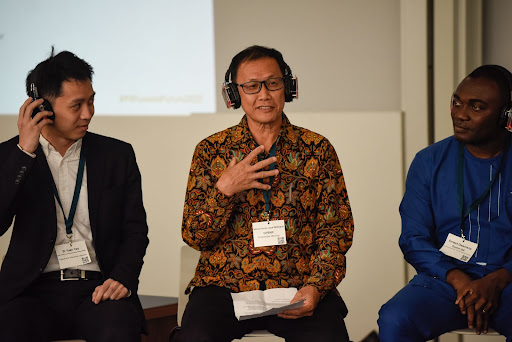
GPSNR Impacts & Assurance Associate Si Yuan and myself at the P4F Forum in London
We live in a world where 6 million smallholder farmers produce almost 90% of the world’s natural rubber. In such a world, any conversation on change in this supply chain has to include smallholders.
In its second General Assembly in 2020, GPSNR members passed a resolution to include smallholders as a category within the membership. We started with 28 odd smallholders, including myself, engaging in conversations on sustainability, capacity building and the meaning of true inclusion and having the smallholder voice heard at various decision making levels. Today, I represent over 130 smallholders across 10 countries in the GPSNR Executive Committee.
To bring smallholders into each conversation, we work closely with country level champions and local government entities for outreach and engagement. Interpretation facilities and key documents being translated to smallholder languages are some small but significant steps we take at GPSNR to further facilitate smallholder participation.
Reflection 2: Membership does not guarantee active participation
While many of our smallholder members are actively engaged in core decision making and at the working group level, many find it difficult to do so. The digital divide, language barriers and a skewed equation of structural power could be some key reasons for this. Some smallholders simply may not have the time for it.
Yet, as we embark on transforming the entire supply chain, we need active smallholder voices to join and remain in the GPSNR fold. To this end, the smallholder representation working group has put forward a resolution with proposed changes in smallholder membership structure, where smallholders will have to participate in the General Assembly to take up ordinary membership. All others will be classified as affiliate members by default. You can take a look at the resolution here.
Reflection 3: Making a supply chain sustainable requires thorough capacity building at all levels
There are more than 2 million smallholders in Indonesia. Yet, despite being the largest producer, it has the lowest productivity in the world. This is because of diseases and poor planting materials. Many other rubber producing nations face similar problems.
If we are to make this supply chain sustainable, equitable and fair, and achieve the desired state that the GPSNR Theory of Change spells out, smallholders have to be equipped with the skills and resources. The capacity building working group has already kicked-off the first such projects in Indonesia with SNV-Proforest and Koltiva. GPSNR has also received funding pledges from Renault, Goodyear, Michelin and Pirelli for other projects, but scaling them requires more. Funding information is available here for any one in the natural rubber industry.
Capacity building will also equip smallholders to participate further in GPSNR decision making and other processes.
As we move forward, I am energised by the progress GPSNR has made so far on smallholder participation. In our attempt to move towards more active engagement, we need the support of all our members. Our ability to meet in person will further strengthen this support, and I look forward to working with all of you to transform the supply chain.