

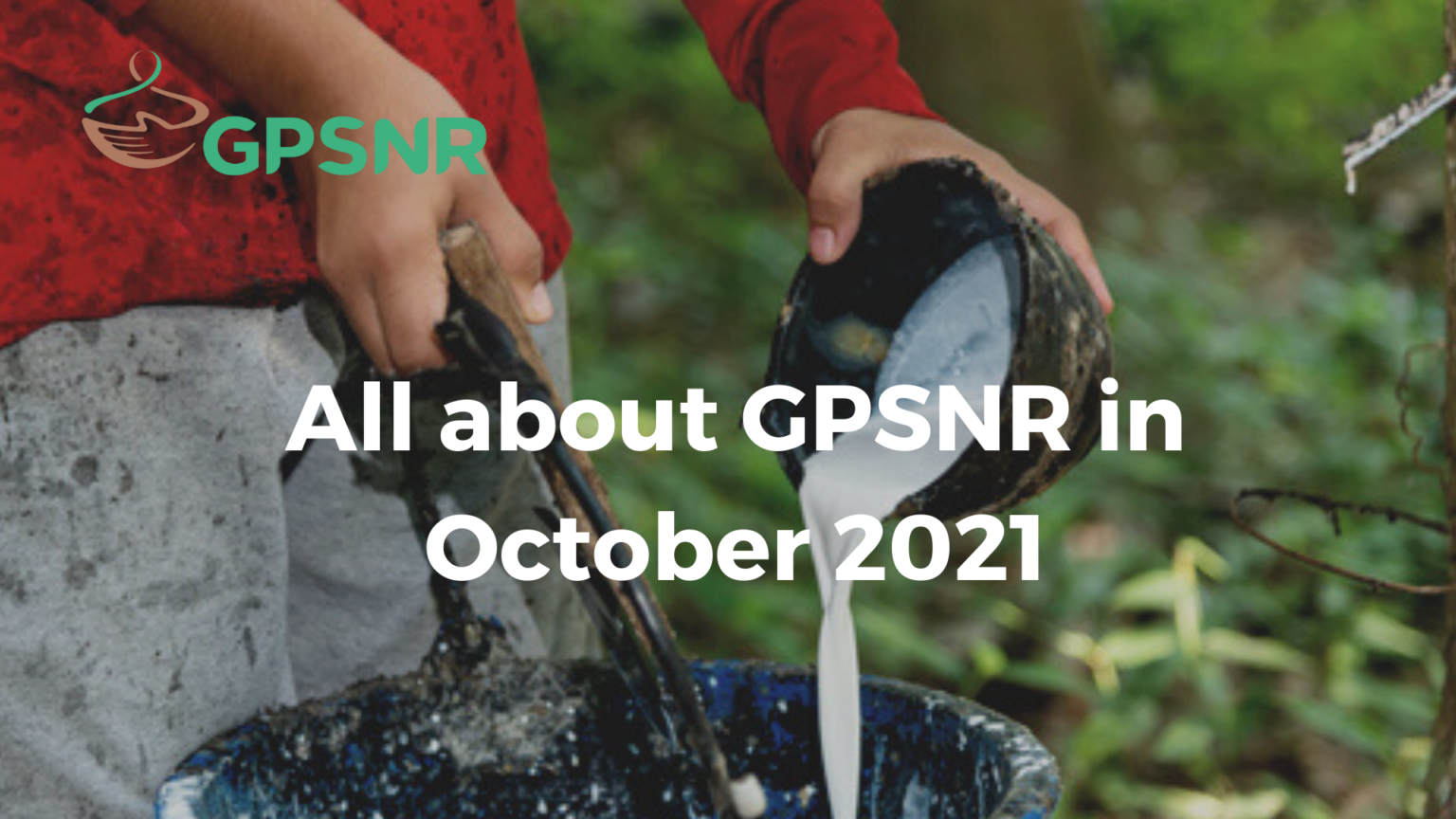
GPSNR Working Groups Update: October 2021

Share This Post

It’s been a busy month, to say the least! If you haven’t had the chance to take stock of everything that has happened, here is the update: 

Strategy and Objectives Working Group

After conducting 2 sessions of the Theory of Change (ToC) Workshop last  month, the Strategy and Objectives working group will soon finalise the ToC document and potentially identify new strategies for GPSNR. They are also working on developing a Request for Proposals for the Economic Risk Study. If you are interested in working on this RFP, please let Aidan know (aidan@gpsnr.org)

Smallholder Representation Working Group

After three successful smallholder onboarding workshops for smallholders from Indonesia, India and Cambodia over the last two months, the working group is formally incorporating new smallholders from the three countries as GPSNR members. 28 new smallholders from Indonesia have already been accepted as members. The group will also be conducting onboarding workshops for Sri Lanka, Thailand and Ivory Coast, and is facilitating smallholder EC nominations ahead of the 2021 General Assembly on 14th December.

Policy Toolbox Working Group

As the General Assembly of 2021 comes closer, the group has met numerous times in October to finalize the Reporting Requirements. . 

Capacity Building Working Group

After finalising the agroforestry position paper via the Agroforestry Task Force, the Capacity Building Working Group is busy finalising the Good Agricultural Practices (GAP), a system to monitor impacts of capacity building activities, implementation plans for Ivory Coast and Indonesia as well as developing key deliverables and milestones for the Thailand national sub working group. 

Traceability and Transparency Working Group

This working group is conducting member consultations on the recently developed Traceability Benchmark, and will provide recommendations on the same to the EC based on traceability studies from last year. At the same time, they are developing a TOR for a new working group on risk assessment.

Shared Responsibility Working Group

The group has discussed and explored solutions to identified root causes for each focus area of shared responsibility. It is also continuing to draft activities and a framework for Shared Responsibility for integration into other processes such as the Implementation Guidance, which will include consultations with GPSNR members and WGs to ensure alignment on Shared Responsibility for the platform. 

More To Explore

GPSNR Celebrates a Landmark Year and Strengthens Collective Commitment at 7th General Assembly

Singapore, 15 December 2025 — Members of the Global Platform for Sustainable Natural Rubber (GPSNR) gathered today for the organisation’s 7th General Assembly, marking a landmark year of progress in collective responsibility, accountability, and member-driven sustainability across the natural rubber value chain.

A major milestone in 2025 was the launch of GPSNR’s risk-based Assurance System, which sets clear sustainability expectations, introduces independent verification, and promotes continuous improvement beyond compliance. Developed collaboratively over several years, the system provides a credible, globally relevant framework for advancing sustainability in the sector. At this GA, End User companies reaffirmed their support and agreed on a structured pathway toward full implementation in their category.

“This year marks a turning point for GPSNR,” said Stefano Savi, CEO of GPSNR. “The Assurance System gives our members a shared and trusted foundation for demonstrating progress across the value chain.”

Members also marked the first year of the Shared Investment Mechanism, an innovative model enabling manufacturers to equitably share the costs of large-scale capacity-building projects, ensuring long-term benefits for upstream actors, particularly smallholders.

“Sustainability cannot be achieved by one part of the value chain alone,” Savi added. “By investing together, our members are enabling more inclusive and impactful outcomes worldwide.”

Looking ahead to 2026, GPSNR will support implementation of the Assurance System through data gathering, member learning, and cross-stakeholder dialogue to ensure the system reflects on-the-ground realities and diverse business models. 

The Assembly concluded with renewed commitment from members to advance equitable, resilient, and sustainable natural rubber supply chains.

About GPSNR:

The Global Platform for Sustainable Natural Rubber (GPSNR) is a multi-stakeholder, member-driven initiative working to advance sustainability across the natural rubber value chain.

More at sustainablenaturalrubber.org

Media contact:

 Bani Bains, Communications Director
bani.bains@gpsnr.org | +65 9726 8165

News

Launching the Global Platform for Sustainable Natural Rubber

Sustainable natural rubber, a Tire Industry Project priority

This, of course, means looking after the people, communities and natural resources touched by natural rubber production and supply – which all stand to benefit from the creation and adoption of sustainable practices and businesses.

TIP leading change

The tire industry consumes around 70 percent of natural rubber in the world and demand for natural rubber is growing, which throws into sharp relief the various social, economic and environmental opportunities associated with the production of this important commodity.

Together with other stakeholders, TIP members are working to transform the natural rubber supply chain for the better in developing the Global Platform for Sustainable Natural Rubber (GPSNR) – an independent platform to lead improvements in the socio-economic and environmental performance of the natural rubber value chain.

An ambitious and wide-reaching set of priorities

Twelve months of stakeholder collaboration have resulted in development of an ambitious, wide-reaching, common set of priorities for the natural rubber supply chain. The GPSNR will work to harmonize standards to improve respect for human rights, prevent land-grabbing, protect biodiversity and water resources, improve yields, and increase supply chain transparency and traceability.

Mainstreaming for meaningful change

A review of comparable supply chain sustainability initiatives revealed that the mainstreaming of good practices is linked to the delivery of meaningful change at the global level. This is something that requires actionable commitment from the entire supply chain, and numerous different stakeholder groups have important roles to play. In the case of natural rubber, this includes tire manufacturers and other natural rubber-using industries (such as those producing rubber gloves, condoms and other engineered products), natural rubber suppliers and processors, representatives of individual smallholder producers, vehicle manufacturers, and non-governmental organizations.

Binding commitments

A chain is only as strong as its weakest link; it is in the interest of the entire supply chain to ensure sustainable standards are met and maintained. The GPSNR will have clear membership criteria and supply chain standards that members must commit to maintain effective involvement. Members of the GPSNR will undertake binding commitments, and the GPSNR will constructively address failures to honor those commitments and act decisively in the event of noncompliance with remedial measures.

Industry backed, collaboratively driven

TIP has spearheaded development of the GPSNR and will provide initial support for the platform during its first two years of start-up and operation. This necessary level of support ensures basic operations during the establishment of a paying membership base. From launch, the platform will be independently managed with governance and decision making overseen by a representative group of stakeholders.

TIP has employed a truly collaborative effort to ready the GPSNR for launch, and that spirit of collaboration will define the actions of the platform going forward. TIP is confident that the diverse interests, experiences, areas of expertise, and motivations represented within the GPSNR will combine to deliver a successful, sustainable natural rubber supply chain.

Join the platform

If you are a natural rubber stakeholder and would like to learn more about the GPSNR and membership opportunities, please contact stefano.savi@gpsnr.org

Scroll to Top