
GPSNR Working Groups Update: September 2021

Share This Post

What an interesting month has passed us by! As we step closer to the General Assembly of 2021, here’s what the working groups have on their plate:

Strategy and Objectives Working Group

After conducting 2 sessions of the Theory of Change (ToC) Workshop this month, the Strategy and Objectives working group will soon finalise the ToC document and potentially identify new strategies for GPSNR.

Smallholder Representation Working Group

After two successful smallholder onboarding workshops for smallholders from Indonesia and Cambodia, the working group is formally incorporating new smallholders from the two countries as GPSNR members. The group is also conducting onboarding workshops for India at the end of September and Sri Lanka and Thailand in October. 

At the same time, they are developing workshops to onboard more smallholders from Vietnam, Thailand, Ivory Coast, and Ghana and organizing the third Smallholders International Call next month. 

Policy Toolbox Working Group

As the General Assembly of 2021 comes closer, the group is continuing to develop the Implementation Guidance, Reporting Requirements and Compliance Panel Guidance. 

Capacity Building Working Group

As they develop key deliverables and milestones for Thailand National Subgroup and the Agroforestry Task Force, the Capacity Building Working Group is also busy with the Good Agricultural Practices (GAP), a system to monitor impacts of capacity building activities and implementation plans for Ivory Coast and Indonesia.

Traceability and Transparency Working Group

This working group has developed a Traceability Benchmark to support member uptake of traceability and provided draft input and received feedback for Implementation Guidance on traceability. They are now working on finalising the draft and conducting member consultations on the Benchmark. 

Shared Responsibility Working Group

The group is currently exploring and discussing detailed  solutions to identified root causes for each focus area of shared responsibility. It is also drafting activities and a framework for Shared Responsibility for integration into other processes such as the Implementation Guidance.
More To Explore

News

GPSNR Working Groups Update: June 2022

Here are all their updates from the last month:

Strategy and Objectives Working Group

For the strategy and objectives working group, the development of the assurance model will be on priority for the next few months. To this end, they have finalised the draft terms of reference for an Assurance Model taskforce, which will be presented to the Executive Committee in their next meeting. Once approved, recruitment will begin extensively. The risk subgroup is also finalizing a document to be shared with the Executive Committee for their feedback.

Smallholder Representation Working Group

The group has submitted a resolution ahead of the July 22 General Assembly to restructure smallholder membership within GPSNR to enhance active participation. You can take a look at it in the GA Booklet here. In the next few months, they will begin planning smallholder workshops in Malaysia while also working on the smallholder policy equivalent. In case you missed it, they have also published an RFP recently to pilot agroforestry workshops for smallholders. Find it here. Preparations for a workshop for smallholders in Malaysia have also begun, which would be held in Q3 of 2022.

Policy Toolbox Working Group

In the last month, the group has finalised two major resolutions presented to the July General Assembly – one on the implementation guidance and the other on the disclosure requirements for year one reporting. Take a look here. Additionally, they have also finalised the guidance and templates for reporting for manufacturers and end users. If you are an end user or manufacturer who has not yet received the guidance and/or the templates, please write to the secretariat at info@gpsnr.org

For the next couple of months, the working group will be busy with finalising the operational guidance for the compliance panel and will continue conversations on the transparent reporting roadmap for years 2 and 3.

Capacity Building Working Group

After the kick-off of the GAPs coaching project in Indonesia with SNV and Koltiva, the group is  busy in the development of GPSNR’s knowledge sharing platform, which includes smallholder interviews, compiling and assessing responses of member surveys and holding focus group discussions. At the same time, they are working on advancing Capacity Building plans for Indonesia, Thailand and Côte d’Ivoire. 

They have also published two key RFPs for capacity building projects in Indonesia: one on disease fighting and the other on the provision of certified planting materials.

Shared Responsibility Working Group

The Shared Responsibility working group has prepared the Shared Responsibility framework resolution ahead of the GA, which you can read here

News

Secretariat Update – October 2019

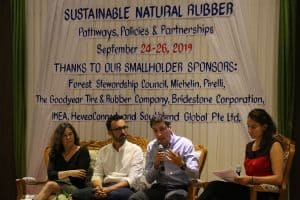
In attendance were farmers, processors, tire companies, apparel and footwear brands, NGOs and governmental representatives, all together over 100 participants. 

 The event offered a space for the diverse set of attendees to discuss the challenges and opportunities experienced by the rubber sector in the adoption and implementation of individual and global commitments to sustainable and ethical rubber with a focus on solutions. What set the workshop apart from the regular workshop we all know, was the addition of a field-excursion to two rubber-plantations operating under differing production models: a farm applying agro-forestry with a mix of native hardwoods and rubber trees and one fully developed diversified community agro-forestry farm. Additionally, instead of solely focusing on NGOs, companies and governmental representation (as the regular workshop often does), delegations from a number of farmer associations representing various countries also attended and provided key input to inform discussions from the farmer’s perspective.

Days 2 and 3 of the workshop were focused on forming partnerships and generating solutions to begin working towards a transformed natural rubber supply chain which delivers value to all actors from the farm to the end user.  Break out groups comprised of farmers, processors, brands, NGOs, tire companies and government representatives discussed topics such as traceability, policy implementation and capacity building for smallholders. Each break out group then categorized their discussions into short term actions, long term actions, barriers and learning curves which will be summarized into a collective call to action by the organizing team.  One of the most powerful outcomes was an overall agreement amongst all stakeholders in attendance that to truly bring about positive transformation we must all work together towards a shared vision.

A public summary of the event will be shared in the coming days, please contact Samantha Morrissey (smorrissey@ra.org) or Margaret Kran-Annexstein (margaret@mightyearth.org) with any questions.

Scroll to Top