

From Strategy to Implementation: Next Steps for Capacity Building

Share This Post

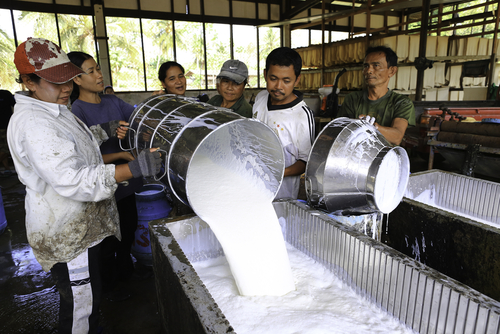
One of the key strategies identified by GPSNR to achieve our vision of a fair, equitable and environmentally sound natural rubber value chain is to ensure that there is capacity amongst smallholders and industrial plantations to adopt best practices in natural rubber production.  

In 2020, the Capacity Building Working Group, through various stakeholder interviews and Working Group discussions, proposed a set of country-specific capacity building activities for four countries as a start: Côte d’Ivoire, Indonesia, Myanmar and Thailand. In developing these strategies, the Working Group sought to first identify threats to the sustainable production of natural rubber within the different local contexts, as well as the underlying causes for these threats. From this initial research, the working group developed proposed capacity building actions, along with main objectives and rationales for each chosen action. The approach adopted by the Working Group in designing these actions is to allow for immediate engagement and implementation on the ground. 

Following the Executive Committee’s endorsement of the Working Group’s capacity building proposals, the Working Group will be conducting a sharing session for all GPSNR members, during which more details about each national capacity building strategy will be presented.

Recruiting Members to Capacity Building National Sub-Groups

Now that the capacity building strategies are in place, the Working Group is inviting interested GPSNR members to join the soon-to-be-created National Sub-Groups that will be mandated to oversee, guide and implement the national capacity building strategies and to promote GPSNR policies and initiatives.  

The development of the National Sub-Groups recognizes existing local capacity building initiatives in the rubber sector and their independence of GPSNR and aims to cooperate with local efforts and stakeholders to achieve mutually agreed outcomes.

More To Explore

News

Smallholders Representation Working Group Update – January 2020

Of the 22 applicants, one is from Brazil, four from Côte d’Ivoire, two from Ghana, five are from Indonesia, four from Thailand and six are from Vietnam.

The 2nd General Assembly on 31 March 2020 will see the proposal of a new membership category, ‘Smallholder Producers’. Should the voting on this resolution pass, smallholders will officially find their voice in global efforts to ensure a socially, economically and environmentally sound natural rubber supply chain.

Thanks to sustained funding from Partnerships for Forests (P4F), we will be able to invite the geographically diverse group of smallholders to Singapore to attend their first General Assembly, with the view to onboard them and to have smallholder producers represented in the Executive Committee via the voting of nominated individuals.

As it is important for the smallholders to understand what is required of them at the General Assembly and as an Executive Committee member, the Working Group will be scheduling several sessions, both remote and on-site, to thoroughly brief the smallholders on GPSNR’s Statutes and Code of Conduct. The smallholders will also have the opportunity to get acquainted with one another in the two days prior to the General Assembly.

In preparation for this, the appointed Country Champions of the Working Group will be assisting the smallholders in travel logistics and other administrative matters. The Working Group is also looking into engaging professional translation services at the General Assembly to emphasize impartiality.

News

GPSNR Working Groups Update: December 2021

What a year! All our working groups successfully overcame the challenges of remote working and time-zone coordination, while moving the needle on sustainability in natural rubber. Here are their updates for December 2021:

Strategy and Objectives Working Group

The group has finalized the Theory of change, which is currently in the process of being designed for public communications. They have also published the Environmental Risk Study, which can be found here.  Currently, the group is working on developing the RFP for the Economic Risk Study, which will be published and worked on in 2022. The group is also working on developing next steps for itself based on the finalized Theory of Change.

Smallholder Representation Working Group

In 2021, the working group onboarded 39 new smallholders at GPSNR. In 2022, they will be focussing on mapping out the possibility of smallholder onboarding workshops in Columbia, Ghana, Liberia and Malaysia, which are countries with a relatively lower representation of smallholders within GPSNR. From January 2022, they will also be busy with developing a Smallholders Policy Framework. 

Policy Toolbox Working Group

The group saw a major milestone in the approval of the reporting requirements at the 2021 General Assembly. In 2022, they will be busy developing guidance for thereporting requirements and a transparency roadmap before the reporting cycle begins in mid-2022. At the same time, the group continues to refine the Implementation Guidance before the General Assembly of 2022. 

Capacity Building Working Group

The group recently hosted a webinar on GPSNR’s Good Agricultural Practices (GAPs) before the 2021 General Assembly, and published two RFPs for the assessment of the Knowledge Sharing Platform and GAP coaching for Indonesia respectively. In the next few months, it will focus on kickstarting the Thailand national sub-working group, advancing agroforestry implementation plans for GPSNR as well continuing to advance capacity building implementation in Indonesia and Ivory Coast. 

Traceability and Transparency Working Group

The Traceability and Transparency working group has requested members’ input on the traceability benchmark and will work on refining it based on the feedback received. You can take a look at the draft benchmark here and give your feedback here before 31st December. 

Shared Responsibility Working Group

The working group has discussed and explored solutions to address the root causes identified for each of the three focus areas of Shared Responsibility. It has also identified a consultant to support the development of a shared responsibility framework. In 2022, the group will draft activities and framework for Shared Responsibility for integration into other processes such as the Implementation Guidance and align with other working groups. 


Scroll to Top