

Shared Responsibility in Action: Goodyear and GM Support Smallholder Rubber in Indonesia

Share This Post

Indonesia is the world’s second-largest producer of natural rubber, a material vital to the global tire and automotive supply chain, which consumes more than 70% of global production. However, the country’s smallholder farmers, who produce the majority of this rubber, face mounting challenges, including aging tree stock, limited technical support, and decreasing participation from younger generations.
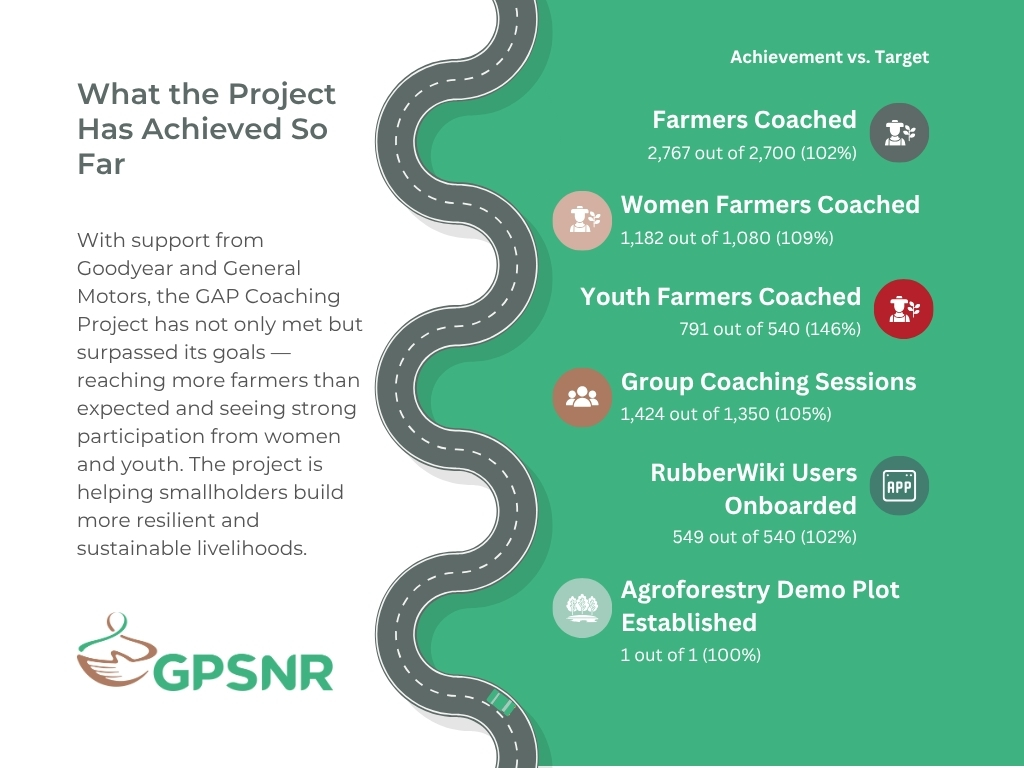
Figure. 1

To help address these structural issues, The Goodyear Tire & Rubber Company has supported the Smallholder GAP Coaching Project since its launch in 2022 under the Global Platform for Sustainable Natural Rubber (GPSNR). In its third phase (September 2024 to September 2025), Goodyear is joined by General Motors (GM) as a co-funder. As shown in Fig. 1, this phase has exceeded its target, reaching 2,767 smallholders in South Sumatra (target: 2,700).


Coaching the Next Generation

This project established participation targets of at least 40% women and 20% youth. By July 2025, these benchmarks were not only met but exceeded — 1,182 women (109%) and 791 youth (146%) have received coaching.

One of these youth participants is a 24-year-old farmer from South Sumatra who manages a 1.5-hectare rubber plot inherited from her family. Despite challenges, she continues to tap daily and maintain the farm herself. Through the project, a farm assessment revealed previously undiagnosed leaf disease. With targeted support, she learned to identify early symptoms, adopt better tapping practices, and implement yield-improving interventions.


Planting for the Future, Earning in the Present
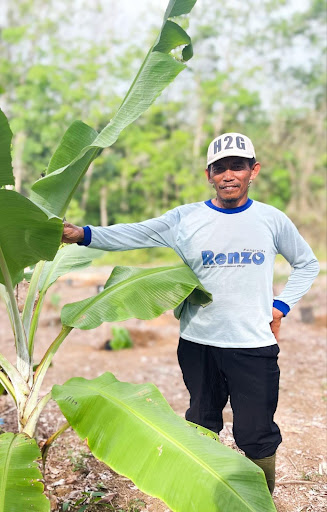
 In Musi Rawas, the project’s sole demonstration plot highlights how regenerative practices can offer both environmental and economic benefits. The 0.25-hectare agroforestry site, managed by 54-year-old Subarni, was converted from a 33-year-old jungle rubber plot into a more productive and diversified system.

With support from the project implementation team, Subarni replanted 120 improved rubber clones and intercropped the land with bananas, peanuts, and durian. The peanuts alone are expected to yield approximately 150 kilograms every four months, beginning in July 2025 — a critical alternate source of income during the long replanting period.

“Normally, you wait years after replanting rubber before seeing any return,” he said. “Now, I see income while waiting too, and that gives me the motivation to keep going.”

Beyond immediate income, long-term investments like durian, a high-value crop locally known for its premium quality, reflect how smallholders are planning beyond subsistence. The demonstration plot now serves as a practical model for neighbouring farmers exploring integrated, sustainable rubber production.


Digital Tools for Real-World Change

Complementing in-person coaching is RubberWiki, a mobile app developed to extend learning beyond the field. As of July 2025, 549 farmers have been successfully onboarded, just over the initial target of 540.

The app offers training modules and real-time rubber price updates, which have proven especially valuable. “I check it almost every day,” said 40-year-old Partini, who uses it to monitor price fluctuations. Others, like 35-year-old Ari, revisit coaching content through the app in the evenings.

By offering flexible, on-demand learning, RubberWiki helps ensure that farmers can continue to build knowledge and confidence well after formal sessions have concluded.


A Model for Shared Industry Commitment

Goodyear has supported the GAP Coaching Project since its earliest days, recognizing that smallholders form the backbone of the global natural rubber value chain. In Phase 3, Goodyear invited General Motors to co-fund the initiative, reflecting a growing movement toward shared accountability across the supply chain.

“Smallholders are the foundation of the natural rubber industry,” said Chuan Heng, Associate Director, GOCPL Natural Rubber, Goodyear. “And, Goodyear, as part of GPSNR, engages in programs that support the natural rubber industry’s move towards a more sustainable supply chain.

General Motors’ contribution also highlights its broader commitment to responsible sourcing. By funding smallholder-centred programs like this, GM is helping to ensure that sustainability principles are embedded at the very beginning of the rubber lifecycle, where real transformation begins.

Together, Goodyear and GM have shown that when downstream actors work together, the impact is tangible: higher participation from women and youth, expanded access to digital tools, and better agronomic outcomes for thousands of smallholders.
More To Explore

GPSNR Assurance System – Assessment Service Provider Application

Singapore, 15 December 2025 — Members of the Global Platform for Sustainable Natural Rubber (GPSNR) gathered today for the organisation’s 7th General Assembly, marking a landmark year of progress in collective responsibility, accountability, and member-driven sustainability across the natural rubber value chain.

A major milestone in 2025 was the launch of GPSNR’s risk-based Assurance System, which sets clear sustainability expectations, introduces independent verification, and promotes continuous improvement beyond compliance. Developed collaboratively over several years, the system provides a credible, globally relevant framework for advancing sustainability in the sector. At this GA, End User companies reaffirmed their support and agreed on a structured pathway toward full implementation in their category.

“This year marks a turning point for GPSNR,” said Stefano Savi, CEO of GPSNR. “The Assurance System gives our members a shared and trusted foundation for demonstrating progress across the value chain.”

Members also marked the first year of the Shared Investment Mechanism, an innovative model enabling manufacturers to equitably share the costs of large-scale capacity-building projects, ensuring long-term benefits for upstream actors, particularly smallholders.

“Sustainability cannot be achieved by one part of the value chain alone,” Savi added. “By investing together, our members are enabling more inclusive and impactful outcomes worldwide.”

Looking ahead to 2026, GPSNR will support implementation of the Assurance System through data gathering, member learning, and cross-stakeholder dialogue to ensure the system reflects on-the-ground realities and diverse business models.

The Assembly concluded with renewed commitment from members to advance equitable, resilient, and sustainable natural rubber supply chains.

About GPSNR:

The Global Platform for Sustainable Natural Rubber (GPSNR) is a multi-stakeholder, member-driven initiative working to advance sustainability across the natural rubber value chain.

More at sustainablenaturalrubber.org

Media contact:

Bani Bains, Communications Director
bani.bains@gpsnr.org | +65 9726 8165

News

GPSNR Working Groups Update: January 2021

Strategy and Objectives Working Group

In our December update, we reported that the Working Group would be conducting interviews with the shortlisted candidates who had responded to the Request for Proposal for a study on environmental impacts, and risks, in the natural rubber value chain. The Working Group has since completed their interviews and will soon be making a decision on who to award the contract to.

The refinement of GPSNR’s Theory of Change is also underway, with a planning call having taken place on Monday this week. The call involved nominated representatives  from across all GPSNR’s Working Groups, working to chart the plan for a collaborative effort to refine the Platform’s Theory of Change.

In other news, several Thai smallholders have been onboarded into the Working Group and, after an introductory call with the Co-Chairs,  are now participating in the Working Group calls.

As the Equity Sub-Group prepares to present the living income studies to GPSNR members, more details will be conveyed to members nearer the date.

‘Policy Toolbox’ Working Group

Following the approval of the GPSNR Policy Framework, the Policy Toolbox Working Group will develop Implementation Guidance and future Reporting Requirements as they pertain to the specific policy components in the framework.  

In order to achieve this, a Request for Proposal (RFP) has been posted for a fixed term consultancy to facilitate the development of the Implementation Guidance and Reporting Requirements for each of the three stakeholder categories: natural rubber producers/processors and traders, tire makers and other natural rubber product manufacturers, and auto makers and other end users.  GPSNR members are invited to circulate the RFP to any relevant contacts who might be interested in submitting proposals for this work. The deadline for submission is 5 February 2021.

The Implementation Guidance and Reporting Requirements will vary depending on where a member company sits within the natural rubber supply chain. As such, GPSNR will invite the creation of category focus groups to enable broader participation of members from the three stakeholder categories (although focus groups can also include members from other stakeholder categories). The details on recruitment for these focus groups will be announced sometime next month.

Apart from facilitating the development of category-specific Implementation Guidance by reviewing guidance and requirements from other initiatives, the consultant will also facilitate discussion sessions with the focus groups to finalize the implementation guidance for each stakeholder category.

‘Capacity Building’ Working Group

In 2020, the Working Group proposed national capacity building strategies for four countries as a starting point. Following the Executive Committee’s endorsement of the strategies, the Working Group is embarking on the next step of putting these plans into action on-the-ground. The Working Group is looking for interested members to form National Sub-Groups mandated to oversee, guide and implement the strategies. The Working Group will conduct a webinar in mid February to share the strategies with GPSNR members. Check out our article, ‘From Strategy to Implementation: Next Steps for Capacity Building’ for more on this story.

‘Traceability and Transparency’ Working Group

The two studies around traceability and transparency tools and technology commissioned in 2020 by the Working Group are ready to be shared with GPSNR members. Read our article, ‘Seeing Through to a Solution: Traceability and Transparency Tools and Technology Studies’ for more on this topic.

Smallholder Representation Working Group

The Working Group’s revised Terms of Reference (ToR) was approved by the Executive Committee during its monthly call in January. Under the revised ToR, the Smallholder Representation Working Group has identified two main objectives for its work moving forward: the first, to support the creation of an active smallholder community within GPSNR and the second, to extend the on-boarding of smallholders from rubber producing countries. The Working Group will be planning its activities for the year head, ensuring that they support and contribute towards achieving these new objectives. 

As a start, the Working Group will be looking to onboard smallholder members into the group, as well as facilitate the organization of the next Smallholder Category Call.

Scroll to Top