
Rubber, representation and reform – What smallholders bring to the sustainability conversation

Share This Post

By Febrius Wibisana, GPSNR Executive Committee Member & Co-Chair, GPSNR Smallholder Inclusion Working Group

For those who do not know me yet, my name is Febrius Wibisana and I have been a rubber smallholder in Indonesia for over 25 years. At GPSNR, I represent the smallholder category at the Executive Committee level. I am also the co-chair of the Smallholders Representation working group.

In June 2022, I was invited by the Partnership for Forests or P4F to the P4F Forum with their partners and projects from across the world. They wanted me to speak about my experience at GPSNR on smallholder inclusion in the sustainability conversation in natural rubber. The experience gave me the opportunity to put some thought into our work over the last three years – the challenges, the successes and carving the path forward.

I am writing this to share some of those reflections with my fellow GPSNR members.

Reflection 1: It is impossible to have holistic sustainability solutions in natural rubber without smallholder participation
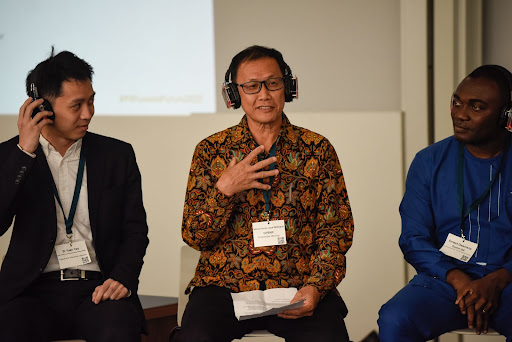
GPSNR Impacts & Assurance Associate Si Yuan and myself at the P4F Forum in London

We live in a world where 6 million smallholder farmers produce almost 90% of the world’s natural rubber. In such a world, any conversation on change in this supply chain has to include smallholders. 

In its second General Assembly in 2020, GPSNR members passed a resolution to include smallholders as a category within the membership. We started with 28 odd smallholders, including myself, engaging in conversations on sustainability, capacity building and the meaning of true inclusion and having the smallholder voice heard at various decision making levels. Today, I represent over 130 smallholders across 10 countries in the GPSNR Executive Committee. 

To bring smallholders into each conversation, we work closely with country level champions and local government entities for outreach and engagement. Interpretation facilities and key documents being translated to smallholder languages are some small but significant steps we take at GPSNR to further facilitate smallholder participation.

Reflection 2: Membership does not guarantee active participation

While many of our smallholder members are actively engaged in core decision making and at the working group level, many find it difficult to do so. The digital divide, language barriers and a skewed equation of structural power could be some key reasons for this. Some smallholders simply may not have the time for it. 

Yet, as we embark on transforming the entire supply chain, we need active smallholder voices to join and remain in the GPSNR fold. To this end, the smallholder representation working group has put forward a resolution with proposed changes in smallholder membership structure, where smallholders will have to participate in the General Assembly to take up ordinary membership. All others will be classified as affiliate members by default. You can take a look at the resolution here

Reflection 3: Making a supply chain sustainable requires thorough capacity building at all levels

There are more than 2 million smallholders in Indonesia. Yet, despite being the largest producer, it has the lowest productivity in the world. This is because of diseases and poor planting materials. Many other rubber producing nations face similar problems. 

If we are to make this supply chain sustainable, equitable and fair, and achieve the desired state that the GPSNR Theory of Change spells out, smallholders have to be equipped with the skills and resources. The capacity building working group has already kicked-off the first such projects in Indonesia with SNV-Proforest and Koltiva. GPSNR has also received funding pledges from Renault, Goodyear, Michelin and Pirelli for other projects, but scaling them requires more. Funding information is available here for any one in the natural rubber industry. 

Capacity building will also equip smallholders to participate further in GPSNR decision making and other processes. 

As we move forward, I am energised by the progress GPSNR has made so far on smallholder participation. In our attempt to move towards more active engagement, we need the support of all our members. Our ability to meet in person will further strengthen this support, and I look forward to working with all of you to transform the supply chain. 
More To Explore

News

Message from the Director: Updates on COVID-19

Dear Members,

Since our last update to you, the COVID-19 situation has escalated into a global pandemic, with Europe and the US some of the hardest hit areas. The implications for us as a multi-stakeholder platform, are many. Today, I am taking the opportunity to update you on how we have addressed the issues within our control.

Secretariat Operations
For the health and welfare of our staff, we have instituted a work from home recommendation. We are also complying with the local government travel advisory to defer all non-essential travel. Rest assured that these measures will have minimal disruption to the operations of the Secretariat, and we remain only an email or a teleconference call away.

Working Groups
All our Working Groups remain active and continue to make progress in their respective areas of focus despite the situation. They are taking the extra time to enhance their deliverables, and I am confident that we will have many sound proposals and resolutions to consider and approve as a Platform. I encourage you to read the updates on the News and Publications page of our website, so that you are aware of the achievements to date of our Strategy & Objectives and Smallholders Representation Working Groups.

General Assembly
The severity of this pandemic has caused inevitable delays to our 2nd General Assembly (GA). As the safety and wellbeing of our members is our utmost priority, we will not be able to hold the GA within the first half of the year as we had anticipated. Nevertheless, the Executive Committee is in ongoing discussions on plans for the GA, and, where necessary, will assist all Working Groups to finetune their proposals to ensure a smooth and productive GA. 

Finally, I would like to thank each and every one of you for your continued contribution and teamwork even in these trying times. I also appreciate your understanding and patience as we decide on the best way forward for the Platform in these unprecedented times. 

Our thoughts are with the natural rubber farmers and producers, and their families, whose livelihoods are being mostly impacted by COVID-19. To those whose family, friends or co-workers have been directly affected by the virus, our thoughts go out to you.

I urge you all to stay safe, stay vigilant, and stay positive.

All my support,

Stefano Savi
Director

News

Following the Conversation with GPSNR Topic Talks!

The GPSNR Topic Talks webinar series is organised by the GPSNR Secretariat and presented by GPSNR members. The webinars cover several themes around sustainability and the global natural rubber supply chain.

The series kicked off on 27 October with a presentation by Philippe Thaler from CIRAD, on the implications of EU legislation on imported deforestation.

The second webinar’s theme was on smallholder solutions and featured two separate presentations. “A landscape-level approach to inclusion and capacity building for rubber smallholders” was presented by Rizki Permana from SNV, Widyantoko Sumarlin from Kirana Megatara, and Tony Hill from Proforest. Speaking from experience with the Kelola-Sendang project in South Sumatra, the presenters explained how SNV, with Proforest support, worked with rubber smallholder groups in the jurisdictional initiative, which helped to forge new links between the smallholders and a crumb rubber factory buyer in the Kirana group. 

Next, “Exploring Smallholder Solutions in the Rubber Sector – The Processing and Sale of Rubberwood to Support Smallholder Financing in Indonesia” was presented by Amy Smith from WWF, Gerald Tan from HeveaConnect, with Renée Corstens and Remco Geervliet from Financial Access. This presentation shared the findings of a study which analyzed the potential of rubberwood to serve as a mechanism to support smallholder financing in Indonesia.

The next theme is Assurance and smallholders, and how we can learn from existing schemes. PEFC’s CEO Ben Gunneberg presented a webinar last night, elaborating on PEFC’s approach to standard-setting and certification. He also showcased PEFC’s current collaborative projects with their national members and companies to support smallholder producers, and how these will benefit GPSNR members and the work GPSNR is engaged in.

Continuing with the theme of Assurance and smallholders, FSC will be presenting on 8 December, an overview of smallholder certification solutions.

We are also pleased to announce an addition to the Topic Talks lineup: ‘REDD+, are carbon credits impacts overstated?’. This new presentation, jointly organized with GIZ and which will be held on 10 December, puts the spotlight on reducing emissions from deforestation and forest degradation (REDD+) with an introduction to the REDD+ methodology, followed by a discussion with the authors of a recently published study, “Overstated carbon emission reductions from voluntary REDD+ projects in the Brazilian Amazon”. 

GPSNR members may contact the Secretariat to register for the upcoming Topic Talks.


Assurance and Smallholders: Learning from Existing Schemes Part 2

“FSC Smallholder Certification Solutions”

8 December | 7PM (GMT+8)

Presented by: FSC

The presentation will cover FSC’s solutions for smallholders to become certified. First, an overview of the evaluation of certification solutions for smallholders will be given. FSC’s existing solutions will be covered, with a focus on the benefits for FSC Group Certification. Next, solutions in the pipeline will be covered, addressing the impact of pilot projects and highlighting success stories.

REDD+, are carbon credits impacts overstated?  

10 December | 3PM (GMT+8)

Jointly Organized by: GIZ 

Presented by: GIZ and authors of the study

Using REDD+ projects to offset carbon emissions through avoided deforestation and the financial support of local communities is popular but also highly debated. Especially, voluntary REDD+ projects are regularly criticized as inefficient or even greenwashing. This presentation will provide an introduction to the REDD+ methodology. The authors of a recent critical study, “Overstated carbon emission reductions from voluntary REDD+ projects in the Brazilian Amazon” will then present their findings and suggestions as a basis for discussion.

Scroll to Top