
GPSNR Working Groups Update: October 2021

Share This Post

It’s been a busy month, to say the least! If you haven’t had the chance to take stock of everything that has happened, here is the update: 

Strategy and Objectives Working Group

After conducting 2 sessions of the Theory of Change (ToC) Workshop last  month, the Strategy and Objectives working group will soon finalise the ToC document and potentially identify new strategies for GPSNR. They are also working on developing a Request for Proposals for the Economic Risk Study. If you are interested in working on this RFP, please let Aidan know (aidan@gpsnr.org)

Smallholder Representation Working Group

After three successful smallholder onboarding workshops for smallholders from Indonesia, India and Cambodia over the last two months, the working group is formally incorporating new smallholders from the three countries as GPSNR members. 28 new smallholders from Indonesia have already been accepted as members. The group will also be conducting onboarding workshops for Sri Lanka, Thailand and Ivory Coast, and is facilitating smallholder EC nominations ahead of the 2021 General Assembly on 14th December.

Policy Toolbox Working Group

As the General Assembly of 2021 comes closer, the group has met numerous times in October to finalize the Reporting Requirements. . 

Capacity Building Working Group

After finalising the agroforestry position paper via the Agroforestry Task Force, the Capacity Building Working Group is busy finalising the Good Agricultural Practices (GAP), a system to monitor impacts of capacity building activities, implementation plans for Ivory Coast and Indonesia as well as developing key deliverables and milestones for the Thailand national sub working group. 

Traceability and Transparency Working Group

This working group is conducting member consultations on the recently developed Traceability Benchmark, and will provide recommendations on the same to the EC based on traceability studies from last year. At the same time, they are developing a TOR for a new working group on risk assessment.

Shared Responsibility Working Group

The group has discussed and explored solutions to identified root causes for each focus area of shared responsibility. It is also continuing to draft activities and a framework for Shared Responsibility for integration into other processes such as the Implementation Guidance, which will include consultations with GPSNR members and WGs to ensure alignment on Shared Responsibility for the platform. 
More To Explore

News

Continuing the Conversation with GPSNR Topic Talks – The Sumatran Rubber Pilot

The GPSNR Topic Talks webinar series is organised by the GPSNR Secretariat and presented by GPSNR members. The webinars cover several themes around sustainability and the global natural rubber supply chain.

The Topic Talks series continued on the 17th of March with Dr. Michael Steuwe from WWF US and Gerald Tan from HeveaConnect presenting on the Sumatran Rubber Pilot.

The Sumatran Rubber Pilot (SRP) is a voluntary, self-financed collaboration of rubber supply chain players and technical experts interested to facilitate the production and trade of transparent and sustainable natural rubber. The participating processing mills, tire makers, civil society organisations, technology providers and financial institutions have three major objectives:

  • Demonstrate how rubber’s downstream can work together to make its upstream more sustainable.
  • Identify, test, evaluate, and report on what it takes to achieve, and how to pay for transparent sustainable natural rubber supply chains.
  • Develop “Proof of Concept” approaches from and for GPSNR discussions on policy requirements and implementation, transparency and traceability, capacity building, and shared responsibility.

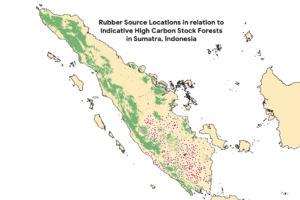
Within a few months of the project launch in July 2020, SRP’s four rubber processing factories, managed by the Halcyon Agri and ITOCHU groups, had traced up to 1 year of rubber supplies to the village and/or sub-district of origin based on self-declarations by their supplying dealers. These approximate origins of the rubber sources were filtered through WWF Indonesia’s new environmental risk assessment and management tool which identifies High Conservation Value Areas and High Carbon Stock Forest for the whole island of Sumatra. The results allow processors and their respective downstream supply chains to focus their sustainability work with farmers on priority areas.

The SRP partners are enhancing dealer self-declarations with digital apps such as CropIn and Hamurni to assess farms’ potential environmental, social, equity, labour and legal issues accurately and to address them.

As GPSNR adopts principles and criteria for what constitutes transparent and sustainable rubber, the risk assessment algorithms will be adapted to flag compliant rubber accordingly. This is increasingly important for rubber’s downstream as companies’ Environmental, Social, Governance (ESG) impacts are becoming key evaluation criteria for investors and financiers who will demand the disclosure of the relevant information. In a parallel development, new supply chain laws will require major companies like the world’s car and tire makers to be responsible for the environmental and social impacts of their supply chains. The collection and analysis of detailed data on upstream supply chains will have to become an essential part of doing business and SRP partners are working to respond appropriately to these changes.

While continuing to focus on increasing the resolution of tracing rubber to its origin and collecting the respective data, SRP will now begin finding ways to best address the social, equity, labour, and legal issues that may have come up in supply chain assessments. 

The SRP is a voluntary, open and flexible platform of like minded partners interested in testing a diversity of approaches to achieve supply chain transparency and sustainability, and welcomes interested rubber supply chain actors to reach out and discuss how they might join the collaboration. GPSNR members interested in participating in the SRP should reach out to the GPSNR Secretariat to get involved in the project.

News

GPSNR Working Groups Update: June 2022

Here are all their updates from the last month:

Strategy and Objectives Working Group

For the strategy and objectives working group, the development of the assurance model will be on priority for the next few months. To this end, they have finalised the draft terms of reference for an Assurance Model taskforce, which will be presented to the Executive Committee in their next meeting. Once approved, recruitment will begin extensively. The risk subgroup is also finalizing a document to be shared with the Executive Committee for their feedback.

Smallholder Representation Working Group

The group has submitted a resolution ahead of the July 22 General Assembly to restructure smallholder membership within GPSNR to enhance active participation. You can take a look at it in the GA Booklet here. In the next few months, they will begin planning smallholder workshops in Malaysia while also working on the smallholder policy equivalent. In case you missed it, they have also published an RFP recently to pilot agroforestry workshops for smallholders. Find it here. Preparations for a workshop for smallholders in Malaysia have also begun, which would be held in Q3 of 2022.

Policy Toolbox Working Group

In the last month, the group has finalised two major resolutions presented to the July General Assembly – one on the implementation guidance and the other on the disclosure requirements for year one reporting. Take a look here. Additionally, they have also finalised the guidance and templates for reporting for manufacturers and end users. If you are an end user or manufacturer who has not yet received the guidance and/or the templates, please write to the secretariat at info@gpsnr.org

For the next couple of months, the working group will be busy with finalising the operational guidance for the compliance panel and will continue conversations on the transparent reporting roadmap for years 2 and 3.

Capacity Building Working Group

After the kick-off of the GAPs coaching project in Indonesia with SNV and Koltiva, the group is  busy in the development of GPSNR’s knowledge sharing platform, which includes smallholder interviews, compiling and assessing responses of member surveys and holding focus group discussions. At the same time, they are working on advancing Capacity Building plans for Indonesia, Thailand and Côte d’Ivoire. 

They have also published two key RFPs for capacity building projects in Indonesia: one on disease fighting and the other on the provision of certified planting materials.

Shared Responsibility Working Group

The Shared Responsibility working group has prepared the Shared Responsibility framework resolution ahead of the GA, which you can read here

Scroll to Top