
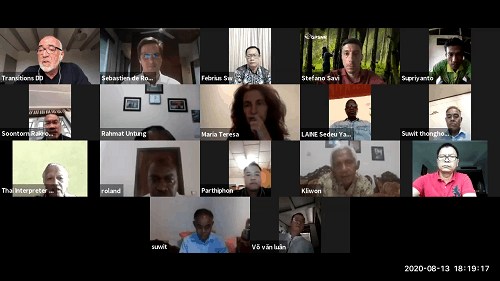
13 August 2020 – Kliwon is a natural rubber smallholder from Jambi Province, Indonesia, whose work with natural rubber started in the 80s. This evening, however, he’s doing something quite different from his usual rubber farming activities. Dressed in a light brown shirt of traditional Indonesian batik, Kliwon’s wiry frame and distinct head of white hair is visible on the computer and mobile phone screens of over 20 other natural rubber smallholders from around the world. He is one of the participants in GPSNR’s first international call for smallholder members to prepare them for the upcoming General Assembly.
At 68, Kliwon is one of the more experienced smallholder members in GPSNR. Today, he is being joined by other smallholders. Some, like H Nasoro Nie, a fresh-faced young lady from Vietnamese province of Dak Lak, are as young as 24, almost one third Kliwon’s age. Despite the difference in years, these smallholders all have something in common. They recognize the increasing importance of a sustainable global natural rubber value chain, and are actively participating in efforts to transform the industry.
It is the first time that the smallholders are meeting each other on an international level. Prior to this, they have been engaged in national level calls, making their presentations to their fellow natural rubber farmers from the same country. More than 20 natural rubber smallholders are present on the call – a handful are unable to join as they live in remote locations where access to the internet is not always a given. Unfortunately, the four smallholders from Myanmar are unable to connect due to heavy flooding in the areas where they live.
As with any meet-and-greet, communication is of paramount importance, and this includes being able to understand and be understood regardless of the language you speak. Here, five foreign languages come into play: Bahasa Indonesia, French, Myanmar, Thai and Vietnamese. Using Zoom’s in-built interpretation feature, the smallholders are able to access special audio channels within the meeting, where they can hear everything that is said, interpreted into their local language. Thanks to sustained funding from Partnerships for Forests (P4F), a UK aid funded program, GPSNR was able to engage interpreters to perform this simultaneous interpretation remotely. The funds were also channeled to the appointment of Transitions, a sustainable development consultancy agency, who is facilitating the international sessions with smallholders.
The call begins with opening remarks by GPSNR Director Stefano Savi, followed by a quick runthrough of the agenda and an overview of the global natural rubber market.
Then, the smallholders start to introduce themselves. We hear from those from Indonesia, then Thailand, Vietnam, Côte d’Ivoire, Ghana and Brazil. They share about the size of their natural rubber plantations, their activities around rubber farming. Many of them are actively involved in the natural rubber scene in their country, from Baroan Roland, who is the Chairman of the Association of Natural Rubber Producers of Côte d’Ivoire (APROCANCI) to Thailand’s Soontorn Rakrong, who has been involved in initiating dialogue with the Thai government for policy development around fair tenure and land use rights. As one smallholder speaks in their native language, the interpreter interprets, in real-time, their words into English for the rest of the participants. The other interpreters, picking up the English interpretation, convey it to the other smallholders in their respective native languages.
All too soon, two hours fly by. There is just enough time for a short Question and Answer segment. At the end of the night, it’s clear that the smallholders are excited to have more opportunities to get to know each other and further discuss the issues around natural rubber that they all similarly share regardless of geography. —
The 2nd GPSNR Smallholder International Call will take place on 27 August 2020.