


Platform Updates for August

Share This Post

Baseline Reporting Requirements Pilot Testing

The Baseline Reporting Requirements, developed by the Policy Toolbox Working Group, is a document that indicates certain qualitative and quantitative sustainability data to be reported to the Secretariat. Back in June, we invited GPSNR members to volunteer to be part of a pilot testing for these Baseline Reporting Requirements. Since then, we have had 12 member companies coming forward to contribute their time and efforts to the exercise. These member companies consist of processors, tire makers and one car maker. As part of the pilot testing, each company was given access to a secure reporting platform where they could input the necessary reporting data.  

The Secretariat has conducted in-depth interviews with ten of the volunteer members so far. Following this, all feedback and data received will be reviewed, with the view to refine the Baseline Reporting Requirements in preparation for the formal launch in the near future.

Strategy and Objectives Working Group

The Working Group has commenced an extension of the study on Human Rights and Labour Rights’ Risk Mapping in the Global Natural Rubber Value Chains conducted by independent consultants James Griffiths & Associates Sàrl. This extension will see the consultant preparing an Annex to the main report that focuses on “equity issues” in the global natural rubber value chain. The objective of this extension is to understand current levels of equity (or inequity) along the natural rubber supply chain and identify where these could pose a threat to ecological, social and economic sustainability.

The report will also touch on how GPSNR’s current definition of “equity” compares to definitions used by others in related sectors or related risk assessments, providing suggested revisions to GPSNR’s definition where appropriate.

The Equity sub-Group published four Requests for Proposals (RFPs) in mid August, for studies on the Living Income Gap in the global natural rubber value chain. These initial studies will focus on collecting information and metrics from four countries: Côte d’Ivoire, Indonesia, Myanmar and Thailand. The deadline for submission of proposals is over. The Secretariat has received several proposals and will be evaluating them before presenting them to the sub-Working Group for consideration.

‘Traceability and Transparency’ Working Group

The two Requests for Proposals (RFPs) that the Working Group has been developing were also published in mid August. The deadline for submission of proposals was last week.

The first RFP is for a study that will assess the methodologies of existing traceability and transparency tools and how they match up against the traceability and transparency requirements of GPSNR members. 

The second RFP is for a study that will compare existing and currently under-development GIS databases and mapping tools along with their mapping approaches through research and interviews.

The Secretariat has received several proposals and is in the process of evaluating them. The Working Group will make the final decision thereafter.

More To Explore

Members

Continuing the Conversation with GPSNR Topic Talks – The Sumatran Rubber Pilot

The GPSNR Topic Talks webinar series is organised by the GPSNR Secretariat and presented by GPSNR members. The webinars cover several themes around sustainability and the global natural rubber supply chain.

The Topic Talks series continued on the 17th of March with Dr. Michael Steuwe from WWF US and Gerald Tan from HeveaConnect presenting on the Sumatran Rubber Pilot.

The Sumatran Rubber Pilot (SRP) is a voluntary, self-financed collaboration of rubber supply chain players and technical experts interested to facilitate the production and trade of transparent and sustainable natural rubber. The participating processing mills, tire makers, civil society organisations, technology providers and financial institutions have three major objectives:

  • Demonstrate how rubber’s downstream can work together to make its upstream more sustainable.
  • Identify, test, evaluate, and report on what it takes to achieve, and how to pay for transparent sustainable natural rubber supply chains.
  • Develop “Proof of Concept” approaches from and for GPSNR discussions on policy requirements and implementation, transparency and traceability, capacity building, and shared responsibility.

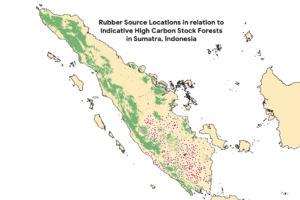
Within a few months of the project launch in July 2020, SRP’s four rubber processing factories, managed by the Halcyon Agri and ITOCHU groups, had traced up to 1 year of rubber supplies to the village and/or sub-district of origin based on self-declarations by their supplying dealers. These approximate origins of the rubber sources were filtered through WWF Indonesia’s new environmental risk assessment and management tool which identifies High Conservation Value Areas and High Carbon Stock Forest for the whole island of Sumatra. The results allow processors and their respective downstream supply chains to focus their sustainability work with farmers on priority areas.

The SRP partners are enhancing dealer self-declarations with digital apps such as CropIn and Hamurni to assess farms’ potential environmental, social, equity, labour and legal issues accurately and to address them.

As GPSNR adopts principles and criteria for what constitutes transparent and sustainable rubber, the risk assessment algorithms will be adapted to flag compliant rubber accordingly. This is increasingly important for rubber’s downstream as companies’ Environmental, Social, Governance (ESG) impacts are becoming key evaluation criteria for investors and financiers who will demand the disclosure of the relevant information. In a parallel development, new supply chain laws will require major companies like the world’s car and tire makers to be responsible for the environmental and social impacts of their supply chains. The collection and analysis of detailed data on upstream supply chains will have to become an essential part of doing business and SRP partners are working to respond appropriately to these changes.

While continuing to focus on increasing the resolution of tracing rubber to its origin and collecting the respective data, SRP will now begin finding ways to best address the social, equity, labour, and legal issues that may have come up in supply chain assessments. 

The SRP is a voluntary, open and flexible platform of like minded partners interested in testing a diversity of approaches to achieve supply chain transparency and sustainability, and welcomes interested rubber supply chain actors to reach out and discuss how they might join the collaboration. GPSNR members interested in participating in the SRP should reach out to the GPSNR Secretariat to get involved in the project.

The recording and slide deck from the webinar can be accessed with the links below:

  1. Link to Recording
  2. Link to Slide Deck

Members

GPSNR Working Groups Update: January 2021 (Members Version)

Strategy and Objectives Working Group

In our December update, we reported that the Working Group would be conducting interviews with the shortlisted candidates who had responded to the Request for Proposal for a study on environmental impacts, and risks, in the natural rubber value chain. The Working Group has since completed their interviews and will soon be making a decision on who to award the contract to.

The refinement of GPSNR’s Theory of Change is also underway, with a planning call having taken place on Monday this week. The call involved nominated representatives  from across all GPSNR’s Working Groups, working to chart the plan for a collaborative effort to refine the Platform’s Theory of Change.

In other news, several Thai smallholders have been onboarded into the Working Group and, after an introductory call with the Co-Chairs,  are now participating in the Working Group calls.

As the Equity Sub-Group prepares to present the living income studies to GPSNR members, more details will be conveyed to members nearer the date. 

‘Policy Toolbox’ Working Group

Following the approval of the GPSNR Policy Framework, the Policy Toolbox Working Group will develop Implementation Guidance and future Reporting Requirements as they pertain to the specific policy components in the framework.  

In order to achieve this, a Request for Proposal (RFP) has been posted for a fixed term consultancy to facilitate the development of the Implementation Guidance and Reporting Requirements for each of the three stakeholder categories: natural rubber producers/processors and traders, tire makers and other natural rubber product manufacturers, and auto makers and other end users.  GPSNR members are invited to circulate the RFP to any relevant contacts who might be interested in submitting proposals for this work. The deadline for submission of proposals is 5 February 2021.

The Implementation Guidance and Reporting Requirements will vary depending on where a member company sits within the natural rubber supply chain. As such, GPSNR will invite the creation of category focus groups to enable broader participation of members from the three stakeholder categories (although focus groups can also include members from other stakeholder categories). The details on recruitment for these focus groups will be announced sometime next month.

Apart from facilitating the development of category-specific Implementation Guidance by reviewing guidance and requirements from other initiatives, the consultant will also facilitate discussion sessions with the focus groups to finalize the implementation guidance for each stakeholder category.

‘Capacity Building’ Working Group

In 2020, the Working Group proposed national capacity building strategies for four countries as a starting point. Following the Executive Committee’s endorsement of the strategies, the Working Group is embarking on the next step of putting these plans into action on-the-ground. The Working Group is looking for interested members to form National Sub-Groups mandated to oversee, guide and implement the strategies. The Working Group will conduct a webinar on 17 February to share the strategies with GPSNR members. Check out our article, ‘From Strategy to Implementation: Next Steps for Capacity Building’ for more on this story.

‘Traceability and Transparency’ Working Group

The two studies around traceability and transparency tools and technology commissioned in 2020 by the Working Group are ready to be shared with GPSNR members. Read our article, ‘Seeing Through to a Solution: Traceability and Transparency Tools and Technology Studies’ for more on this topic.

Smallholder Representation Working Group

The Working Group’s revised Terms of Reference (ToR) was approved by the Executive Committee during its monthly call in January. Under the revised ToR, the Smallholder Representation Working Group has identified two main objectives for its work moving forward: the first, to support the creation of an active smallholder community within GPSNR and the second, to extend the on-boarding of smallholders from rubber producing countries. The Working Group will be planning its activities for the year head, ensuring that they support and contribute towards achieving these new objectives. 

As a start, the Working Group will be looking to onboard smallholder members into the group, as well as facilitate the organization of the next Smallholder Category Call.

Scroll to Top