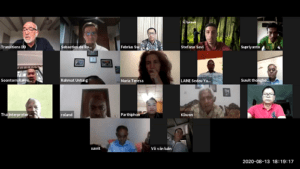
Strategy and Objectives Working Group Update – November 2019

Strategy & Objectives Working Group continues to work on the desired state document and Theory of Change. Strategy 1, 2, and 3 Working Groups kicked off the first calls with the background information on how their works are contributing to the design of GPSNR Assurance Model, which will be recommended by consultant Liza Murphy.

Share This Post

Desired state V1-0 and Theory of Change documents were circulated among Strategy & Objectives Working Group in November. Comments from the members were consolidated and will be responded to in the next version.  Theory of Change will be finalized and submitted to the Executive Committee in order to be approved at the General Assembly in March 2020.

Strategy 1 ‘Policy Toolbox’ Working Group primarily agreed on the scope of work. The desired state V1-0 serves as a baseline document which will be cross referenced with Accountability Framework initiative in order to come up with policy framework that will be applicable to GPSNR members.  The drafters volunteers will present the first draft of a policy framework to the working group members in December 2019.

Strategy 2 ‘Capacity Building’ Working Group members worked on defining priority geographical areas based on current production volume and emerging trend of natural rubber production.  The existing stakeholders and capacity building activities in those countries are being identified in order to design the plan for GPSNR on capacity building.

Strategy 3 ‘Traceability and Transparency’ Working Group members were requested to list down traceability tools that are currently in use and/or traceability tools that could be potentially used for natural rubber supply chain.  In December they will analyze the attributes of each tool to see the compatibility and applicability for transparency and risk assessment.

All the 3 working groups including Strategy & Objectives and Smallholders Representation Working Group members are given access to GPSNR discussion forum which aims to increase transparency and synergy among the working groups. You will be able to see the discussions and the documents of all the working groups but will be able to contribute only to the groups you signed up for.  Please contact nigel@gpsnr.org for your log-in credentials.

More To Explore

Natural Rubber Supply Chain urges European Parliament not to amend essence of EUDR

PRESS RELEASE

Natural Rubber Supply Chain urges European Parliament not to amend essence of EUDR 


Singapore, 13 November 2024: As Members of the European Parliament (MEPs) convene to vote on 14th November on the proposed amendments to the EUDR, the Global Platform for Sustainable Natural Rubber (GPSNR) urges them to provide legal certainty around the implementation timeline and not re-open the regulatory text.

Along with the European Tire and Rubber Manufacturers Association, GPSNR has written to the European Parliament earlier this month to ask MEPs to use the proposal for amendments solely to create certainty about the timeline and not change the substance of the regulation. 

GPSNR members represent almost 60% of the global NR demand and include OEMs, manufacturers of rubber products, producers and traders of natural rubber, smallholder farmers, and civil society. All these stakeholders have worked tirelessly and swiftly to comply with the regulation, whose original date of implementation is weeks away. 

Notwithstanding this, GPSNR believes MEPs have a key role in ensuring the European Commission uses the proposed additional 12 months for implementation to resolve the remaining issues, particularly the functioning of the information system and the necessary secondary legislation, including on the benchmarking system as well as completing the planned review of the relevant products in Annex I by June 2025. 

The natural rubber industry strongly supports the vision of the EUDR and GPSNR members have been working on committing to and implementing strong environmental and human rights related principles in their operations for a long time. These efforts need the support of a fair and transparent regulatory environment that can help the industry move further ahead on their efforts on deforestation and human rights. 


END

About GPSNR: 

GPSNR is an international membership driven platform set up to define sustainability for the natural rubber value chain. It brings together various stakeholders to a common ground based on fairness, equity and environmental sustainability. More on sustainablenaturalrubber.org


For more information, please contact:

Bani Bains

Communications Director

Email: bani.bains@gpsnr.org

Ph: +65 97268165


News

Following the Conversation with GPSNR Topic Talks!

The GPSNR Topic Talks webinar series is organised by the GPSNR Secretariat and presented by GPSNR members. The webinars cover several themes around sustainability and the global natural rubber supply chain.

The series kicked off on 27 October with a presentation by Philippe Thaler from CIRAD, on the implications of EU legislation on imported deforestation.

The second webinar’s theme was on smallholder solutions and featured two separate presentations. “A landscape-level approach to inclusion and capacity building for rubber smallholders” was presented by Rizki Permana from SNV, Widyantoko Sumarlin from Kirana Megatara, and Tony Hill from Proforest. Speaking from experience with the Kelola-Sendang project in South Sumatra, the presenters explained how SNV, with Proforest support, worked with rubber smallholder groups in the jurisdictional initiative, which helped to forge new links between the smallholders and a crumb rubber factory buyer in the Kirana group. 

Next, “Exploring Smallholder Solutions in the Rubber Sector – The Processing and Sale of Rubberwood to Support Smallholder Financing in Indonesia” was presented by Amy Smith from WWF, Gerald Tan from HeveaConnect, with Renée Corstens and Remco Geervliet from Financial Access. This presentation shared the findings of a study which analyzed the potential of rubberwood to serve as a mechanism to support smallholder financing in Indonesia.

The next theme is Assurance and smallholders, and how we can learn from existing schemes. PEFC’s CEO Ben Gunneberg presented a webinar last night, elaborating on PEFC’s approach to standard-setting and certification. He also showcased PEFC’s current collaborative projects with their national members and companies to support smallholder producers, and how these will benefit GPSNR members and the work GPSNR is engaged in.

Continuing with the theme of Assurance and smallholders, FSC will be presenting on 8 December, an overview of smallholder certification solutions.

We are also pleased to announce an addition to the Topic Talks lineup: ‘REDD+, are carbon credits impacts overstated?’. This new presentation, jointly organized with GIZ and which will be held on 10 December, puts the spotlight on reducing emissions from deforestation and forest degradation (REDD+) with an introduction to the REDD+ methodology, followed by a discussion with the authors of a recently published study, “Overstated carbon emission reductions from voluntary REDD+ projects in the Brazilian Amazon”. 

GPSNR members may contact the Secretariat to register for the upcoming Topic Talks.


Assurance and Smallholders: Learning from Existing Schemes Part 2

“FSC Smallholder Certification Solutions”

8 December | 7PM (GMT+8)

Presented by: FSC

The presentation will cover FSC’s solutions for smallholders to become certified. First, an overview of the evaluation of certification solutions for smallholders will be given. FSC’s existing solutions will be covered, with a focus on the benefits for FSC Group Certification. Next, solutions in the pipeline will be covered, addressing the impact of pilot projects and highlighting success stories.

REDD+, are carbon credits impacts overstated?  

10 December | 3PM (GMT+8)

Jointly Organized by: GIZ 

Presented by: GIZ and authors of the study

Using REDD+ projects to offset carbon emissions through avoided deforestation and the financial support of local communities is popular but also highly debated. Especially, voluntary REDD+ projects are regularly criticized as inefficient or even greenwashing. This presentation will provide an introduction to the REDD+ methodology. The authors of a recent critical study, “Overstated carbon emission reductions from voluntary REDD+ projects in the Brazilian Amazon” will then present their findings and suggestions as a basis for discussion.

Scroll to Top