
Secretariat Update – October 2019

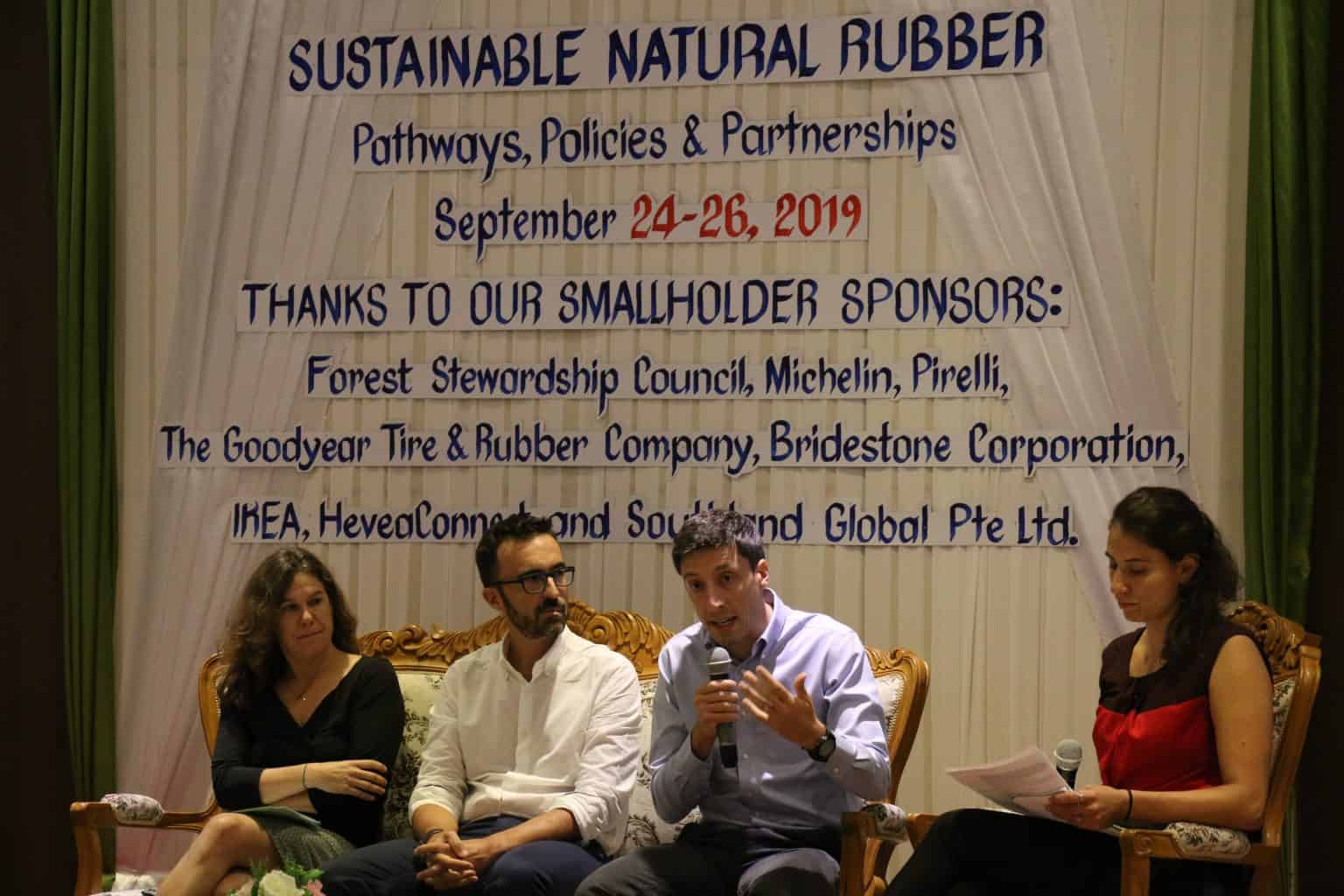
On September 24-26th, stakeholders from around the world and across the rubber value chain came together in the city of Hat Yai - the rubber hub in South of Thailand – to attend a three-day workshop organized by the Rainforest Alliance, Mighty Earth, Einhorn Products, Earth Net Foundation and supported by the Prince of Songkhla University. 

Share This Post

In attendance were farmers, processors, tire companies, apparel and footwear brands, NGOs and governmental representatives, all together over 100 participants. 

 The event offered a space for the diverse set of attendees to discuss the challenges and opportunities experienced by the rubber sector in the adoption and implementation of individual and global commitments to sustainable and ethical rubber with a focus on solutions. What set the workshop apart from the regular workshop we all know, was the addition of a field-excursion to two rubber-plantations operating under differing production models: a farm applying agro-forestry with a mix of native hardwoods and rubber trees and one fully developed diversified community agro-forestry farm. Additionally, instead of solely focusing on NGOs, companies and governmental representation (as the regular workshop often does), delegations from a number of farmer associations representing various countries also attended and provided key input to inform discussions from the farmer’s perspective.

Days 2 and 3 of the workshop were focused on forming partnerships and generating solutions to begin working towards a transformed natural rubber supply chain which delivers value to all actors from the farm to the end user.  Break out groups comprised of farmers, processors, brands, NGOs, tire companies and government representatives discussed topics such as traceability, policy implementation and capacity building for smallholders. Each break out group then categorized their discussions into short term actions, long term actions, barriers and learning curves which will be summarized into a collective call to action by the organizing team.  One of the most powerful outcomes was an overall agreement amongst all stakeholders in attendance that to truly bring about positive transformation we must all work together towards a shared vision.

A public summary of the event will be shared in the coming days, please contact Samantha Morrissey (smorrissey@ra.org) or Margaret Kran-Annexstein (margaret@mightyearth.org) with any questions.


More To Explore

News

GPSNR unveils first ever collective grievance mechanism in the natural rubber industry

Singapore, 15 June 2021: The Global Platform for Sustainable Natural Rubber (GPSNR) has unveiled the natural rubber industry’s first ever grievance mechanism. The process provides a platform to address complaints against its members. It also creates a space for collaboration, improved relations and amicable and meaningful solutions amongst stakeholders in the natural rubber value chain. In situations where this is not possible, the Grievance Mechanism offers recourse and seeks to ensure remedy is provided to impacted parties.  

Members and non-members can now use this process to address existing concerns regarding a member’s violation of membership requirements or other guiding principles of the Platform. The mechanism seeks to provide transparency and predictability in the process and requires resolutions to be reached in a timely manner. It asserts particular emphasis on finding expedient and impartial resolution for high risk cases involving impact on communities or the environment, through the creation of a Complaints Panel. This panel will be made up of volunteer members, an external expert, and will judge whether and what kind of corrective actions need to be taken. 

The process is comprehensive and risk-based, and is designed with the aim  to bring parties to viable solutions and concrete remedy through a transparent process. ‘’The mechanism makes it possible for third parties to address issues with GPSNR members through an unbiased yet amicable process. The focus of the process will always be on finding solutions that work for everyone and provide both Complainants and Respondents with a transparent platform for resolution and accountability’’ said GPSNR Platform Director Stefano Savi.  

In slightly over two years, GPSNR has established itself as a platform working towards systemic change in the natural rubber supply chain. The existence of a strong redressal process like this grievance mechanism showcases its commitment to a culture of fairness and transparency.  

-Ends-  

About GPSNR:  

GPSNR is an international membership driven platform set up to define sustainability for the natural rubber value chain. It brings together various stakeholders to a common ground based on fairness, equity and environmental sustainability. GPSNR member companies account for almost 50% of the global natural rubber volume.  

More on sustainablenaturalrubber.org 

For more information, please contact: 

Bani Bains 

Communications Manager 

Email: bani.bains@gpsnr.org 

Ph: +65 97268165 

News

GPSNR Working Groups Update: November 2020

Strategy and Objectives Working Group

The Strategy and Objectives Working Group is currently revising its Terms of References (ToR) to better reflect the plans for further developing GPSNR’s Theory of Change. 

The Request for Proposal (RFP) for a study on environmental impacts, and risks, in the natural rubber value chain has been published. GPSNR members are invited to circulate the RFP to any relevant contacts who might be interested in submitting proposals for this work. The deadline for submission of proposals is 27 November 2020.  

The Equity sub-Group has received the first drafts of the Living Income Gap studies for Indonesia and Thailand, and these are currently in review by both members of the sub-Group as well as the engaged consultants. The extension of the study on Human Rights and Labour Rights’ Risk Mapping in the Global Natural Rubber Value Chains conducted by independent consultants James Griffiths & Associates Sàrl, which focuses on issues of equity, is near its completion phase.

‘Policy Toolbox’ Working Group

The revised Terms of Reference (ToR) for the Policy Toolbox Working Group is being reviewed. Following approval of the ToR, the Working Group will be in a good position to move forward on development of the implementation guidance for stakeholder groups, as well as policy equivalents for civil society organizations and smallholder producers.

The Working Group has also conducted a preliminary revision of the Baseline Reporting Requirements following feedback from GPSNR member companies during the pilot testing stage. To find out more about the Baseline Reporting Requirements pilot testing, check out our latest article, ‘Updates on the GPSNR Baseline Reporting Requirements Pilot Test’.

‘Capacity Building’ Working Group

The Working Group is in the midst of revising its Terms of Reference (ToR) to cater to the shift in focus to implementation plans. The Working Group is also putting together a Good Agricultural Practices (GAP) Task Force that will work to identify and/or refine guiding principles for GAPs appropriate for the sustainable production of natural rubber that cater to both Industrial Plantations and Smallholder Farmers. The goal of this Task Force will be to create a document stating a high-level, international set of GAPs that can be disseminated to national Capacity Building groups for adaptation to local contexts.

The Task Force is currently looking for smallholder members who have experience in Good Agricultural Practices to join the Task Force. They will have the opportunity to collaborate and create the GAPs together with other Task Force members. Interested smallholder members are welcome to contact Aidan for more information.

‘Traceability and Transparency’ Working Group

The Working Group is reviewing the two studies that were commissioned earlier. Plans to review the Working Group’s Terms of Reference (ToR) are also in the works as its members consider the next steps vis-à-vis the findings and conclusions from the studies. 

Smallholder Representation Working Group

Following the fourth international call with smallholder members, the Working Group has consolidated the responses from smallholder members who indicated their interest in participating in our Working Groups. A plan is underway to onboard these smallholder members into the various Working Groups.

Scroll to Top