
GPSNR Working Groups Update: November 2022

Share This Post

Strategy and Objectives Working Group

The risk subgroup, which sits under the umbrella of this working group, has studied the various definitions of polygons in the EU Deforestation Regulation through an extensive survey conducted for GPSNR PPT members.

The assurance model subgroup continues to work on the KPIs set during the last in-person meeting as they are to be finalised at the end of the year and presented during the next in-person and hybrid meetings in January 2023.

Smallholder Representation Working Group

After completing two rounds of pilot agroforestry workshops for smallholder members in Indonesia, and Cambodia, the working group is working on concluding how GPSNR should approach agroforestry capacity building in the long term. This work stream aims to integrate priorities of smallholders with developing long-term income diversification strategies through the Capacity Building Working Group.

They are also busy holding focus group discussions towards the smallholder policy equivalent and evaluating proposals received for the GPSNR-HCSA Smallholder Toolkit Field Trials.

Policy Toolbox Working Group

The group is working on finalizing the TORs for the Year 1 Reporting Review to be conducted in the first quarter of next year. They are also assessing if any changes to the reporting framework and its details (i.e. process, extensions, questions) are needed based on the Year 1 Reporting Review results.

Capacity Building Working Group

The group is currently evaluating proposals to appoint a software developer for the second phase of the GPSNR Knowledge Sharing Platform. They have kicked off the Disease Fighting Project with SNV-IRRI in Indonesia, after having recently completed the first milestone of the SNV-Proforest GAP coaching in the country. They continue to seek members’ funding for capacity building projects in Indonesia (second stream of disease fighting) and Cote d’Ivoire (training centres). To know more, you can find the project details here.


Shared Responsibility Working Group

  The group has completed 40% progress on the agreed deliverable for each pillar, and is continuing to work towards completion ahead of the meetings in January. The WG is also working to align with the Assurance Model Task Force to advance the Shared Responsibility agenda. 
More To Explore

News

The Start of Change in the Natural Rubber Supply Chain

By James Chang Wen Jie, Michelin

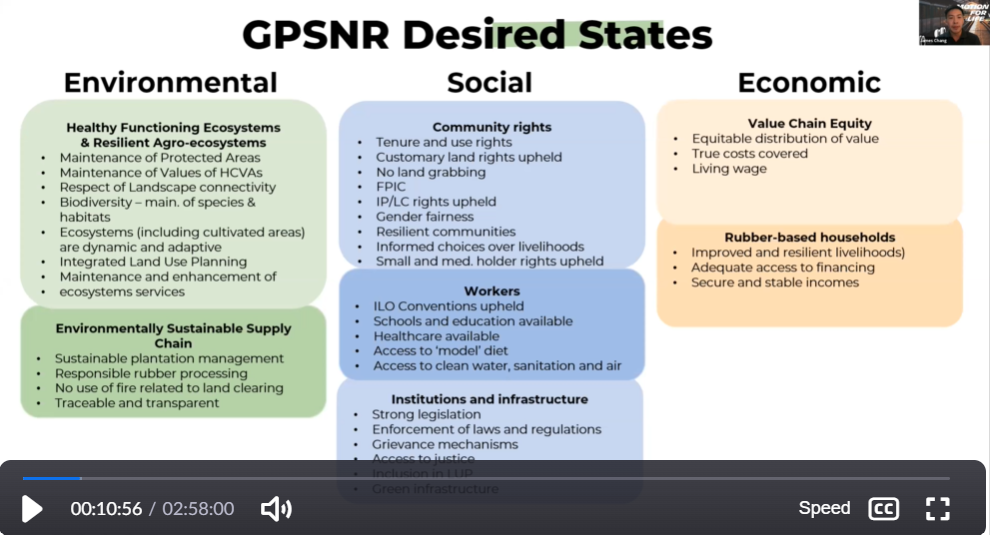
In February 2022, the Global Platform for Sustainable Natural Rubber released its Theory of Change (ToC), a document which articulates how the platform aims to positively impact the supply chain and achieve its desired states.  As a representative of my company Michelin at the platform, I have been part of this intensive, fulfilling task for the last year.

While I had some previous experience with ToC frameworks for individual projects, this was the first time I was engaged in one at a multi stakeholder platform level. The major difference here, and one emblematic of the ‘GPSNR multi-stakeholder experience’, was that we needed to integrate as many perspectives and expertise as we could, from all of GPSNR’s working groups and member categories. After all, bringing this theory of change to life is a task that will eventually fall on every stakeholder represented in GPSNR. If we wanted a document that the platform could truly rally around, we needed a co-creation process built on inclusivity as well as accountability.

My fellow task team members Martin Hollands (BirdLife International) and James Laimos (Goodyear) can attest to the fact that the journey was hard work. Yet, over the two half-day platform workshops and numerous additional consultation sessions with working group chairs and interested members, the strength of the platform showed itself in the depth of insights provided during discussions, and in the rigor of the final document. I am confident we would not have arrived where we did without the unique mix of experiences and operating contexts that members had. As a representative of my organization, the exposure to a wide range of perspectives from all along the natural rubber value chain is also a valuable input to our own sustainability journey, alongside and in addition to GPSNR.

Image 1: A screenshot of me presenting how GPSNR’s Desired State will be aligned with our Theory of Change at a workshop in 2021

The most visible output of this work is this interactive web-document accessible on the GPSNR website. While it is an easy and simple introduction to our work, it is nonetheless a result of a rigorous and intensive process, which required the investment of many stakeholders (including many hours of hard deliberation by the task team!). This of course belies the question:

Does theory matter and was this time really worth it?

It’s a question the task team asked itself a number of times as well. However, my own journey in sustainability has taught me that while it is tempting to jump straight to action, issues on the ground are often more complex than they seem, and well-meaning actions can lead to unintended outcomes. We therefore not only need to know where we are going, but also need to map and understand the series of events or actions that will get us there. A theory of change exercise allows us to dig deep into the root causes of the current situation, leveraging on the experience and expertise we have across working groups and stakeholder categories to work on plans that tackle issues at their core.

Articulating the theory of change at this juncture in GPSNR’s journey also allows for a ‘stock take’ before the platform accelerates into implementation. The journey towards sustainability in the natural rubber supply chain is a complex one which requires a careful balance of environmental, social, and economic spheres. It also requires coordinating work on multiple action areas (i.e., the work of GPSNR’s many working groups) to make sure that our activities truly address identified root problems without any major gaps.

In fact, these conversations did end up identifying some gaps, and spurred us to explore solutions. For example, a member brought up the point that real impact across the world’s 6 million smallholders would mean that GPSNR would need some way to multiply its impact beyond farmers benefited through direct involvement in GPSNR or its capacity building programmes. Further conversation and the sharing of case studies from experiences in other commodities identified that a key intervention to tackle will be to empower networks of farmers that can promulgate good practices in, and beyond their communities.

As the world emerges from the aftermath of the pandemic and unprecedented supply chain disruptions, being clear on what we need to do to truly make an impact is more important than ever. I hope that interacting with GPSNR’s Theory of Change will give you a good idea of where we’re headed, and how we hope to get there!

News

Secretariat Update – December 2019

What does it take to revive the Natural Rubber economy? Could the Natural Rubber 2.0 be the ultimate game changer for the new NR economy? These were some of the difficult questions discussed at the 15th Global Rubber Conference.

Hosted in Hainan, China from 12-14 December, with a theme on ‘Natural Rubber 2.0: The Game Changer’, the conference represented a very exciting event and opportunity for networking and knowledge sharing for Natural Rubber professionals in Asia, and in the rubber industry globally.

GPSNR Director Stefano Savi participated in the conference as a speaker and panel discussion member, to share updates with the industry participants about the progress of the Platform and its working groups. “Sustainability should not be seen as a threat by producers, but an opportunity to place natural Rubber as a leader in the global commodities landscape, best placed to deliver on the UN SDGs and the 2030 agenda.” said Stefano during his remarks, adding that “GPSNR is here to support smallholders in this journey, and ensure that the cost of this sustainable shift will not be borne by farmers, but supported by the industry through the Global Platform.”

Amidst the current backdrop of the fourth industrial revolution, the conference was a good opportunity to discuss the convergence of artificial intelligence and data technology as new solutions to address innovation gaps and current low demand for NR across the globe. It is obvious that from drones to satellite images and sensor technology, the natural rubber industry is poised for a radical change. So, what role will sustainability play in this desired and required industry shift? Will the natural rubber industry take advantage of this opportunity to improve its practices, maximise its positive impact, and reposition itself as a leader in innova

Scroll to Top