Indonesia is the world’s second-largest producer of natural rubber, a material vital to the global tire and automotive supply chain, which consumes more than 70% of global production. However, the country’s smallholder farmers, who produce the majority of this rubber, face mounting challenges, including aging tree stock, limited technical support, and decreasing participation from younger generations.
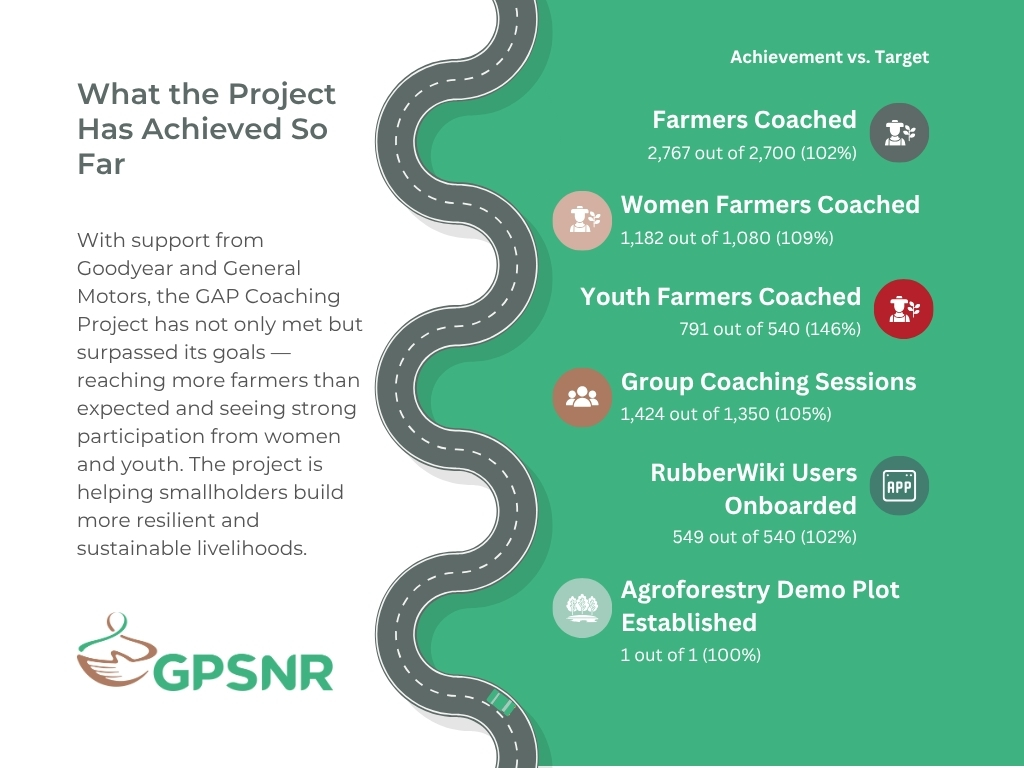
Figure. 1
To help address these structural issues, The Goodyear Tire & Rubber Company has supported the Smallholder GAP Coaching Project since its launch in 2022 under the Global Platform for Sustainable Natural Rubber (GPSNR). In its third phase (September 2024 to September 2025), Goodyear is joined by General Motors (GM) as a co-funder. As shown in Fig. 1, this phase has exceeded its target, reaching 2,767 smallholders in South Sumatra (target: 2,700).
Coaching the Next Generation
This project established participation targets of at least 40% women and 20% youth. By July 2025, these benchmarks were not only met but exceeded — 1,182 women (109%) and 791 youth (146%) have received coaching.
One of these youth participants is a 24-year-old farmer from South Sumatra who manages a 1.5-hectare rubber plot inherited from her family. Despite challenges, she continues to tap daily and maintain the farm herself. Through the project, a farm assessment revealed previously undiagnosed leaf disease. With targeted support, she learned to identify early symptoms, adopt better tapping practices, and implement yield-improving interventions.
Planting for the Future, Earning in the Present
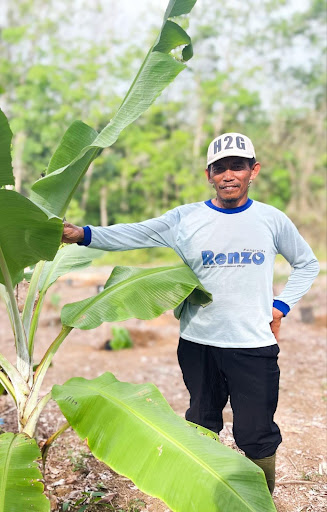
 In Musi Rawas, the project’s sole demonstration plot highlights how regenerative practices can offer both environmental and economic benefits. The 0.25-hectare agroforestry site, managed by 54-year-old Subarni, was converted from a 33-year-old jungle rubber plot into a more productive and diversified system.
With support from the project implementation team, Subarni replanted 120 improved rubber clones and intercropped the land with bananas, peanuts, and durian. The peanuts alone are expected to yield approximately 150 kilograms every four months, beginning in July 2025 — a critical alternate source of income during the long replanting period.
“Normally, you wait years after replanting rubber before seeing any return,” he said. “Now, I see income while waiting too, and that gives me the motivation to keep going.”
Beyond immediate income, long-term investments like durian, a high-value crop locally known for its premium quality, reflect how smallholders are planning beyond subsistence. The demonstration plot now serves as a practical model for neighbouring farmers exploring integrated, sustainable rubber production.
Digital Tools for Real-World Change
Complementing in-person coaching is RubberWiki, a mobile app developed to extend learning beyond the field. As of July 2025, 549 farmers have been successfully onboarded, just over the initial target of 540.
The app offers training modules and real-time rubber price updates, which have proven especially valuable. “I check it almost every day,” said 40-year-old Partini, who uses it to monitor price fluctuations. Others, like 35-year-old Ari, revisit coaching content through the app in the evenings.
By offering flexible, on-demand learning, RubberWiki helps ensure that farmers can continue to build knowledge and confidence well after formal sessions have concluded.
A Model for Shared Industry Commitment
Goodyear has supported the GAP Coaching Project since its earliest days, recognizing that smallholders form the backbone of the global natural rubber value chain. In Phase 3, Goodyear invited General Motors to co-fund the initiative, reflecting a growing movement toward shared accountability across the supply chain.
“Smallholders are the foundation of the natural rubber industry,” said Chuan Heng, Associate Director, GOCPL Natural Rubber, Goodyear. “And, Goodyear, as part of GPSNR, engages in programs that support the natural rubber industry’s move towards a more sustainable supply chain.“
General Motors’ contribution also highlights its broader commitment to responsible sourcing. By funding smallholder-centred programs like this, GM is helping to ensure that sustainability principles are embedded at the very beginning of the rubber lifecycle, where real transformation begins.
Together, Goodyear and GM have shown that when downstream actors work together, the impact is tangible: higher participation from women and youth, expanded access to digital tools, and better agronomic outcomes for thousands of smallholders.