
Shared Responsibility in Action: Goodyear and GM Support Smallholder Rubber in Indonesia

Share This Post

Indonesia is the world’s second-largest producer of natural rubber, a material vital to the global tire and automotive supply chain, which consumes more than 70% of global production. However, the country’s smallholder farmers, who produce the majority of this rubber, face mounting challenges, including aging tree stock, limited technical support, and decreasing participation from younger generations.
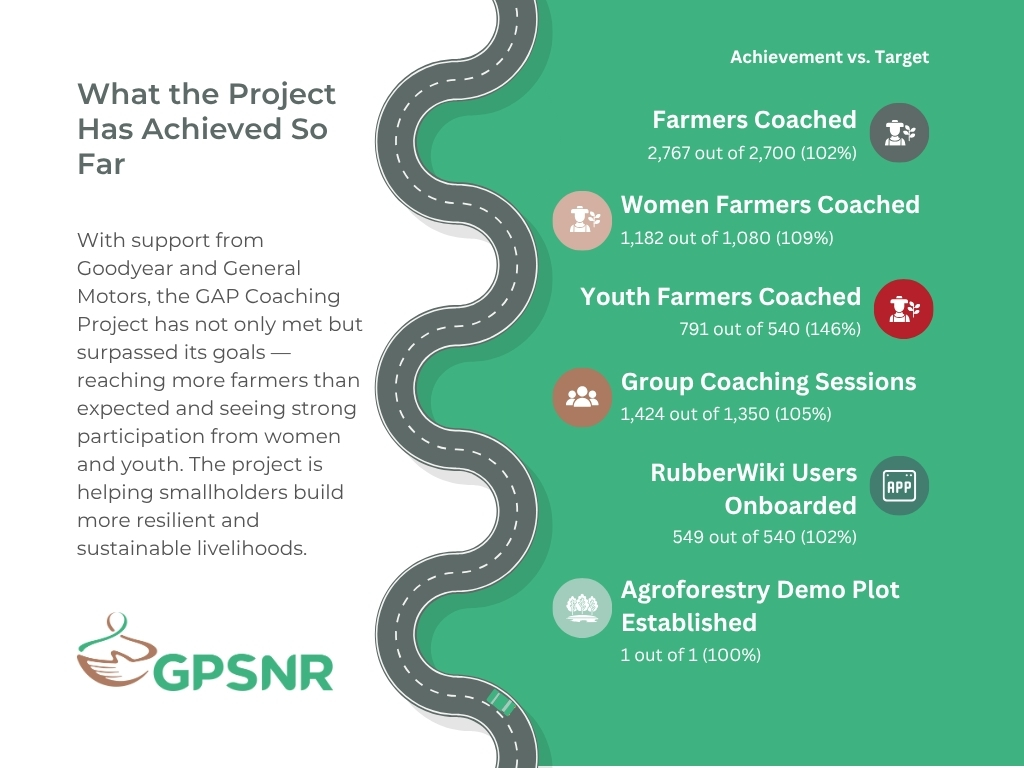
Figure. 1

To help address these structural issues, The Goodyear Tire & Rubber Company has supported the Smallholder GAP Coaching Project since its launch in 2022 under the Global Platform for Sustainable Natural Rubber (GPSNR). In its third phase (September 2024 to September 2025), Goodyear is joined by General Motors (GM) as a co-funder. As shown in Fig. 1, this phase has exceeded its target, reaching 2,767 smallholders in South Sumatra (target: 2,700).


Coaching the Next Generation

This project established participation targets of at least 40% women and 20% youth. By July 2025, these benchmarks were not only met but exceeded — 1,182 women (109%) and 791 youth (146%) have received coaching.

One of these youth participants is a 24-year-old farmer from South Sumatra who manages a 1.5-hectare rubber plot inherited from her family. Despite challenges, she continues to tap daily and maintain the farm herself. Through the project, a farm assessment revealed previously undiagnosed leaf disease. With targeted support, she learned to identify early symptoms, adopt better tapping practices, and implement yield-improving interventions.


Planting for the Future, Earning in the Present
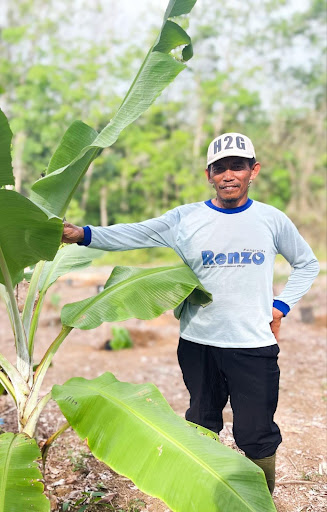
 In Musi Rawas, the project’s sole demonstration plot highlights how regenerative practices can offer both environmental and economic benefits. The 0.25-hectare agroforestry site, managed by 54-year-old Subarni, was converted from a 33-year-old jungle rubber plot into a more productive and diversified system.

With support from the project implementation team, Subarni replanted 120 improved rubber clones and intercropped the land with bananas, peanuts, and durian. The peanuts alone are expected to yield approximately 150 kilograms every four months, beginning in July 2025 — a critical alternate source of income during the long replanting period.

“Normally, you wait years after replanting rubber before seeing any return,” he said. “Now, I see income while waiting too, and that gives me the motivation to keep going.”

Beyond immediate income, long-term investments like durian, a high-value crop locally known for its premium quality, reflect how smallholders are planning beyond subsistence. The demonstration plot now serves as a practical model for neighbouring farmers exploring integrated, sustainable rubber production.


Digital Tools for Real-World Change

Complementing in-person coaching is RubberWiki, a mobile app developed to extend learning beyond the field. As of July 2025, 549 farmers have been successfully onboarded, just over the initial target of 540.

The app offers training modules and real-time rubber price updates, which have proven especially valuable. “I check it almost every day,” said 40-year-old Partini, who uses it to monitor price fluctuations. Others, like 35-year-old Ari, revisit coaching content through the app in the evenings.

By offering flexible, on-demand learning, RubberWiki helps ensure that farmers can continue to build knowledge and confidence well after formal sessions have concluded.


A Model for Shared Industry Commitment

Goodyear has supported the GAP Coaching Project since its earliest days, recognizing that smallholders form the backbone of the global natural rubber value chain. In Phase 3, Goodyear invited General Motors to co-fund the initiative, reflecting a growing movement toward shared accountability across the supply chain.

“Smallholders are the foundation of the natural rubber industry,” said Chuan Heng, Associate Director, GOCPL Natural Rubber, Goodyear. “And, Goodyear, as part of GPSNR, engages in programs that support the natural rubber industry’s move towards a more sustainable supply chain.

General Motors’ contribution also highlights its broader commitment to responsible sourcing. By funding smallholder-centred programs like this, GM is helping to ensure that sustainability principles are embedded at the very beginning of the rubber lifecycle, where real transformation begins.

Together, Goodyear and GM have shown that when downstream actors work together, the impact is tangible: higher participation from women and youth, expanded access to digital tools, and better agronomic outcomes for thousands of smallholders.
More To Explore

News

Strategy and Objectives Working Group Update – November 2019

Desired state V1-0 and Theory of Change documents were circulated among Strategy & Objectives Working Group in November. Comments from the members were consolidated and will be responded to in the next version.  Theory of Change will be finalized and submitted to the Executive Committee in order to be approved at the General Assembly in March 2020.

Strategy 1 ‘Policy Toolbox’ Working Group primarily agreed on the scope of work. The desired state V1-0 serves as a baseline document which will be cross referenced with Accountability Framework initiative in order to come up with policy framework that will be applicable to GPSNR members.  The drafters volunteers will present the first draft of a policy framework to the working group members in December 2019.

Strategy 2 ‘Capacity Building’ Working Group members worked on defining priority geographical areas based on current production volume and emerging trend of natural rubber production.  The existing stakeholders and capacity building activities in those countries are being identified in order to design the plan for GPSNR on capacity building.

Strategy 3 ‘Traceability and Transparency’ Working Group members were requested to list down traceability tools that are currently in use and/or traceability tools that could be potentially used for natural rubber supply chain.  In December they will analyze the attributes of each tool to see the compatibility and applicability for transparency and risk assessment.

All the 3 working groups including Strategy & Objectives and Smallholders Representation Working Group members are given access to GPSNR discussion forum which aims to increase transparency and synergy among the working groups. You will be able to see the discussions and the documents of all the working groups but will be able to contribute only to the groups you signed up for.  Please contact nigel@gpsnr.org for your log-in credentials.

News

Launching the Global Platform for Sustainable Natural Rubber

Sustainable natural rubber, a Tire Industry Project priority

This, of course, means looking after the people, communities and natural resources touched by natural rubber production and supply – which all stand to benefit from the creation and adoption of sustainable practices and businesses.

TIP leading change

The tire industry consumes around 70 percent of natural rubber in the world and demand for natural rubber is growing, which throws into sharp relief the various social, economic and environmental opportunities associated with the production of this important commodity.

Together with other stakeholders, TIP members are working to transform the natural rubber supply chain for the better in developing the Global Platform for Sustainable Natural Rubber (GPSNR) – an independent platform to lead improvements in the socio-economic and environmental performance of the natural rubber value chain.

An ambitious and wide-reaching set of priorities

Twelve months of stakeholder collaboration have resulted in development of an ambitious, wide-reaching, common set of priorities for the natural rubber supply chain. The GPSNR will work to harmonize standards to improve respect for human rights, prevent land-grabbing, protect biodiversity and water resources, improve yields, and increase supply chain transparency and traceability.

Mainstreaming for meaningful change

A review of comparable supply chain sustainability initiatives revealed that the mainstreaming of good practices is linked to the delivery of meaningful change at the global level. This is something that requires actionable commitment from the entire supply chain, and numerous different stakeholder groups have important roles to play. In the case of natural rubber, this includes tire manufacturers and other natural rubber-using industries (such as those producing rubber gloves, condoms and other engineered products), natural rubber suppliers and processors, representatives of individual smallholder producers, vehicle manufacturers, and non-governmental organizations.

Binding commitments

A chain is only as strong as its weakest link; it is in the interest of the entire supply chain to ensure sustainable standards are met and maintained. The GPSNR will have clear membership criteria and supply chain standards that members must commit to maintain effective involvement. Members of the GPSNR will undertake binding commitments, and the GPSNR will constructively address failures to honor those commitments and act decisively in the event of noncompliance with remedial measures.

Industry backed, collaboratively driven

TIP has spearheaded development of the GPSNR and will provide initial support for the platform during its first two years of start-up and operation. This necessary level of support ensures basic operations during the establishment of a paying membership base. From launch, the platform will be independently managed with governance and decision making overseen by a representative group of stakeholders.

TIP has employed a truly collaborative effort to ready the GPSNR for launch, and that spirit of collaboration will define the actions of the platform going forward. TIP is confident that the diverse interests, experiences, areas of expertise, and motivations represented within the GPSNR will combine to deliver a successful, sustainable natural rubber supply chain.

Join the platform

If you are a natural rubber stakeholder and would like to learn more about the GPSNR and membership opportunities, please contact stefano.savi@gpsnr.org

Scroll to Top