
Getting to Know You: GPSNR’s First Smallholder International Call

Share This Post

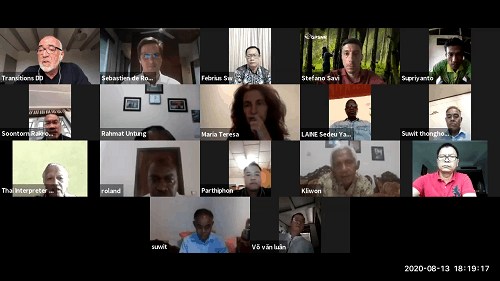
13 August 2020 – Kliwon is a natural rubber smallholder from Jambi Province, Indonesia, whose work with natural rubber started in the 80s. This evening, however, he’s doing something quite different from his usual rubber farming activities. Dressed in a light brown shirt of traditional Indonesian batik, Kliwon’s wiry frame and distinct head of white hair is visible on the computer and mobile phone screens of over 20 other natural rubber smallholders from around the world. He is one of the participants in GPSNR’s first international call for smallholder members to prepare them for the upcoming General Assembly.

At 68, Kliwon is one of the more experienced smallholder members in GPSNR. Today, he is being joined by other smallholders. Some, like H Nasoro Nie, a fresh-faced young lady from Vietnamese province of Dak Lak, are as young as 24, almost one third Kliwon’s age. Despite the difference in years, these smallholders all have something in common. They recognize the increasing importance of a sustainable global natural rubber value chain, and are actively participating in efforts to transform the industry.

It is the first time that the smallholders are meeting each other on an international level. Prior to this, they have been engaged in national level calls, making their presentations to their fellow natural rubber farmers from the same country. More than 20 natural rubber smallholders are present on the call – a handful are unable to join as they live in remote locations where access to the internet is not always a given. Unfortunately, the four smallholders from Myanmar are unable to connect due to heavy flooding in the areas where they live.

As with any meet-and-greet, communication is of paramount importance, and this includes being able to understand and be understood regardless of the language you speak. Here, five foreign languages come into play: Bahasa Indonesia, French, Myanmar, Thai and Vietnamese. Using Zoom’s in-built interpretation feature, the smallholders are able to access special audio channels within the meeting, where they can hear everything that is said, interpreted into their local language. Thanks to sustained funding from Partnerships for Forests (P4F), a UK aid funded program, GPSNR was able to engage interpreters to perform this simultaneous interpretation remotely. The funds were also channeled to the appointment of Transitions, a sustainable development consultancy agency, who is facilitating the international sessions with smallholders.

The call begins with opening remarks by GPSNR Director Stefano Savi, followed by a quick runthrough of the agenda and an overview of the global natural rubber market. 

Then, the smallholders start to introduce themselves. We hear from those from Indonesia, then Thailand, Vietnam, Côte d’Ivoire, Ghana and Brazil. They share about the size of their natural rubber plantations, their activities around rubber farming. Many of them are actively involved in the natural rubber scene in their country, from Baroan Roland, who is the Chairman of the Association of Natural Rubber Producers of Côte d’Ivoire (APROCANCI) to Thailand’s Soontorn Rakrong, who has been involved in initiating dialogue with the Thai government for policy development around fair tenure and land use rights. As one smallholder speaks in their native language, the interpreter interprets, in real-time, their words into English for the rest of the participants. The other interpreters, picking up the English interpretation, convey it to the other smallholders in their respective native languages.

All too soon, two hours fly by. There is just enough time for a short Question and Answer segment. At the end of the night, it’s clear that the smallholders are excited to have more opportunities to get to know each other and further discuss the issues around natural rubber that they all similarly share regardless of geography. —

The 2nd GPSNR Smallholder International Call will take place on 27 August 2020.
More To Explore

Rubber, representation and reform – What smallholders bring to the sustainability conversation

By Febrius Wibisana, GPSNR Executive Committee Member & Co-Chair, GPSNR Smallholder Inclusion Working Group

For those who do not know me yet, my name is Febrius Wibisana and I have been a rubber smallholder in Indonesia for over 25 years. At GPSNR, I represent the smallholder category at the Executive Committee level. I am also the co-chair of the Smallholders Representation working group.

In June 2022, I was invited by the Partnership for Forests or P4F to the P4F Forum with their partners and projects from across the world. They wanted me to speak about my experience at GPSNR on smallholder inclusion in the sustainability conversation in natural rubber. The experience gave me the opportunity to put some thought into our work over the last three years – the challenges, the successes and carving the path forward.

I am writing this to share some of those reflections with my fellow GPSNR members.

Reflection 1: It is impossible to have holistic sustainability solutions in natural rubber without smallholder participation

GPSNR Impacts & Assurance Associate Si Yuan and myself at the P4F Forum in London

We live in a world where 6 million smallholder farmers produce almost 90% of the world’s natural rubber. In such a world, any conversation on change in this supply chain has to include smallholders. 

In its second General Assembly in 2020, GPSNR members passed a resolution to include smallholders as a category within the membership. We started with 28 odd smallholders, including myself, engaging in conversations on sustainability, capacity building and the meaning of true inclusion and having the smallholder voice heard at various decision making levels. Today, I represent over 130 smallholders across 10 countries in the GPSNR Executive Committee. 

To bring smallholders into each conversation, we work closely with country level champions and local government entities for outreach and engagement. Interpretation facilities and key documents being translated to smallholder languages are some small but significant steps we take at GPSNR to further facilitate smallholder participation.

Reflection 2: Membership does not guarantee active participation

While many of our smallholder members are actively engaged in core decision making and at the working group level, many find it difficult to do so. The digital divide, language barriers and a skewed equation of structural power could be some key reasons for this. Some smallholders simply may not have the time for it. 

Yet, as we embark on transforming the entire supply chain, we need active smallholder voices to join and remain in the GPSNR fold. To this end, the smallholder representation working group has put forward a resolution with proposed changes in smallholder membership structure, where smallholders will have to participate in the General Assembly to take up ordinary membership. All others will be classified as affiliate members by default. You can take a look at the resolution here

Reflection 3: Making a supply chain sustainable requires thorough capacity building at all levels

There are more than 2 million smallholders in Indonesia. Yet, despite being the largest producer, it has the lowest productivity in the world. This is because of diseases and poor planting materials. Many other rubber producing nations face similar problems. 

If we are to make this supply chain sustainable, equitable and fair, and achieve the desired state that the GPSNR Theory of Change spells out, smallholders have to be equipped with the skills and resources. The capacity building working group has already kicked-off the first such projects in Indonesia with SNV-Proforest and Koltiva. GPSNR has also received funding pledges from Renault, Goodyear, Michelin and Pirelli for other projects, but scaling them requires more. Funding information is available here for any one in the natural rubber industry. 

Capacity building will also equip smallholders to participate further in GPSNR decision making and other processes. 

As we move forward, I am energised by the progress GPSNR has made so far on smallholder participation. In our attempt to move towards more active engagement, we need the support of all our members. Our ability to meet in person will further strengthen this support, and I look forward to working with all of you to transform the supply chain. 

News

Natural rubber stakeholders align on GPSNR governance

A 22-23 January stakeholder workshop in Singapore saw Founding Members of the GPSNR and other stakeholders, align on a multi-stakeholder governance structure that includes a greater share of voting weight for civil society members. “This is a significant development,” said Stefano Savi, GPSNR Director “the model aligned on last week in Singapore comes out of a November 2018 workshop in Geneva – it’s a product of the dedication of all stakeholders to the shared goal of sustainable natural rubber – we’ve seen compromise from all parties, there’s a spirit of cooperation and inclusivity that shows there’s real commitment to make this work.”

The proposed governance structure will be put forward for adoption at the platform’s inaugural General Assembly (GA) planned for 21 March 2019, Singapore, scheduled in conjunction with the World Rubber Summit. Whilst multiple stakeholders have provided valuable input to the development of the platform thus far, governance roles and rights-to-vote are reserved for platform members only.

The platform includes the enrollment of smallholder members amongst its priorities. Despite the challenges associated with recruiting smallholder representatives, the more than 50 GPSNR stakeholders present at the workshop agreed that this critically important stakeholder group should be part of the GPSNR decision making structure. A dedicated working group will be established to coordinate actions to identify and secure adequate smallholder representation.

The workshop also confirmed the need for targeted member-recruitment to bolster the inclusion of rubber processors, NGOs specialized in social aspects relevant to rubber production, as well as non-tire manufacturing rubber makers.

“Agreement on platform governance is excellent progress and means the platform can better focus on the work ahead. We’re all aware of the critical challenges that remain, but there’s a feeling that, together, we can meet those challenges” said Savi, speaking at the close of the two-day workshop.

Scroll to Top