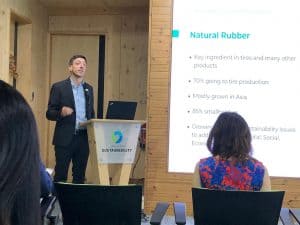
The GPSNR Topic Talks series is organised by the GPSNR Secretariat and presented by GPSNR members. The presentations cover several themes around sustainability and the global natural rubber supply chain.
The series kicked off on 27 October with a presentation by Philippe Thaler from CIRAD, on the implications of EU legislation on imported deforestation. View the webinar recording or download the slide deck from this webinar using the links provided.
The second webinar’s theme was on smallholder solutions and featured two separate presentations. “A landscape-level approach to inclusion and capacity building for rubber smallholders” was presented by Rizki Permana from SNV, Widyantoko Sumarlin from Kirana Megatara, and Tony Hill from Proforest. Speaking from experience with the Kelola-Sendang project in South Sumatra, the presenters explained how SNV, with Proforest support, worked with rubber smallholder groups in the jurisdictional initiative, which helped to forge new links between the smallholders and a crumb rubber factory buyer in the Kirana group.
Next, “Exploring Smallholder Solutions in the Rubber Sector – The Processing and Sale of Rubberwood to Support Smallholder Financing in Indonesia” was presented by Amy Smith from WWF, Gerald Tan from HeveaConnect, with Renée Corstens and Remco Geervliet from Financial Access. This presentation shared the findings of a study which analyzed the potential of rubberwood to serve as a mechanism to support smallholder financing in Indonesia. You can view the webinar recording or download the slide deck for this webinar using the links provided.
The next theme is Assurance and smallholders, and how we can learn from existing schemes. PEFC’s CEO Ben Gunneberg presented a webinar last night, elaborating on PEFC’s approach to standard-setting and certification. He also showcased PEFC’s current collaborative projects with their national members and companies to support smallholder producers, and how these will benefit GPSNR members and the work GPSNR is engaged in. You can view the webinar recording or download the slide deck for this webinar using the links provided.
Continuing with the same theme of Assurance and smallholders, FSC will be presenting on 8 December, an overview of smallholder certification solutions. Members may register for the webinar in the subsequent section of this article.
We are also pleased to announce an addition to the Topic Talks lineup: ‘REDD+, are carbon credits impacts overstated?’. This new presentation, jointly organized with GIZ and which will be held on 10 December, puts the spotlight on reducing emissions from deforestation and forest degradation (REDD+) with an introduction to the REDD+ methodology, followed by a discussion with the authors of a recently published study, “Overstated carbon emission reductions from voluntary REDD+ projects in the Brazilian Amazon”. Members may register for this Topic Talk in the subsequent section of this article.
Assurance and Smallholders: Learning from Existing Schemes Part 2
“FSC Smallholder Certification Solutions”
8 December | 7PM (GMT+8)
Click here to register
Presented by: FSC
The presentation will cover FSC’s solutions for smallholders to become certified. First, an overview of the evaluation of certification solutions for smallholders will be given. FSC’s existing solutions will be covered, with a focus on the benefits for FSC Group Certification. Next, solutions in the pipeline will be covered, addressing the impact of pilot projects and highlighting success stories.
REDD+, are carbon credits impacts overstated?
10 December | 3PM (GMT+8)
Click here to register
Jointly Organized by: GIZ
Presented by: GIZ and authors of the study
Using REDD+ projects to offset carbon emissions through avoided deforestation and the financial support of local communities is popular but also highly debated. Especially, voluntary REDD+ projects are regularly criticized as inefficient or even greenwashing. This presentation will provide an introduction to the REDD+ methodology. The authors of a recent critical study, “Overstated carbon emission reductions from voluntary REDD+ projects in the Brazilian Amazon” will then present their findings and suggestions as a basis for discussion.