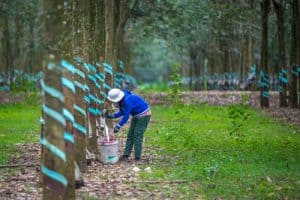

Smallholder farmers are key stakeholders in natural rubber supply chains accounting for 85% of global supply, and enabling the resilience and sustainability of the value chain. However, smallholder farmers are the most vulnerable to major changes in the economic and regulatory landscape. Their vulnerability is heightened by the fact that many smallholders lack formal land documentation. Fortunately, many rubber producing countries are progressively implementing land tenure formalization programmes for smallholders but they undoubtedly will take significant amounts of time to fully implement.
The Global Platform for Sustainable Natural Rubber (GPSNR) supports the intent and implementation of the EU Regulation on Deforestation-free products (EUDR), and considers it a bold and necessary step to addressing deforestation, human rights violations, and illegality in commodity production, including natural rubber. However, it is key that its implementation ensures the continued inclusion and support of smallholders in EU supply chains.
GPSNR includes more than 200 smallholder farmers from 12 countries in its membership and has heard their concerns regarding the potential unintended consequences of the law.
As reflected in its Policy Framework, GPSNR is committed to recognise and protect the customary, traditional and communal land tenure and use rights of Indigenous People and local communities (IPLC), including smallholder farmers who have such rights, even in cases where they are not formalised yet in the legal system of the country in which they reside.
In view of supporting the inclusion of smallholders in EU supply chains, while ensuring due diligence against illegality, the GPSNR requests the European Commission provide additional EUDR guidance to competent national authorities regarding how to effectively check that operators and traders have conducted sufficient due diligence to determine the legality of commodities falling within the scope of the Regulation considering the mosaic of native and customary land rights arrangements found on smallholder farms around the world. Examples of how this could be achieved might include:
- The creation of a shared information system amongst competent national authorities to assess the practical state of producing countries’ efforts to document and formalize recognition of customary land tenure arrangements for smallholder farmers;
- Work with producer country governments to identify prevalence of customary tenure.
- Providing practical guidance to EU competent authorities and regulated companies on:
o How to robustly assess and map the customary land title claims in each country to ensure smallholders are not cut out of supply chains before formal land registries are created and protect the right to self-determination of IPLCs who do not wish to engage in land title formalisation even if it becomes available.
o In countries where formalization of land tenure is still under development, prioritize assessment of legality to establish that commodities placed on the market do not originate from land that has been occupied or acquired in violation of national land laws or customary tenure arrangements (i.e., through a “land grab”); through dispossession or abuse of the rights of vulnerable members of a population by elites; or which is located within prohibited areas such as national parks, wildlife reserves, or other protected areas, or from other restricted use areas.
o Specifics on the types of documentation to collect to substantiate the rights (formal or customary) of smallholder farmers to use land parcels for the production of the relevant commodity. This could include documentation recognized by local authorities, or other evidence of locally recognized land tenure, and evidence that key regulatory bodies in producing countries have indicated general acceptance that smallholder farmers cultivating land under customary and/or communal land tenure arrangements may legally produce and sell rubber (this may be explicit – e.g., through a license – or implicit, e.g. through the provision of official extension support, credit schemes, or marketing assistance to registered smallholders);
We call the Commission and other EU and national institutions for a joint effort to enable smallholder farmer organizations to meet EUDR compliance; and proactively work with the producing countries to address potentially conflicting national laws, issues of inadequate law enforcement and corruption, and provide support to producing countries to tackle these issues and empower smallholders to maintain access to EU markets. GPSNR commits to support just transitions to secure forms of land tenure. We will collaborate with members to enhance capacity in land tenure and support programs facilitating smallholders’ access to formal land documentation where applicable.
Finally, we wish to clarify that the above proposals are in no way intended to avoid compliance by GPSNR operators and traders purchasing and selling natural rubber products covered under the scope of the Regulation. Rather, they are designed to support and enhance the position of the six million smallholders in global rubber supply chains to help realize the potential of the law, whilst themselves benefiting from it. These proposals are supported by GPSNR’s smallholder and civil society representatives, alongside industry members.