
GPSNR Working Groups Update: January 2022

Share This Post

All GPSNR working groups have begun planning the year ahead. Here are all their updates: 

Strategy and Objectives Working Group

After finalising the Theory of Change, the group is working on developing next steps for itself based on the ToC and updating its own Terms of Reference and membership.It is also busy with developing the RFP for the Economic Risk Study, which will be published soon.

Smallholder Representation Working Group

Apart from onboarding workshops in Ghana, Liberia, Malaysia and Colombia, the group is focussed on its newly formed task force to develop the GPSNR Smallholders Policy Framework before the General Assembly of 2022.   

Policy Toolbox Working Group

The group saw a major milestone in the approval of the reporting requirements at the 2021 General Assembly. In the coming months, they will be developing guidance for the reporting requirements and a transparency roadmap before the reporting cycle begins in mid-2022. At the same time, the group continues to refine the Implementation Guidance before the General Assembly of 2022 while supporting the smallholder working group with the Smallholder Policy Framework. Additionally, this group is busy with finalising the compliance panel operational guidance.

Capacity Building Working Group

The group recently closed two RFPs for the assessment of the Knowledge Sharing Platform and GAP coaching for Indonesia respectively. While finalising and appointing service providers from the applicants, the group will also review and finalise the strategy and approach for capacity building in Thailand, including integration with Agroforestry Task Force workstream. To this end, the recently formed Thailand capacity building national subgroup had its first meeting in January 2022. 

The working group is also working on capacity building plans for Indonesia and Ivory Coast. 

Traceability and Transparency Working Group

Having received members’ input on the traceability benchmark, this working group is now refining the benchmark based on the feedback. They will also be providing a summary of tools based on traceability studies conducted in 2021 to the EC.

Shared Responsibility Working Group

The Shared Responsibility working group has appointed a consultant from New Foresight to support the Shared Responsibility (SR) framework development. The consultant is now working on completing the preliminary interviews to gather perspectives on the SR Framework, as well as a data collection exercise. After this, the group will work on drafting the SR framework and policy and preparing a resolution for it by the General Assembly of 2022. 

More To Explore

Members

Presentation on the High Conservation Value Approach (Members Version)

In discussing the proposed member requirements and reporting requirements, the Policy Toolbox Working Group has touched frequently upon the topics of High Conservation Value (HCV), no deforestation, no conversion of non-forested ecosystem, and other issues around developments on post-disturbance vegetation/ land cover. 

To establish a common understanding about HCVs, the High Conservation Value Resource Network (HCVRN) Secretariat took the initiative to organize a video presentation to the Working Group members on the HCV Approach. The presentation touched on governance and historical aspects of the HCV Approach, and its implementation in forest and non-forest ecosystems in the landscape, concession and smallholder contexts.

Watch the presentation here.

Download the slide deck here.

RubberWay Contributes to Achieving GPSNR Goals

By Nicole Tan, Project Manager, RubberWay

A couple of months ago, RubberWay was proud to introduce its contributions to sustainable natural rubber to members of GPSNR. 

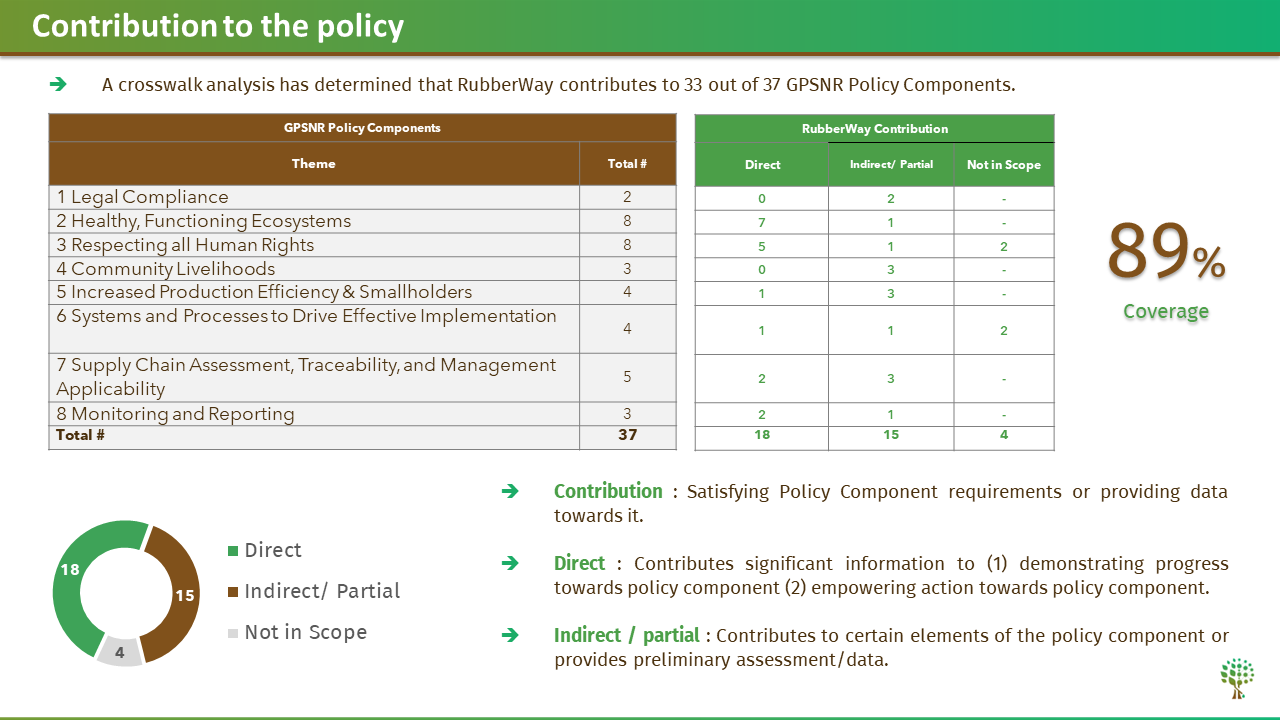
Data obtained through RubberWay contributes to helping users meet the GPSNR Reporting Requirements. A crosswalk analysis done by the RubberWay team showed that it provides 89% coverage of the 37 GPSNR Policy Components, of which 18 Policy Components are directly satisfied by RubberWay while 15 are partially contributed to.


RubberWay meets 33 out of 37 GPSNR Policy Components through direct and indirect contributions.


The webinar hosted by GPSNR gave RubberWay the chance to provide an overview of its solution from the perspective of both tire makers and processors. 

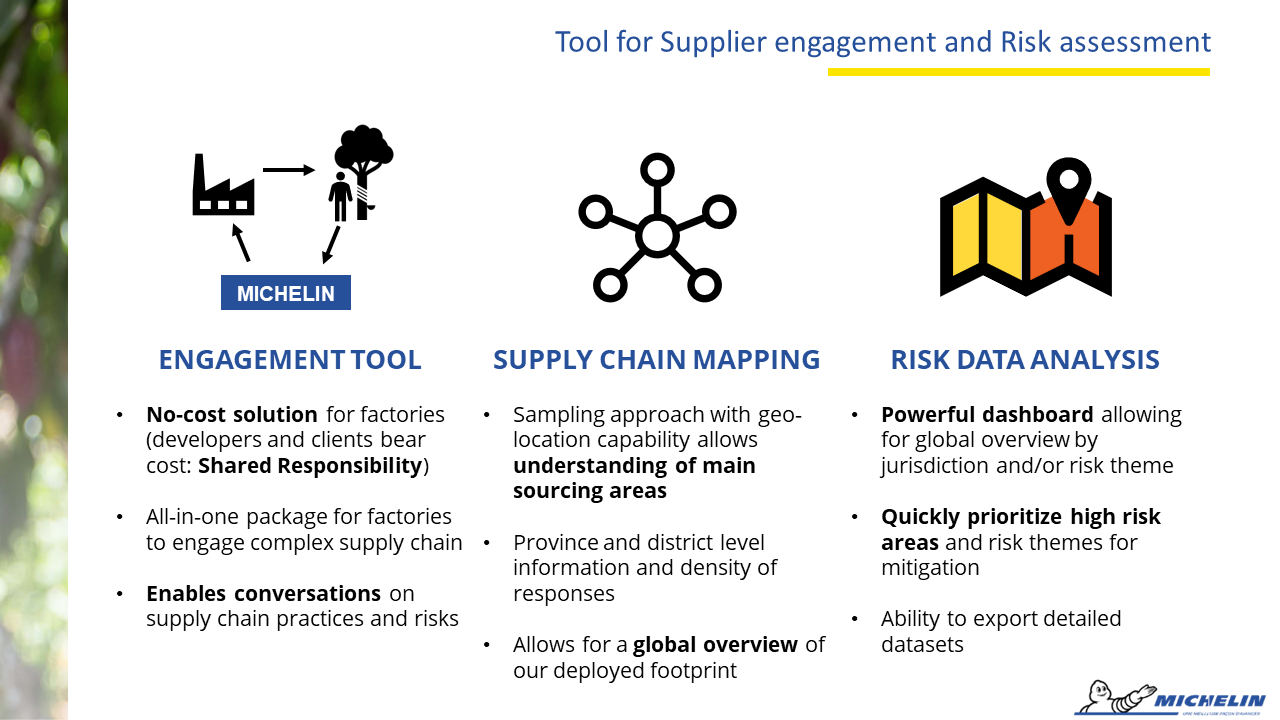
The sharing by tire makers highlighted the motivations for their participation in RubberWay and the ways in which RubberWay’s results have enabled them to engage in efforts on the ground. 

Similarly, natural rubber processors are able to apply data from RubberWay to implement field actions while also using the tool as a channel to facilitate communication directly with smallholders.


Users are able to utilise data generated through RubberWay to inform risk mitigation measures. RubberWay also provides its users with a channel for supplier engagement. 


More detailed information on how RubberWay contributes to achieving GPSNR’s goals for sustainable natural rubber can be found in the RubberWay white paper. Access to the complete crosswalk analysis is also available upon request.

ABOUT RUBBERWAY

RubberWay is a digital risk mapping solution that helps upstream actors to detect environmental and social risks across the natural rubber supply chain. Risk data obtained through RubberWay generates actionable insights for users like tire makers and processors to drive change towards sustainability within the industry. 

With over 50,000 questionnaires completed to date, the RubberWay dataset is set to increase with growing participation of users, enabling expansive reporting of sustainability risks across sourcing countries globally. 

Find out more about RubberWay here

Scroll to Top