

Strategy and Objectives Working Group Update – January 2020

In preparation for the finalized desired state and Theory of Change proposals to be presented at the upcoming 2nd General Assembly, the Working Group has observed the need to develop a user-friendly document for the communication of their deliverables to the rest of the GPSNR members.

Share This Post

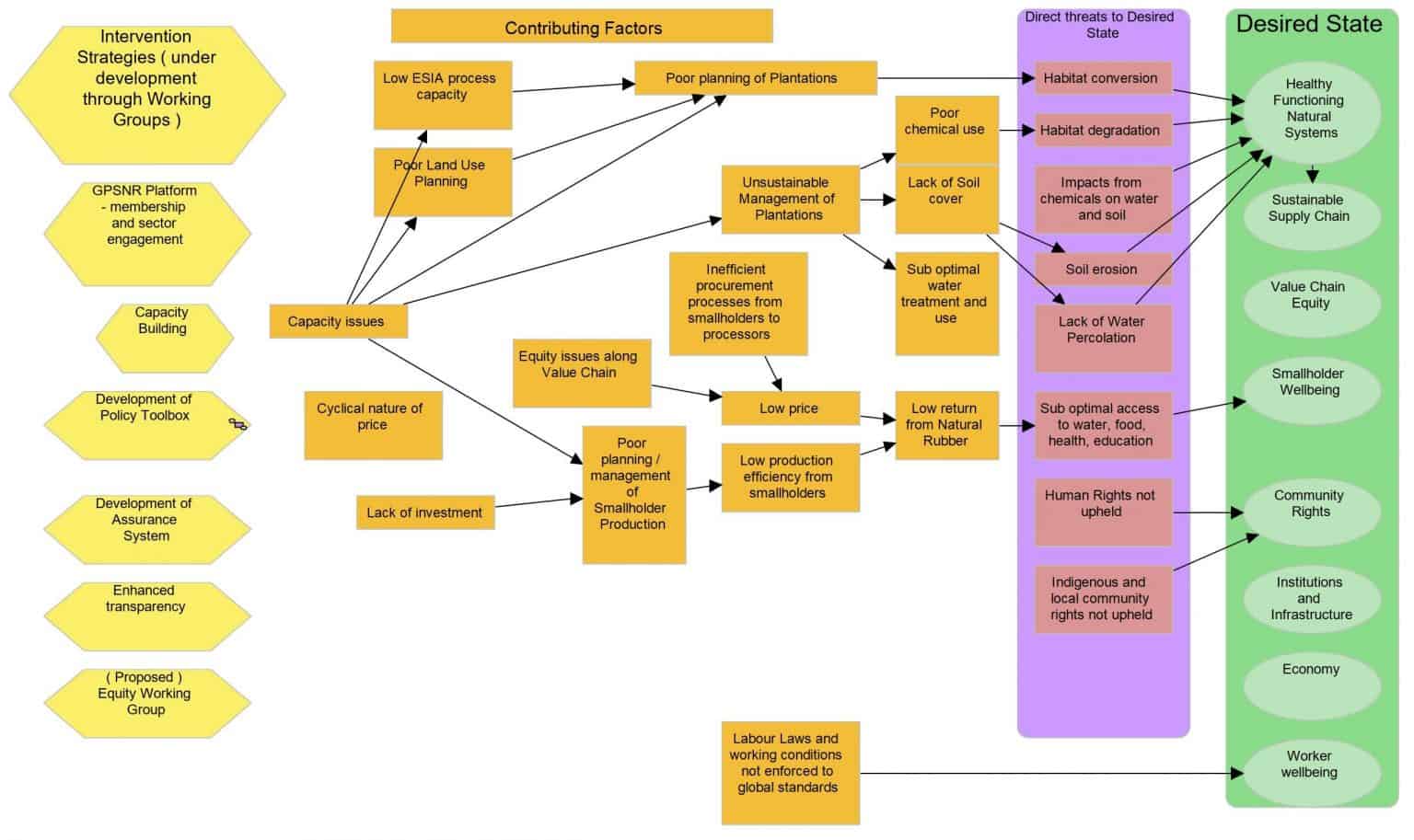
Using the Theory of Change model, the Working Group identified root causes that prevent the natural rubber supply chain from achieving the desired state. Once these root causes were agreed upon, effective strategies could be designed to mitigate them.

Considering that the natural rubber industry and the world around it is not static but changes with time, the Working Group has planned for the Theory of Change to be a living document that GPSNR members will continually update and maintain. This will ensure its relevance and role in realizing the vision of GPSNR.

In addition to the above, the Working Group is drafting the Terms of Reference (ToR) for the Equity sub-Working Group. The sub-Working Group’s focus will be on how we can ensure equity along the supply chain.

‘Policy Toolbox’ Working Group

Working Group members’ comments on the first draft of the top line policy components were consolidated and incorporated into an updated draft. For ease of understanding, it was agreed that the policy components and implementation components would be displayed in separate tables. This would allow members to more easily distinguish the policy commitments they should adopt, and the corresponding actions they should implement.

The Working Group aims to have the top line policy components finalized by the end of January for the Executive Committee’s approval.  

‘Capacity Building’ Working Group

The Working Group has designed the questionnaire on which it will base the interviews of stakeholders conducting capacity building activities in rubber-producing countries. Volunteers from the Working Group as well as the GPSNR Secretariat will contact the previously identified stakeholders and seek their input on past and existing capacity building initiatives, evaluating the success of the activities and exploring the role that GPSNR can play in ensuring that the initiatives fulfill their objectives.

‘Traceability and Transparency’ Working Group

Using the Theory of Change document as an anchor to their discussions, the Working Group was able to analyze how the lack of traceability and transparency in the natural rubber supply chain would constitute a threat to sustainability, and how to tackle the associating challenges. Next, the Working Group will start on the design of pilot studies for tools currently employed to assess supply chain risks and/or achieve supply chain traceability or transparency.
More To Explore

News

GPSNR Working Groups Update: March 2022

All GPSNR working groups have a large chunk of work ahead of them. Here are all their updates: 

Strategy and Objectives Working Group

The group has made good progress by establishing the new risk task force that will evaluate the exact scope of GPSNR’s risk based approach. It has also got its new Terms of Reference approved by the Executive Committee, and is now working on contracting a consultant for the Economic Risk Study and conducting a gap analysis of GPSNR’s current activities based on the platform’s Theory of Change.

Smallholder Representation Working Group

Having published the RFP to develop the GPSNR Smallholders Policy Framework equivalent, the group is focussing on the first Smallholders International Call of the year in March 2022, workshops in Liberia and Malaysia, and on developing country-specific smallholder engagement activities with smallholders and Country Champions.

Policy Toolbox Working Group

This group is continuing discussions among its three new subgroups: Transparent reporting roadmap, Implementation Guidance and RR Guidance & Tools. In the coming months, they will finalize guidance for the reporting requirements and share it with companies

At the same time, they are working with the smallholder representation working group on the Smallholder Policy Framework equivalent.

Capacity Building Working Group

After publishing the GAPs as living documents in English and Bahasa and selecting SNV-Proforest and Koltiva as consultants to work on the GAPs coaching in Indonesia, the working group continues to develop capacity building plans for Indonesia, Thailand and Ivory Coast.

They are also seeking your inputs for GPSNR’s knowledge sharing platform, which you can provide here.

Traceability and Transparency Working Group

Having finalized the traceability and transparency primer, the WG will wind down its operations.

Shared Responsibility Working Group

The Shared Responsibility has completed a review of the Shared Responsibility Framework, incorporating feedback from the Executive Committee. The Working Group will present an updated proposal to the EC as the next step, with a view to prepare a resolution at the 2022 General Assembly.

News

Updates from the Working Groups

Strategy and Objectives Working Group

The study on Human Rights and Labour Rights’ Risk Mapping in the Global Natural Rubber Value Chains conducted by independent consultants James Griffiths & Associates Sàrl has been submitted to the Working Group. The full study will be published on the GPSNR website shortly, and the document will be open to stakeholders for comments.

Meanwhile, the Strategy and Objectives Working Group has started to engage with the rest of the Working Groups on aligning with the Theory of Change, and developing platform KPIs. 

The Equity sub-Group has collected comments from the Strategy and Objectives Working Group on the proposed definition of equity. The sub-Group is also exploring engaging consultant James Griffiths to conduct research into equity risks along the natural rubber supply chain, with the plan to have the findings of this study feed into the definition. The sub-Group is currently in the process of establishing an operational plan to define the various workstreams, processes, timelines, and  responsibilities for the Living Income study. The first phase of the study will involve collecting existing benchmark data and doing desk research on national poverty lines, minimum wages, and other relevant information. For greater alignment with the Capacity Building Working Group’s scope, the Equity sub-Group has decided to focus on the same four countries: Côte d’Ivoire, Indonesia, Myanmar and Thailand. 

‘Policy Toolbox’ Working Group

The proposed Policy Components and Baseline Reporting Requirements are open for member consultation until 3 July 2020. Find out more here

‘Capacity Building’ Working Group

The regional sub-Groups described the various findings and recommendations in a presentation to the larger Working Group at the end of May. Eight initiatives were proposed to be shared across the four focus countries, each corresponding to a critical issue identified through stakeholder interviews. These eight initiatives are: access to pure certified (re)planting material, promote the CO2 compensation scheme, promote value rubber wood, improve access to finance, disease fighting, dissemination of Good Agricultural Practices (GAP), income diversification, and improve reach and quality of extension services. Depending on the initiatives recommended for each country, three priority actions have been suggested, forming the basis for a 3-year programme.

The sub-Group for Thailand organized a call with some of Thai smallholder members to seek their opinion on the proposed initiatives. The discussion proved to be a fruitful one, with the smallholders providing advice and suggesting alternative initiatives for the sub-Group to consider. The subgroup for Côte d’Ivoire, which has a smallholder member who is a representative from a local producer association in participation, has also contextualized the proposed initiatives to the local conditions of smallholders and industrial plantations.

The other sub-Groups are also planning to get smallholder members’ input on the capacity building initiatives for their respective countries of focus.

‘Traceability and Transparency’ Working Group

The Working Group has started discussions on risk assessment, and will be linking up with the Policy Toolbox Working Group as well as consultant James Griffiths on the results of the social risks study.

The terms of reference for the two pilot proposals have been finalized after several rounds of additional revision. The documents will be submitted soon to the Executive Committee. 

Smallholders Representation Working Group

The Working Group continues to plan and prepare for the smallholders programme prior to the General Assembly. In particular, terms of reference are being drafted for a professional facilitator to manage the smallholder workshop sessions for the pre-GA programme.

Scroll to Top