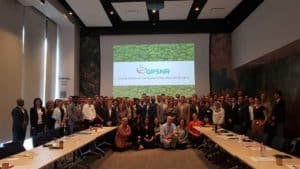

The Global Platform for Sustainable Natural Rubber (GPSNR) affirms the commitment of its membership toward deforestation-free natural rubber supply chains and acknowledges the importance of engaging with regulators to support its ambitions. In considering how to address the risk of deforestation and forest degradation associated with products placed on the EU market, we urge EU regulators to continue to engage with the rubber and tyre sector to ensure that the due diligence requirements ultimately deliver social and environmental benefits, including eliminating deforestation from rubber supply chains and improving smallholder livelihoods. Adopting a risk-based approach at jurisdictional or landscape level with mitigation and impact driven capacity building actions would promote inclusive and scalable progress in the smallholder context, whilst effectively addressing the goal of preventing products derived from deforestation caused by natural rubber from being placed on EU markets.
In this respect, GPSNR believes that any regulation addressing deforestation in the natural rubber supply chain, including the present proposal, must align with the following factors to be transformative:
• Sustainable natural rubber must promote equity for smallholders. Smallholders represent 85% of natural rubber production globally. The design of any regulation relating to natural rubber must consider and mitigate any potential negative impacts on smallholder farmers while aiming to improve the livelihoods of farmers who adopt sustainable practices.
• Considering the complexity of the natural rubber supply chain, a risk-based approach that has jurisdictional traceability as its foundation offers a practical and effective approach to addressing deforestation. While advances in traceability are being made in the natural rubber sector, it is currently infeasible to conduct farm-to-factory tracing in all cases. A risk-based approach would include requiring some farm-to-factory tracing where risk is non-negligible, but not in every natural rubber supply chain.
• Capacity building to promote sustainable practices, for smallholders and plantations alike, is an essential tool to curb deforestation in the natural rubber supply chain, so any regulation should prioritize funding to enhance capacity building.