

Smallholders Representation Working Group Update – July 2019

In January 2019, interested stakeholders came together in Singapore to discuss on the governance and objectives of the platform. Participants attending the workshop unanimously agreed that to bring about a change, work must be done to ensure smallholder inclusivity within the platform. In order to achieve this, the Smallholders Representation Working Group was created and assigned the main responsibility of coordinating actions to identify and secure adequate smallholder representation within the GPSNR governance.

Share This Post

Since its establishment a few months ago, the Smallholders Representation Working Group has been working consistently and collectively to accomplish its mission. The group has been actively involved in understanding, strategizing and testing the methods by which the platform can ensure adequate and relevant smallholder inclusion. 

In its work to date, the group has selected 11 Working Group members as “Country Champions” who have extensive regional knowledge regarding the rubber supply chain. These members have been in charge of conducting interviews of various smallholder associations and organizations in their assigned country or region. The Working Group also refers to these “Country Champions” as “GPSNR Ambassadors” because of the role they play in creating awareness about the platform. In the past few months, they have helped promote the platform internationally, specifically in Natural Rubber producing countries, by interacting with several organizations, companies and government authorities in different regions of the world. This in turn has helped create curiosity and interest regarding the platform with local stakeholders and in the international rubber community.  

To further this process, the Working Group is currently planning on organizing a series of workshops in various rubber producing regions of the world, including Indonesia, Thailand and Vietnam in Asia Pacific, Brazil in Latin America and Cote d’Ivoire, Ghana and Liberia in Africa. The objective of these workshops will be to understand the local needs and motivations of smallholders and onboard organizations representing  smallholders to join the platform. The Working Group agreed these workshops will be a chance to facilitate an open and constructive discussion between the participants, including smallholders, smallholder representatives and other rubber stakeholders. By organizing multiple workshops in different regions of the world, the Working Group is trying to ensure appropriate coverage of the vast and diverse global natural rubber supply chain.  

Through these workshops and the onboarding work done by the Country Champions, the group will be able to identify relevant smallholder representatives, in view of onboarding them as GPSNR members, to ensure smallholders representation in the GPSNR governance is achieved by the next General Assembly in March 2020.

It has been encouraging to see volunteer members of the Working Group actively participate and contribute to fulfill the tasks and responsibilities assigned to the team. Going forward, the Working Group Co-chair expects more involvement of the members as the group implements its developed action plan of organizing regular events like the regional workshops aimed at the betterment of Rubber Smallholders.

More To Explore

Members

Continuing the Conversation with GPSNR Topic Talks – The Sumatran Rubber Pilot

The GPSNR Topic Talks webinar series is organised by the GPSNR Secretariat and presented by GPSNR members. The webinars cover several themes around sustainability and the global natural rubber supply chain.

The Topic Talks series continued on the 17th of March with Dr. Michael Steuwe from WWF US and Gerald Tan from HeveaConnect presenting on the Sumatran Rubber Pilot.

The Sumatran Rubber Pilot (SRP) is a voluntary, self-financed collaboration of rubber supply chain players and technical experts interested to facilitate the production and trade of transparent and sustainable natural rubber. The participating processing mills, tire makers, civil society organisations, technology providers and financial institutions have three major objectives:

  • Demonstrate how rubber’s downstream can work together to make its upstream more sustainable.
  • Identify, test, evaluate, and report on what it takes to achieve, and how to pay for transparent sustainable natural rubber supply chains.
  • Develop “Proof of Concept” approaches from and for GPSNR discussions on policy requirements and implementation, transparency and traceability, capacity building, and shared responsibility.

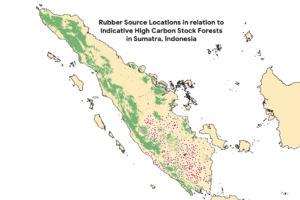
Within a few months of the project launch in July 2020, SRP’s four rubber processing factories, managed by the Halcyon Agri and ITOCHU groups, had traced up to 1 year of rubber supplies to the village and/or sub-district of origin based on self-declarations by their supplying dealers. These approximate origins of the rubber sources were filtered through WWF Indonesia’s new environmental risk assessment and management tool which identifies High Conservation Value Areas and High Carbon Stock Forest for the whole island of Sumatra. The results allow processors and their respective downstream supply chains to focus their sustainability work with farmers on priority areas.

The SRP partners are enhancing dealer self-declarations with digital apps such as CropIn and Hamurni to assess farms’ potential environmental, social, equity, labour and legal issues accurately and to address them.

As GPSNR adopts principles and criteria for what constitutes transparent and sustainable rubber, the risk assessment algorithms will be adapted to flag compliant rubber accordingly. This is increasingly important for rubber’s downstream as companies’ Environmental, Social, Governance (ESG) impacts are becoming key evaluation criteria for investors and financiers who will demand the disclosure of the relevant information. In a parallel development, new supply chain laws will require major companies like the world’s car and tire makers to be responsible for the environmental and social impacts of their supply chains. The collection and analysis of detailed data on upstream supply chains will have to become an essential part of doing business and SRP partners are working to respond appropriately to these changes.

While continuing to focus on increasing the resolution of tracing rubber to its origin and collecting the respective data, SRP will now begin finding ways to best address the social, equity, labour, and legal issues that may have come up in supply chain assessments. 

The SRP is a voluntary, open and flexible platform of like minded partners interested in testing a diversity of approaches to achieve supply chain transparency and sustainability, and welcomes interested rubber supply chain actors to reach out and discuss how they might join the collaboration. GPSNR members interested in participating in the SRP should reach out to the GPSNR Secretariat to get involved in the project.

The recording and slide deck from the webinar can be accessed with the links below:

  1. Link to Recording
  2. Link to Slide Deck

News

Member Consultation on proposed GPSNR Policy Components and Baseline Reporting Requirements

Natural rubber faces a similar set of environmental, social and economic issues as other agricultural commodities such as palm oil, but the spotlight on sustainability has only been recently turned towards this key raw material, 70% of which goes into tire production. The launch of GPSNR marked a significant step towards developing sustainable standards for natural rubber, with member organizations making a commitment to 12 Sustainable Natural Rubber Principles. 

The Policy Toolbox Working Group was established to develop a guiding framework for GPSNR members to implement policies and practices that align with the 12 Principles. Two key documents, the Policy Components and Baseline Reporting Requirements, have emerged after a year of discussion and drafting. 

The Policy Components outline specific commitments that GPSNR company members should include in their sustainable natural rubber policies, while the  Baseline Reporting Requirements indicate qualitative and quantitative sustainability data to be reported to the Secretariat for the first year of reporting.

A members webinar was held on 16 June, where the Co-Chairs of the Policy Toolbox Working Group explained the purpose, process and next steps surrounding the two documents. 

Several members have volunteered to participate in an ongoing pilot testing of the Baseline Reporting Requirements. The goal of the pilot is to refine and finalize the Baseline Reporting Requirements based on company feedback.

The proposed Policy Components and Baseline Reporting Requirements are now open for member consultation until 3 July 2020.

Scroll to Top