
Secretariat Update – January 2020

GPSNR recognizes the need to work towards economic sustainability within the natural rubber industry, ensuring that the earnings of millions of smallholders and farmworkers are enough for them to enjoy a decent standard of living. This is why ensuring equity along the value chain is one of our 12 principles critical to achieving a desired, sustainable state of the natural rubber industry. 

Share This Post

We can draw parallels to the coffee industry, which similarly comprises small plantation owners and more profitable downstream actors. In his recent sustainability report on the coffee industry, economist Jeffrey Sachs’ proposal for a global fund to fill the financial gaps for sustainability investments in coffee producing regions garnered vivid discussion.  

Currently, low and unpredictable rubber prices are a constraint to smallholders who produce the bulk of global rubber output. Transparency is critical in the purchasing process, and this kind of disruption typically comes hand in hand with embracing new strategies. 

Under the purview of the Strategy & Objectives Working Group, capacity building and extension services have been identified as potential measures to mitigate the root causes of the social and environmental impact from the natural rubber supply market. Implementing these at scale for the whole industry will require considerable financial investment.   

With the above considerations in mind, GPSNR is exploring new approaches to funding that would not be borne by a single segment of the industry, but in a manner incorporating the spirit of our shared responsibility. 

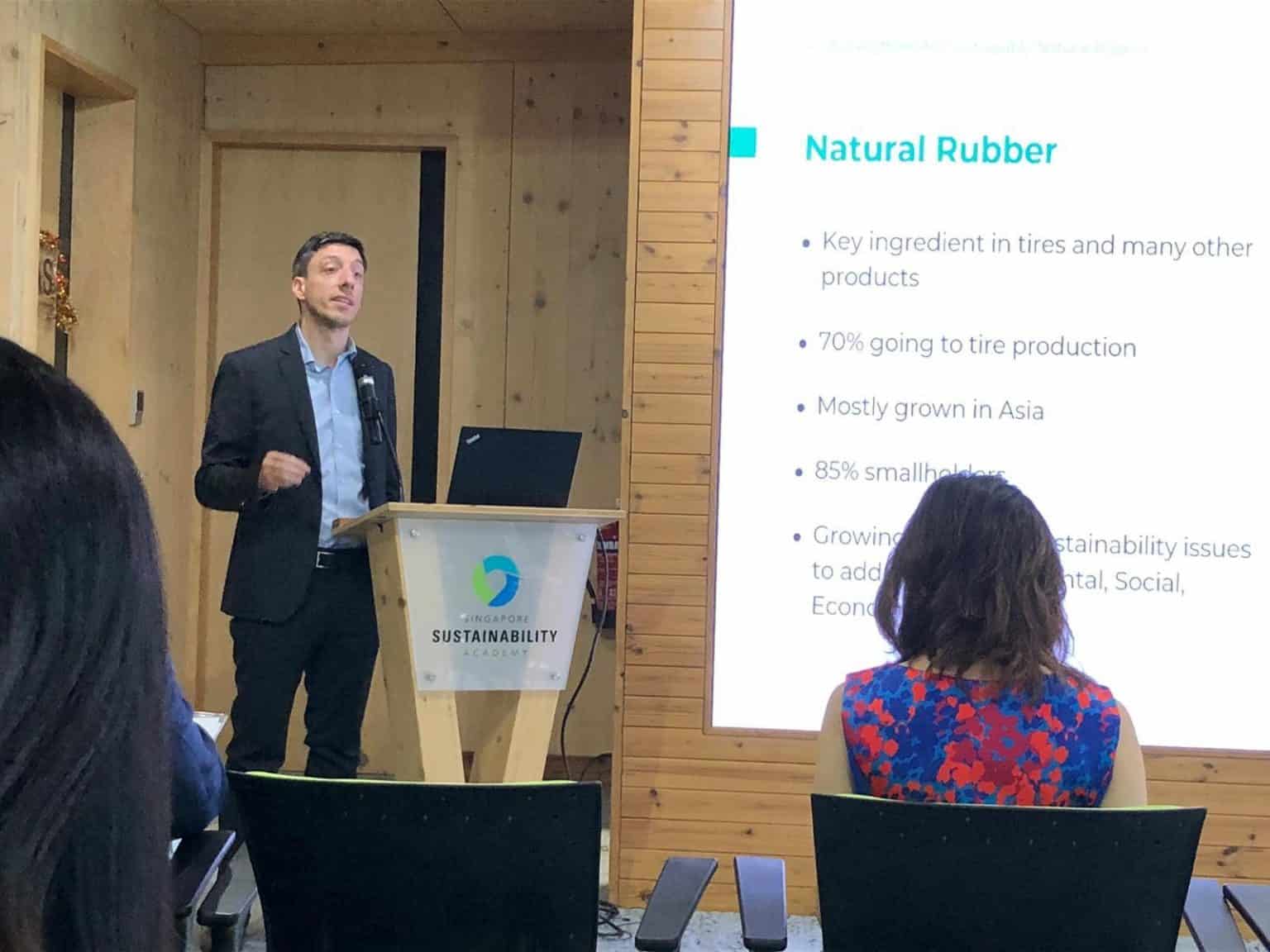
Enterprise Singapore organized an industry meeting on 14 January 2020, and invited GPSNR and Singapore Exchange to better understand the available options of an e-trading platform that could contribute to our funds. The meeting also discussed what could be the options, through GPSNR, to increase the uptake of the e-trading platform.

Tapping the vast potential of digitalization could present an exciting avenue of possibilities for GPSNR to better advance our vision of a fair, equitable and environmentally sound rubber value chain.      

The meeting was initiated by representatives from Enterprise Singapore, and panel speakers comprised representatives from GPSNR, Singapore Exchange and HeveaConnect. Participants included GPSNR members as well as other Natural Rubber buyers, producers, processors and traders .

More To Explore

News

Getting to Know You: GPSNR’s First Smallholder International Call

13 August 2020 – Kliwon is a natural rubber smallholder from Jambi Province, Indonesia, whose work with natural rubber started in the 80s. This evening, however, he’s doing something quite different from his usual rubber farming activities. Dressed in a light brown shirt of traditional Indonesian batik, Kliwon’s wiry frame and distinct head of white hair is visible on the computer and mobile phone screens of over 20 other natural rubber smallholders from around the world. He is one of the participants in GPSNR’s first international call for smallholder members to prepare them for the upcoming General Assembly.

At 68, Kliwon is one of the more experienced smallholder members in GPSNR. Today, he is being joined by other smallholders. Some, like H Nasoro Nie, a fresh-faced young lady from Vietnamese province of Dak Lak, are as young as 24, almost one third Kliwon’s age. Despite the difference in years, these smallholders all have something in common. They recognize the increasing importance of a sustainable global natural rubber value chain, and are actively participating in efforts to transform the industry.

It is the first time that the smallholders are meeting each other on an international level. Prior to this, they have been engaged in national level calls, making their presentations to their fellow natural rubber farmers from the same country. More than 20 natural rubber smallholders are present on the call – a handful are unable to join as they live in remote locations where access to the internet is not always a given. Unfortunately, the four smallholders from Myanmar are unable to connect due to heavy flooding in the areas where they live.

As with any meet-and-greet, communication is of paramount importance, and this includes being able to understand and be understood regardless of the language you speak. Here, five foreign languages come into play: Bahasa Indonesia, French, Myanmar, Thai and Vietnamese. Using Zoom’s in-built interpretation feature, the smallholders are able to access special audio channels within the meeting, where they can hear everything that is said, interpreted into their local language. Thanks to sustained funding from Partnerships for Forests (P4F), a UK aid funded program, GPSNR was able to engage interpreters to perform this simultaneous interpretation remotely. The funds were also channeled to the appointment of Transitions, a sustainable development consultancy agency, who is facilitating the international sessions with smallholders.

The call begins with opening remarks by GPSNR Director Stefano Savi, followed by a quick runthrough of the agenda and an overview of the global natural rubber market. 

Then, the smallholders start to introduce themselves. We hear from those from Indonesia, then Thailand, Vietnam, Côte d’Ivoire, Ghana and Brazil. They share about the size of their natural rubber plantations, their activities around rubber farming. Many of them are actively involved in the natural rubber scene in their country, from Baroan Roland, who is the Chairman of the Association of Natural Rubber Producers of Côte d’Ivoire (APROCANCI) to Thailand’s Soontorn Rakrong, who has been involved in initiating dialogue with the Thai government for policy development around fair tenure and land use rights. As one smallholder speaks in their native language, the interpreter interprets, in real-time, their words into English for the rest of the participants. The other interpreters, picking up the English interpretation, convey it to the other smallholders in their respective native languages.

All too soon, two hours fly by. There is just enough time for a short Question and Answer segment. At the end of the night, it’s clear that the smallholders are excited to have more opportunities to get to know each other and further discuss the issues around natural rubber that they all similarly share regardless of geography. —

The 2nd GPSNR Smallholder International Call will take place on 27 August 2020.

News

A First Look at GPSNR’s second Executive Committee

GPSNR’s Executive Committee comprises Ordinary Member representatives of each membership category, according to the newly approved allocation proposed in the resolution for a standalone category for natural rubber smallholder producers. Each membership category is allocated a total of three seats in the Executive Committee, with representatives chosen by elections within the category.

The Executive Committee serves as a center for overarching ideas of the Platform, and Executive Committee members bear the responsibility of raising awareness of emerging issues to their respective categories, initiating consultation sessions, and encouraging active participation in GPSNR’s Working Groups and activities.

The members of the second GPSNR Executive Committee, according to category, are as follows:

Producers, Processors & Traders

SIPH – represented by Marc Genot (Managing Director, Societe Africaine des  Plantations  d’Heveas SA)

Socfin – represented by Philippe De Groote (Head of Agronomy – Rubber)

Southland Global – represented by Tim Leong (Associate Director)

Tire Makers and Other Natural Rubber Product Makers

Bridgestone Corporation – represented by Andy Thompson (Global Director, Sustainability Strategy, Policy & Integration) 

Continental AG – represented by Claus Petschick (Head of Sustainability)

Michelin – represented by Segsarn Trai-Ukos (Managing Director, Société des Matières Premières Tropicales Pte Ltd)

Car Makers, Other Downstream Users, and Financial Institutions

BMW Group – represented by Vanessa Buchberger (Purchasing and Supplier Network, Sustainability, Innovation Management, Cooperations)

Civil Society

HCV Resource Network – represented by Arie Soetjiadi (SEA Representative)

Mighty Earth – represented by Margaret Kran-Annexstein (Campaign Director)

WWF – represented by Amy Smith (Deputy Director, Forest Sector Transformation)

Smallholder Producers

Baroan Roland – Côte d’Ivoire

Dang Quoc Thong – Vietnam 

Soontorn Rakrong – Thailand

The Executive Committee holds a monthly conference call to discuss proposals put forth by the Working Groups, and other issues pertinent to the Platform.

Scroll to Top