


(CLOSED) Request for Proposal – Smallholders workshop facilitator

Share This Post

Introduction & Background

The Global Platform for Sustainable Natural Rubber (GPSNR) is an international, multi-stakeholder, voluntary membership initiative seeking to lead improvements in the socioeconomic and environmental performance of the natural rubber value chain. Members of the Platform include tire manufacturers, rubber suppliers and processors, vehicle makers and civil society organizations. GPSNR’s structure consists of an Executive Committee and various Working Groups, supported by the Secretariat. All members meet and vote on resolutions at an annual General Assembly (GA).

Since its inception, GPSNR has been working towards smallholder inclusivity, particularly to ensure relevant representation of smallholders in GPSNR’s governance. As part of this effort, a series of workshops was conducted in the last quarter of 2019 aimed at raising awareness of GPSNR and the issue of sustainable natural rubber amongst rubber smallholders.

In 2020, 27 smallholders from 7 countries joined GPSNR as members. They will be participating, for the first time, in the GA scheduled to take place in September 2020. During the GA, a resolution will be proposed to form a new membership category for smallholders, which will be called ‘Smallholder Producers’. As an established category, smallholders will then be involved in voting on other resolutions and will elect representatives to be part of the Executive Committee.
GPSNR requires the services of a facilitator to facilitate several online sessions to prepare the smallholders for the GA, as well as their roles and responsibilities as members of GPSNR.

Objectives of the Sessions
The objectives of the online sessions are:
a) To foster relationships amongst smallholders from all 7 countries (particularly to encourage smallholders to interact with smallholders who are not from their country).
b) To familiarize the smallholders with fellow GPSNR members and GPSNR structure and governance, including but not limited to: Working Groups and their respective scopes of work and deliverables, knowledge of position of other member categories, GA voting process and the impacts of their votes.
c) To trigger and facilitate discussion amongst smallholders on subjects including but not limited to ensuring fair representation amongst smallholder representatives, identifying smallholder needs and priorities for GPSNR, and effective integration of smallholders into the fabric of GPSNR.

Roles and Responsibilities of Facilitator
The facilitator will be the main facilitator for the online sessions. Where necessary, subject matter experts (i.e. GPSNR Members) may be required to make specific presentations for certain sessions. For such sessions, the facilitator will take on a supporting and coordinating role. It is expected that the facilitator will be required to engage in several preparatory calls with GPSNR prior to the actual sessions.

Other responsibilities of the facilitator will include:
i. General familiarization with GPSNR structure and processes, including relevant organizational documents
ii. Familiarization with smallholders, inputs from the previously conducted workshops and national conversations
iii. Develop session methodologies and materials in conjunction with GPSNR
iv. Sessions must be participatory where possible, and designed to provoke critical thinking from the participants
v. Assist GPSNR in planning and coordinating the sessions, including communications to be sent to selected participants (e.g. any pre-workshop reading or activities)
vi. Provide a summary report of the sessions, with recommendations for follow-up activities and strategies to support smallholder integration based on the priorities and recommendations expressed by the participants

Qualifications and Experience
The facilitator should possess the following qualifications/ experience:
• Demonstrated high level of skill and experience in facilitating workshops or meetings involving farmer groups/ indigenous people from several regions
• Demonstrated high awareness and practical and inclusive facilitation skills in working in multicultural and multi-lingual workshop settings
• Experience in planning and designing participatory workshops and consultations with engaging facilitation methods and activities, preferably experience in facilitating online sessions
• Excellent communication skills
• Fluent in written and spoken English
• Fluency in one or more of the following languages is a plus: Bahasa Indonesia, French, Myanmar, Thai, Vietnamese

Submission Guidelines
Interested applicants should ensure that their application contains the following:
1. Profile of facilitator
2. References to similar work1 / projects undertaken
3. Proposed work-plan
4. Detailed costing set against tasks and deliverables

Please submit your application to stefano.savi@gpsnr.org by 24 July 2020.
More To Explore

(Closed) Request For Proposal – GPSNR-RFP-A02-019 Guidance and Tools for GPSNR’s Reporting Requirements

Introduction & Background

The Global Platform for Sustainable Natural Rubber (GPSNR) is an international multi-stakeholder, voluntary membership initiative seeking to lead improvements in the socioeconomic and environmental performance of the natural rubber value chain. Members of the platform include tire manufacturers, rubber producers and processors, vehicle makers and NGOs.

In December 2021, GPSNR members approved Reporting Requirements that would allow member companies to report on their progress implementing their commitments under the Policy Framework. With the approval of the reporting requirements, ordinary member companies shall report annually on the questions included in the Reporting Requirements for the member’s reporting category.

GPSNR members are required to submit data for the previous year according to the following reporting timelines:
• Category A and Category B: Industrial Producers or Processors and Traders of Raw Materials: on or before 30 June
• Category C: Manufacturers and Traders of Processed Material: on or before 30 September
• Category D: OEMs and End Users: on or before 31 December.

To support GPSNR members in fulfilling their obligations under the Reporting Requirements, the platform is calling for consultants to develop a systemic view of the reporting process, inclusive of developing supporting documents and reporting templates for members to facilitate reporting, and exploring the potential user interface and portal design for data submission to ease the integration and consolidation of reported information from various GPSNR member categories.

Reporting scope and materiality are topics for consultant’s review and suggestion based on the GPSNR reporting requirement.

The reporting process should cover the following scenarios (non-exhaustive list):
(i) tier-1 supplier is disclosed to GPSNR
(ii) tier-1 supplier is not disclosed to GPSNR
(iii) members with suppliers across different category groups that are not GPSNR members
(iv) members with external reports that may substantiate the GPSNR reporting requirement
(v) how the information is consolidated at GPSNR level at the end of each category reporting cycle

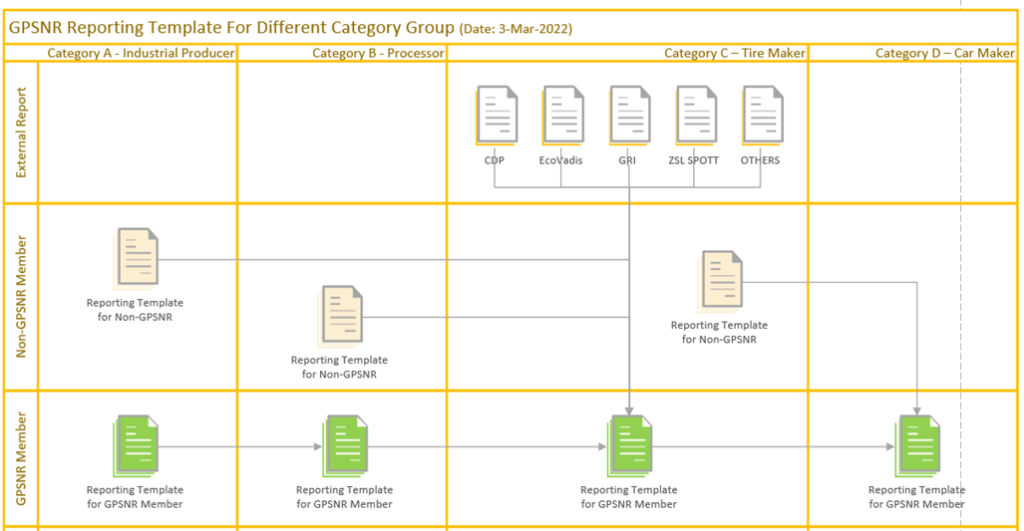
Figure below is taking one example of tire maker category member reporting on NR supply chain scope to illustrate the potential complexity of the reporting process.

The expected documents to be developed should include:

  • A guidance document for each reporting category outlining the appropriate methodology and reporting format for each question, with reference to necessary definitions. One example of reporting segment that requires guidance is Policy Component 2.5 and 2.6 for member categories C and D.
  • Standardized reporting templates which may utilize word documents, excel spreadsheets, or other appropriate reporting formats.

The documents developed should ensure that data can be consolidated easily across the supply chain with an understanding that the information will be passed downstream. Where appropriate, the requested data should align with data gathered by other reporting schemes to reduce the reporting burden (including, but not limited to, CDP, Ecovadis, ZSL SPOTT, GRI, FSC, PEFC, SNR-i).

The reporting user interface which includes ability for member to upload supporting evidence (e.g., documents, photos etc) and portal design should also enable easy intake by the Secretariat for data analysis, verification and reporting. The ability to design integration with Salesforce is a plus.

Submission Guidelines & Requirements

The following submission guidelines & requirements apply to this Request for Proposal:

  1. Proposals will only be accepted from individuals or firms with experience relevant to this project.
  2. Examples of previous relevant work should be provided as well.
  3. A technical proposal must be provided that should be around 6 pages in length. This technical proposal must provide an overview of the proposed methodology as well as resumes of all key personnel performing the work. In addition, the technical proposal should provide a proposed schedule and milestones, as applicable.
  4. A price proposal must be provided that is not more than 1 page. This price proposal should indicate the overall fixed price for the project as well as daily rates and an estimated total number of days.
  5. Proposals must be signed by a representative that is authorized to commit bidder’s company.
  6. Proposals must be received prior to 14th of March to be considered. Proposals should be submitted to stefano.savi@gpsnr.org and aidan@gpsnr.org for consideration.
  7. GPSNR anticipates shortlisting at least two individuals or firms to have more in-depth discussions with, and will make an award to one of these “down-selected” individuals or firms.


Project Timelines

The Request for Proposal timeline is as follows:

Request for Proposal Issuance   4 Mar 2022
Proposal submitted by consultant to stefano.savi@gpsnr.org   14 Mar 2022
Selection of Consultant /
Notification to Unsuccessful Bidders
18 Mar 2022
Contract Award 22 Mar 2022
Work to commence no later than   23 Mar 2022
Specific work-plan agreed upon with GPSNR’s Policy Toolbox Working Group (WG1) 24 Mar 2022
1st deliverable: first draft of guidance on GPSNR Reporting Requirement content and reporting template for PPTs (category A & B), both GPSNR and non-GPSNR. 18 Apr
2022
Final draft of guidance on content for PPTs 25 Apr 2022
2nd deliverable: first draft of guidance on GPSNR Reporting Requirement and reporting template for category C & D, both GPSNR and non-GPSNR. 13 May 2022
Final draft of guidance on content for category C & D 20 May 2022
3rd deliverable: first draft proposal for a streamline reporting process, user interface and portal design to integrate and consolidate the reporting information from all GPSNR member categories 24 Jun
2022
The final draft proposal submitted to WG1 7 Jul 2022

Budget

The Platform is anticipating that a total budget of no more than 30,000 SGD. If the consultant deems that travel plans are required to execute this project, these should be included in the proposal (along with any additional budgetary requirements).

Payment terms shall be:

●       20% at the signing of the contract
●       30% at the midpoint date to be agreed upon and memorialized in the contract based on the submitted work plan
●       50% on delivery of the final report

Evaluation Factors

GPSNR will rate proposals based on the following factors, with cost being the most important factor:

  1. Cost
  2. Responsiveness to the requirements set forth in this Request for Proposals
  3. Relevant past performance/experience
  4. Technical expertise/experience of bidder and bidder’s staff
  5. The ability to collect relevant information at the global and local level

GPSNR reserves the right to award to the bidder that presents the best value to GPSNR as determined solely by GPSNR in its absolute discretion.

Request For Proposal – GPSNR-RFP-C03-036-Review and support the development of a Central Repository

Introduction & Background
The Global Platform for Sustainable Natural Rubber (GPSNR) is an international, multi-stakeholder, voluntary membership initiative seeking to lead improvements in the socioeconomic and environmental performance of the natural rubber value chain. Members of the platform include rubber products manufacturers, natural rubber suppliers and processors (PPTs), end users, smallholders, and civil society organisations. 

The Manufacturer’s Subgroup (SG) consists of GPSNR members who are rubber product manufacturers only.  Traditionally tracing each companies supply chain takes on an individualistic approach due to the sensitive nature of the data. However, to expedite the enhancement of traceability in view of EUDR, the SG has decided on a collaborative approach by developing a Central Repository. 

The Central Repository functions as a database for storing polygons and supply chain information contributed by individual members. It will also link the smallholders, PPTs and manufacturers on a single platform while reducing duplicated mapping efforts between different manufacturers. The Repository should allow for easy extraction of information for GPSNR’s Due Diligence System and be integrated with the EU information system. Moreover, the repository should either integrate different Risk, Traceability and Deforestation mapping tools or have the data formatted in a way that allows for seamless input into the tools. 

In addition, considering the sensitive nature of individual companies’ supply chain information, the platform must implement various layers of access control. This will ensure that each manufacturer can only access information pertaining to their own supply chain. Furthermore, the repository should have distinct tiers of users, including end users, manufacturers, PPTs, and smallholders, with each tier granted access privileges relevant to their role.

Objectives and Scope of Work/ Deliverables
GPSNR expects the consultant to deliver the following:

  1. Craft a database that stores polygon and supply chain information to the plantation level and allows for the upload of geo-mapping information. 
    1. The database should also have an online dashboard view of mapped / Mapping-in-progress farmlands, contract/seller invoice information – outstanding and shipped)

  2. The Central Repository should allow data to flow to and from or store data in a way that is compatible for the uses below:
    1. Traceability tool providers (Eg – Koltiva, TRST01, Harmuni (Agridence etc))
    2. Deforestation mapping tools (Eg – LiveEO, Satelligence, Starling etc)
    3. Risk assessment systems/tools (Eg – ASI Tool or Others as available etc)

  3. Create levels of access authorizations for different accounts within the platform – 
    1. User accounts for uploading geo mapped data
    2. Access to viewing the geo-mapped data linked to user accounts for the PPTs and Manufacturers
      1. Users should only have access to information from within their own supply chains or information that they input to the repository
      2. Users should be able to form links across different tiers. For example, users should be able to form links between smallholders and PPTs, PPTs and manufacturers. 
      3. When there are several members which require access to geo mapped data from one user, the platform should have the ability to extend access authorization to multiple users.
    3. Extracting information from Due Diligence Systems and integrating it with the EU Information System (this should be limited to manufacturers only)

  4. The platform should be compliant with applicable data privacy norms and regulations which include but are not limited to the GDPR and PDPA.

  5. A fee structure including management of shared cost arising from overlapping access to geo mapped data.

  6. Data protection and cyber security policies

  7. Service Level Agreements including downtime, maintenance, customer support and service, updates.

  8. Data Backup

  9. Server location – Singapore (Preferred)

  10. A timeline for development of the Central Repository (milestones with details)

  11. Optional – Deforestation monitoring tool integrated with central repository and the applicable fee structures

Proposal Format and Contents
The proposal should include the following:

  1. A workplan that outlines all key activities of the deliverables (as outlined in Expected Deliverables above)
  2. Timeline and key stages of operations (based on Project Timeline below) 
  3. Budget, including detailed breakdown of expected manpower, logistics, and costs 
  4. Description of past work and technical expertise that is relevant to this RFP
  5. A list of project team members with their roles in the project and associated qualifications.

Submission Guidelines & Requirements 
The following submission guidelines & requirements apply to this Request for Proposal: 

  1. Proposals will only be accepted from individuals or firms with experience relevant to this project. 
  2. Examples of previous relevant work should be provided as well. 
  3. A technical proposal must be provided that is not more than 4 pages. This technical proposal must provide an overview of the proposed solution as well as resumes of all key personnel performing the work. In addition, the technical proposal should provide a proposed schedule and milestones, as applicable. 
  4. A price proposal must be provided that is not more than 1 pages. This price proposal should indicate the overall fixed price for the project, a cost breakdown, and daily rates and an estimated total number of days. 
  5. Proposals must be signed by a representative that is authorized to commit bidder’s company. 
  6. Proposals should be submitted to stefano.savi@gpsnr.org and aidan@gpsnr.org for consideration. 
  7. GPSNR reserves the right to amend the scope and budget of this RFP in order to get the most suitable consultant for each topic. 

Project Timelines 

RFP Published

4 Sep 2023

Proposal Submission Deadline

25 Sep 2023

Contract Awarded

9 Oct 2023

First consultation with Manufacturer’s Subgroup 

23 Oct 2023

Bi-weekly progress updates

23 Oct – 18 Dec

Final Report + Deliverable submission

19 Dec 2023

Budget
The Platform will review budget proposals from service providers and the budget will comprise an important part of awarding the contract.

Payment terms shall be:

  • 20% at the signing of the contract
  • 30% at the midpoint date to be agreed upon and memorialized in the contract based on the submitted work plan
  • 40% on go-live 
  • Balance 10% – 1 month after go-live

Evaluation Factors
GPSNR will rate proposals based on the following factors, with cost being the most important factor:

  1. Responsiveness to the requirements set forth in this Request for Proposal
  2. Relevant past performance/ experience
  3. Samples of work
  4. Cost, including an assessment of total cost of ownership
  5. Technical expertise/experience of bidder and bidder’s staff

GPSNR reserves the right to award to the bidder that presents the best value to GPSNR as determined solely by GPSNR in its absolute discretion.


View RFP Document here

Scroll to Top