

It’s a Wrap: GPSNR’s Fourth Smallholder International Call

Share This Post

Although it had been more than a month since the GPSNR smallholder members had met at the international level, they took their places in the online meeting with a sense of familiarity that was heartening to see. 

We had come a long way since the first international call in late August. Since then, the second and third international calls had taken place, focusing on preparing the smallholders for the General Assembly. In the weeks after the General Assembly, the Country Champions helped to organise national-level calls for the smallholders to recap the results of the resolutions and Executive Committee (EC) elections, and to discuss topics of interest to be brought up during the fourth and final international call as part of the series.

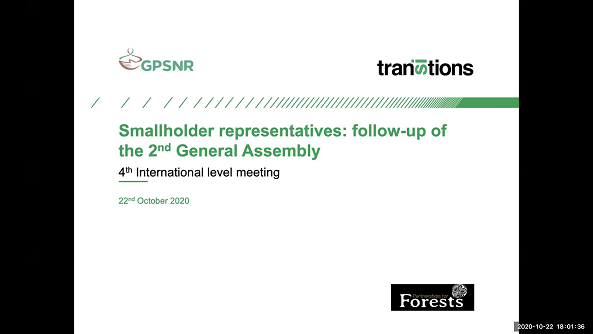
The fourth international call was held in the evening of 22 October, and attended by smallholder members from all seven countries. The call began with an update from the three smallholder EC representatives on the EC calls that they had attended thus far. Overall, the representatives had positive takeaways from the EC meetings, despite some language barriers remaining. 

Next, the Co-Chairs of GPSNR’s various Working Groups joined the call in order to introduce each of their Working Groups and briefly explain key focuses and projects. This generated some questions around the policy equivalent for smallholder members, as well as GPSNR’s approach towards traceability for smallholder producers. Several smallholder members also expressed interest in participating in these Working Groups. The Secretariat will get in touch with all smallholders members to facilitate their inclusion in the platform’s Working Groups.

The final half hour of the call was dedicated to a discussion on smallholder community dynamics and how to manage the exchange of information within the category while understanding the geographical and linguistic differences amongst the clusters of smallholder members. 

This concludes the series of preparatory calls designed by the Smallholder Representation Working Group to prepare smallholders for their first GPSNR General Assembly and outcomes. But as the saying goes: when one door closes, another opens. And in this case, the door has opened for the newest membership category to define the parameters and mechanisms of their involvement within the platform, with the support of the Secretariat and fellow GPSNR members.


More To Explore

Members

Member Consultation on proposed GPSNR Policy Components and Baseline Reporting Requirements (Members Version)

Natural rubber faces a similar set of environmental, social and economic issues as other agricultural commodities such as palm oil, but the spotlight on sustainability has only been recently turned towards this key raw material, 70% of which goes into tire production. The launch of GPSNR marked a significant step towards developing sustainable standards for natural rubber, with member organizations making a commitment to 12 Sustainable Natural Rubber Principles

The Policy Toolbox Working Group was established to develop a guiding framework for GPSNR members to implement policies and practices that align with the 12 Principles. Two key documents, the Policy Components and Baseline Reporting Requirements, have emerged after a year of discussion and drafting. 

The Policy Components outline specific commitments that GPSNR company members should include in their sustainable natural rubber policies, while the Baseline Reporting Requirements indicate qualitative and quantitative sustainability data to be reported to the Secretariat for the first year of reporting. 

A members webinar was held on 16 June, where the Co-Chairs of the Policy Toolbox Working Group explained the purpose, process and next steps surrounding the two documents. 

Several members have volunteered to participate in an ongoing pilot testing of the Baseline Reporting Requirements. The goal of the pilot is to refine and finalize the Baseline Reporting Requirements based on company feedback.

The proposed Policy Components and Baseline Reporting Requirements are now open for member consultation until 3 July 2020.

All GPSNR members are invited to download the draft documents from the links below and submit your feedback by accessing this link.

Additionally, you may view the recording and slide deck of the 16 June webinar from the links below.

Download Policy Components 

Download Baseline Reporting Requirements

View 16 June webinar recording

View 16 June webinar slide deck

News

GPSNR Working Groups Update: October 2020

In our last issue, we explored the road ahead for GPSNR’s Working Groups following the outcome of the second General Assembly. In this update, we check in on each Working Group to see where they are in their respective journeys.

Strategy and Objectives Working Group

The Strategy and Objectives Working Group has already started working on a proposal for increased Working Group alignment within the Platform. The Working Group is also finalizing the Request for Proposal (RFP) for a study on environmental impacts, and risks, in the natural rubber value chain. With its intended focus on biodiversity and ecosystem services, this study will complement the previously commissioned social risks study (conducted by independent consultants James Griffiths & Associates Sàrl). 

The Living Income Gap studies for Indonesia and Thailand, initiated by the Equity sub-Group, are expected to be delivered to the sub-Group in November. 

‘Policy Toolbox’ Working Group

The Policy Toolbox Working Group has drafted revised Terms of Reference (ToR) that will cater to the work they now have to develop following the approval of the Policy Components at the General Assembly on 23 September 2020. The next phase of work will see the Policy Toolbox Working Group developing implementation guidance for each stakeholder group, as well as future reporting requirements that will build on the baseline reporting requirements and align with the policy implementation guidance. The revised ToR will be discussed further at the Executive Committee level before being approved. 

The Policy Components were approved as part of a resolution for the endorsement of a GPSNR policy framework for natural rubber production and sourcing for ordinary member companies. A booklet containing the Policy Components can be found here.

‘Capacity Building’ Working Group

The Working Group’s latest discussion was centered around its restructuring, and touched on considerations for a revised ToR to accommodate the shift in focus from developing strategies to operationalizing them. The Working Group has also kickstarted discussions around the initiation process for one of the capacity building strategies, namely the identification and gathering of Good Agricultural Practices.

‘Traceability and Transparency’ Working Group

The Working Group will soon be reviewing Traceability and Transparency Tools Comparison study to develop next steps as well as recommendations to the Executive Committee.

Download the October 2020 Working Groups Update Slide Deck for more details on the progress of each Working Group.

Scroll to Top