

GPSNR Working Groups Update: March 2022

Share This Post

All GPSNR working groups have a large chunk of work ahead of them. Here are all their updates: 

Strategy and Objectives Working Group

The group has made good progress by establishing the new risk task force that will evaluate the exact scope of GPSNR’s risk based approach. It has also got its new Terms of Reference approved by the Executive Committee, and is now working on contracting a consultant for the Economic Risk Study and conducting a gap analysis of GPSNR’s current activities based on the platform’s Theory of Change.

Smallholder Representation Working Group

Having published the RFP to develop the GPSNR Smallholders Policy Framework equivalent, the group is focussing on the first Smallholders International Call of the year in March 2022, workshops in Liberia and Malaysia, and on developing country-specific smallholder engagement activities with smallholders and Country Champions.

Policy Toolbox Working Group

This group is continuing discussions among its three new subgroups: Transparent reporting roadmap, Implementation Guidance and RR Guidance & Tools. In the coming months, they will finalize guidance for the reporting requirements and share it with companies

At the same time, they are working with the smallholder representation working group on the Smallholder Policy Framework equivalent.

Capacity Building Working Group

After publishing the GAPs as living documents in English and Bahasa and selecting SNV-Proforest and Koltiva as consultants to work on the GAPs coaching in Indonesia, the working group continues to develop capacity building plans for Indonesia, Thailand and Ivory Coast.

They are also seeking your inputs for GPSNR’s knowledge sharing platform, which you can provide here.

Traceability and Transparency Working Group

Having finalized the traceability and transparency primer, the WG will wind down its operations.

Shared Responsibility Working Group

The Shared Responsibility has completed a review of the Shared Responsibility Framework, incorporating feedback from the Executive Committee. The Working Group will present an updated proposal to the EC as the next step, with a view to prepare a resolution at the 2022 General Assembly.
More To Explore

News

Secretariat Update – October 2019

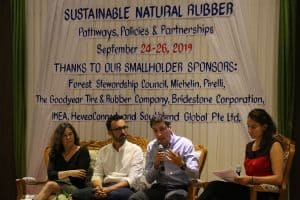
In attendance were farmers, processors, tire companies, apparel and footwear brands, NGOs and governmental representatives, all together over 100 participants. 

 The event offered a space for the diverse set of attendees to discuss the challenges and opportunities experienced by the rubber sector in the adoption and implementation of individual and global commitments to sustainable and ethical rubber with a focus on solutions. What set the workshop apart from the regular workshop we all know, was the addition of a field-excursion to two rubber-plantations operating under differing production models: a farm applying agro-forestry with a mix of native hardwoods and rubber trees and one fully developed diversified community agro-forestry farm. Additionally, instead of solely focusing on NGOs, companies and governmental representation (as the regular workshop often does), delegations from a number of farmer associations representing various countries also attended and provided key input to inform discussions from the farmer’s perspective.

Days 2 and 3 of the workshop were focused on forming partnerships and generating solutions to begin working towards a transformed natural rubber supply chain which delivers value to all actors from the farm to the end user.  Break out groups comprised of farmers, processors, brands, NGOs, tire companies and government representatives discussed topics such as traceability, policy implementation and capacity building for smallholders. Each break out group then categorized their discussions into short term actions, long term actions, barriers and learning curves which will be summarized into a collective call to action by the organizing team.  One of the most powerful outcomes was an overall agreement amongst all stakeholders in attendance that to truly bring about positive transformation we must all work together towards a shared vision.

A public summary of the event will be shared in the coming days, please contact Samantha Morrissey (smorrissey@ra.org) or Margaret Kran-Annexstein (margaret@mightyearth.org) with any questions.

Natural Rubber Supply Chain urges European Parliament not to amend essence of EUDR

PRESS RELEASE

Natural Rubber Supply Chain urges European Parliament not to amend essence of EUDR 


Singapore, 13 November 2024: As Members of the European Parliament (MEPs) convene to vote on 14th November on the proposed amendments to the EUDR, the Global Platform for Sustainable Natural Rubber (GPSNR) urges them to provide legal certainty around the implementation timeline and not re-open the regulatory text.

Along with the European Tire and Rubber Manufacturers Association, GPSNR has written to the European Parliament earlier this month to ask MEPs to use the proposal for amendments solely to create certainty about the timeline and not change the substance of the regulation. 

GPSNR members represent almost 60% of the global NR demand and include OEMs, manufacturers of rubber products, producers and traders of natural rubber, smallholder farmers, and civil society. All these stakeholders have worked tirelessly and swiftly to comply with the regulation, whose original date of implementation is weeks away. 

Notwithstanding this, GPSNR believes MEPs have a key role in ensuring the European Commission uses the proposed additional 12 months for implementation to resolve the remaining issues, particularly the functioning of the information system and the necessary secondary legislation, including on the benchmarking system as well as completing the planned review of the relevant products in Annex I by June 2025. 

The natural rubber industry strongly supports the vision of the EUDR and GPSNR members have been working on committing to and implementing strong environmental and human rights related principles in their operations for a long time. These efforts need the support of a fair and transparent regulatory environment that can help the industry move further ahead on their efforts on deforestation and human rights. 


END

About GPSNR: 

GPSNR is an international membership driven platform set up to define sustainability for the natural rubber value chain. It brings together various stakeholders to a common ground based on fairness, equity and environmental sustainability. More on sustainablenaturalrubber.org


For more information, please contact:

Bani Bains

Communications Director

Email: bani.bains@gpsnr.org

Ph: +65 97268165


Scroll to Top