

GPSNR Working Groups Update: July 2023

Share This Post

Strategy and Objectives Working Group:

The Key Performance Indicators (KPIs) were successfully agreed upon during the June Hybrid meetings, and are awaiting review and approval for the OEMs KPI. 

In pursuit of defining targets related to member’s water withdrawal within the KPIs, surveys have been sent out. The results from the water withdrawal surveys will be analyzed and integrated into the KPIs.

ASI has been selected to develop the Assurance Model for GPSNR and has commenced discussions. ASI’s assignment for the Assurance Model involves presenting a framework proposal before the 2023 General Assembly.

The completion of the first consultation for the Due Diligence System (DDS) was completed during the June Hybrid meetings. The second round of consultations for the Due Diligence System by ZSL has been initiated. A teleconsultation, scheduled for the end of July, will provide an opportunity to discuss the feedback obtained. 

The Risk Subgroup has been working on the Traceability Pilot Field Trials, and consortiums Agridence and Koltiva have provided their midpoint updates.

ASI has finalized the initial version of the Risk Assessment Framework. Feedback has been collected to further enhance its effectiveness. Risk subgroup has extended an invitation to ASI to disclose the underlying formula of the Risk Assessment Framework. The initial trial of pre-setting Indonesia’s Risk level using the ASI risk tool has been completed. The results will aid in evaluating the feasibility of setting risk levels for 20 countries, with members’ feedback actively being incorporated to enhance user-friendliness.

Discussions between the Basel Institute and the Risk subgroup have commenced, this collaboration aims to investigate corruption risks within the supply chain.

The submission of Agridence and Koltiva’s final reports for the Traceability Enhancement will happen at the end of July. Subsequently, work will commence on fleshing out the Enhancing Traceability Report.

Smallholders Representation and Capacity Building (SCB) Working Group:

The discussion on Agroforestry Workshops for 2023-2024 has been successfully finalised. The Agroforestry-Income Diversification Taskforce will complete the contractual signing and then proceed to kick-start the preparation for agroforestry workshops in 2023-2024.

The HCSA-HCVN Field Trials task force has reviewed and provided feedback on the final report submitted by Daemeter. Additionally, the HCSA-HCVN Field Trials task force will revise and prepare to submit their final report.

The Thailand Agroforestry project has presented a progress report covering March to May 2023. The team is actively preparing for upcoming training sessions with smallholders.

The Indonesia National Subgroup will present quarterly progress reports to the SCB WG for the GAP Coaching and Disease Fighting projects in early August. The Thailand National Subgroup is currently evaluating proposals for Thailand GAP Coaching.

The Smallholders Policy-Equivalent (SPE) Taskforce is aiming to obtain endorsement from the SCB WG for the final recommendations of their report in early August.

Policy Toolbox Working Group:

The Transparent Reporting Requirements (TRR) for Year 2 have been successfully agreed upon and are now pending review and approval for the OEM category.

Petra Westerlaan, the selected consultant for the Working Group (WG), proposed a quantitative orientation for the reporting matrix. This quantification approach will simplify data aggregation and streamline the evaluation of annual progress. The WG has received Petra’s proposed reporting matrix and is all set to initiate teleconsultations in the first week of August. These sessions will facilitate valuable discussions on the feedback received, ensuring achievement of the most effective reporting system.

In addition, Agridence has presented their proposal for a new reporting requirements platform. They will keep the Working Group informed about its testing, launch, and any subsequent updates.

Shared Responsibility Working Group: 

During the face-to-face meeting, the Governance and Guiding principles were presented, highlighting their importance in shaping the future direction of GPSNR. Manufacturers are now required to seek internal approval regarding the Governance Framework and subsequently provide a final version for approval to the GPSNR Executive Committee (EC) and General Assembly.

The SR WG is actively engaged in defining an inclusive shared investment framework, encompassing various forms of contribution such as in-kind support, financial contributions, and external funding. The outcomes of discussions at the Manufacturers category level will play a crucial role in shaping this framework.

Collaborating with the Secretariat and other WGs, the SR WG is committed to revamping discussions on data sharing and value transfer, recognizing their significance in achieving our objectives. These discussions will seek to optimize the sharing of data and the value derived from it.

To provide clarity and transparency, the WG aims to define the value and benefits associated with each category within GPSNR, ensuring that all stakeholders are aware of the advantages and opportunities available.

Furthermore, the WG, in collaboration with the Capacity Building WG, is working on developing a protocol to filter and evaluate proposals based on the Equity definition and the stakeholders identified by the EC. This process will ensure fair and comprehensive evaluation of proposals.

Lastly, an open co-chair position is available, and volunteers are welcomed to contribute their expertise and leadership to drive the WG forward. If you are interested in taking on this role, please step forward and join us in this important endeavour.

More To Explore

News

Secretariat Update – August 2019

The signing of the MoU took place at IRSG’s Office in Singapore, on the 6 August 2019 by Mr Salvatore Pinizzotto, IRSG Secretary General and Mr Stefano Savi, GPSNR Director. The MoU will have the aim of consolidating, developing and detailing the cooperation between the two organisations. It will also contribute to the effectiveness to achieve the organisations’ common objectives in the field of sustainable production and consumption of natural rubber.

The cooperation will have a focus on Sustainability in the Natural Rubber Value Chain, particularly in relation to socio-economic and environmental aspects linked to the natural rubber sustainable production and consumption. Immediate opportunities for collaboration have been identified in the following areas: 

  1. Definition of Natural Rubber Sustainability and identification of appropriate standards, building on the activity carried out from IRSG in the SNR-i project.
  2. Natural Rubber Sustainability and socio-economic impacts on smallholders in producing countries.
  3. Land tenure right and sustainable income of smallholders in producing countries.
  4. Impact of climate change in rubber plantations and mitigation of risks.

The International Rubber Study Group (IRSG) was established in 1944 and is the only intergovernmental organization that brings the world’s rubber producing and consuming stakeholders together. The IRSG is the forum for the discussion of matters affecting the supply and demand for natural as well as synthetic rubber. IRSG is at the forefront in conducting activities and research on the sustainability of the natural rubber economy. IRSG has 36 member Governments and more than 700 industry members covering the whole natural rubber value chain.

The Global Platform for Sustainable Natural Rubber (GPSNR) is an international, multistakeholder, voluntary membership organization, with a mission to lead improvements in the socioeconomic and environmental performance of the natural rubber value chain. Development of the GPSNR was initiated by the CEOs of the World Business Council for Sustainable Development (WBCSD) Tire Industry Project (TIP) in November 2017. Currently the Platform has 51 Members including Producers, Processors & Traders, Tire makers and other rubber makers/buyers, Carmakers, other downstream users and Financial Institutions, and Civil society.

Representatives from each of these stakeholder groups have contributed to the development of the Singapore-based platform and the wide-reaching set of priorities that will define GPSNR strategy and objectives.

News

Continuing the Conversation with GPSNR Topic Talks – The Sumatran Rubber Pilot

The GPSNR Topic Talks webinar series is organised by the GPSNR Secretariat and presented by GPSNR members. The webinars cover several themes around sustainability and the global natural rubber supply chain.

The Topic Talks series continued on the 17th of March with Dr. Michael Steuwe from WWF US and Gerald Tan from HeveaConnect presenting on the Sumatran Rubber Pilot.

The Sumatran Rubber Pilot (SRP) is a voluntary, self-financed collaboration of rubber supply chain players and technical experts interested to facilitate the production and trade of transparent and sustainable natural rubber. The participating processing mills, tire makers, civil society organisations, technology providers and financial institutions have three major objectives:

  • Demonstrate how rubber’s downstream can work together to make its upstream more sustainable.
  • Identify, test, evaluate, and report on what it takes to achieve, and how to pay for transparent sustainable natural rubber supply chains.
  • Develop “Proof of Concept” approaches from and for GPSNR discussions on policy requirements and implementation, transparency and traceability, capacity building, and shared responsibility.

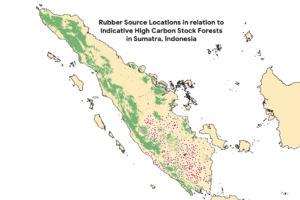
Within a few months of the project launch in July 2020, SRP’s four rubber processing factories, managed by the Halcyon Agri and ITOCHU groups, had traced up to 1 year of rubber supplies to the village and/or sub-district of origin based on self-declarations by their supplying dealers. These approximate origins of the rubber sources were filtered through WWF Indonesia’s new environmental risk assessment and management tool which identifies High Conservation Value Areas and High Carbon Stock Forest for the whole island of Sumatra. The results allow processors and their respective downstream supply chains to focus their sustainability work with farmers on priority areas.

The SRP partners are enhancing dealer self-declarations with digital apps such as CropIn and Hamurni to assess farms’ potential environmental, social, equity, labour and legal issues accurately and to address them.

As GPSNR adopts principles and criteria for what constitutes transparent and sustainable rubber, the risk assessment algorithms will be adapted to flag compliant rubber accordingly. This is increasingly important for rubber’s downstream as companies’ Environmental, Social, Governance (ESG) impacts are becoming key evaluation criteria for investors and financiers who will demand the disclosure of the relevant information. In a parallel development, new supply chain laws will require major companies like the world’s car and tire makers to be responsible for the environmental and social impacts of their supply chains. The collection and analysis of detailed data on upstream supply chains will have to become an essential part of doing business and SRP partners are working to respond appropriately to these changes.

While continuing to focus on increasing the resolution of tracing rubber to its origin and collecting the respective data, SRP will now begin finding ways to best address the social, equity, labour, and legal issues that may have come up in supply chain assessments. 

The SRP is a voluntary, open and flexible platform of like minded partners interested in testing a diversity of approaches to achieve supply chain transparency and sustainability, and welcomes interested rubber supply chain actors to reach out and discuss how they might join the collaboration. GPSNR members interested in participating in the SRP should reach out to the GPSNR Secretariat to get involved in the project.

Scroll to Top