

Continuing the Conversation with GPSNR Topic Talks – The Sumatran Rubber Pilot

Share This Post

The GPSNR Topic Talks webinar series is organised by the GPSNR Secretariat and presented by GPSNR members. The webinars cover several themes around sustainability and the global natural rubber supply chain.

The Topic Talks series continued on the 17th of March with Dr. Michael Steuwe from WWF US and Gerald Tan from HeveaConnect presenting on the Sumatran Rubber Pilot.

The Sumatran Rubber Pilot (SRP) is a voluntary, self-financed collaboration of rubber supply chain players and technical experts interested to facilitate the production and trade of transparent and sustainable natural rubber. The participating processing mills, tire makers, civil society organisations, technology providers and financial institutions have three major objectives:

  • Demonstrate how rubber’s downstream can work together to make its upstream more sustainable.
  • Identify, test, evaluate, and report on what it takes to achieve, and how to pay for transparent sustainable natural rubber supply chains.
  • Develop “Proof of Concept” approaches from and for GPSNR discussions on policy requirements and implementation, transparency and traceability, capacity building, and shared responsibility.

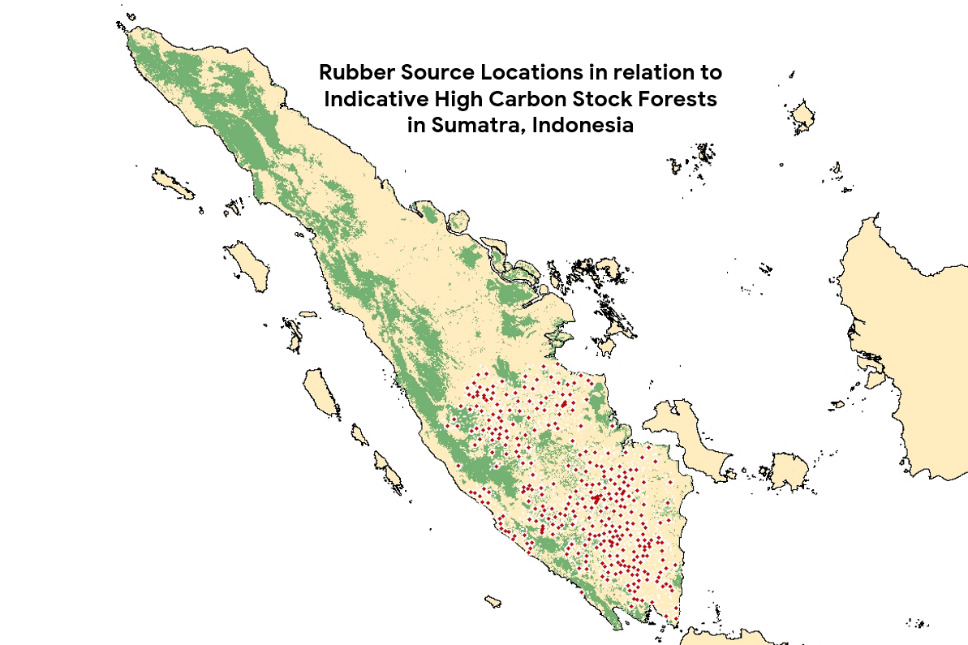
Within a few months of the project launch in July 2020, SRP’s four rubber processing factories, managed by the Halcyon Agri and ITOCHU groups, had traced up to 1 year of rubber supplies to the village and/or sub-district of origin based on self-declarations by their supplying dealers. These approximate origins of the rubber sources were filtered through WWF Indonesia’s new environmental risk assessment and management tool which identifies High Conservation Value Areas and High Carbon Stock Forest for the whole island of Sumatra. The results allow processors and their respective downstream supply chains to focus their sustainability work with farmers on priority areas.

The SRP partners are enhancing dealer self-declarations with digital apps such as CropIn and Hamurni to assess farms’ potential environmental, social, equity, labour and legal issues accurately and to address them.

As GPSNR adopts principles and criteria for what constitutes transparent and sustainable rubber, the risk assessment algorithms will be adapted to flag compliant rubber accordingly. This is increasingly important for rubber’s downstream as companies’ Environmental, Social, Governance (ESG) impacts are becoming key evaluation criteria for investors and financiers who will demand the disclosure of the relevant information. In a parallel development, new supply chain laws will require major companies like the world’s car and tire makers to be responsible for the environmental and social impacts of their supply chains. The collection and analysis of detailed data on upstream supply chains will have to become an essential part of doing business and SRP partners are working to respond appropriately to these changes.

While continuing to focus on increasing the resolution of tracing rubber to its origin and collecting the respective data, SRP will now begin finding ways to best address the social, equity, labour, and legal issues that may have come up in supply chain assessments. 

The SRP is a voluntary, open and flexible platform of like minded partners interested in testing a diversity of approaches to achieve supply chain transparency and sustainability, and welcomes interested rubber supply chain actors to reach out and discuss how they might join the collaboration. GPSNR members interested in participating in the SRP should reach out to the GPSNR Secretariat to get involved in the project.

More To Explore

News

GPSNR Working Groups Update: November 2020

Strategy and Objectives Working Group

The Strategy and Objectives Working Group is currently revising its Terms of References (ToR) to better reflect the plans for further developing GPSNR’s Theory of Change. 

The Request for Proposal (RFP) for a study on environmental impacts, and risks, in the natural rubber value chain has been published. GPSNR members are invited to circulate the RFP to any relevant contacts who might be interested in submitting proposals for this work. The deadline for submission of proposals is 27 November 2020.  

The Equity sub-Group has received the first drafts of the Living Income Gap studies for Indonesia and Thailand, and these are currently in review by both members of the sub-Group as well as the engaged consultants. The extension of the study on Human Rights and Labour Rights’ Risk Mapping in the Global Natural Rubber Value Chains conducted by independent consultants James Griffiths & Associates Sàrl, which focuses on issues of equity, is near its completion phase.

‘Policy Toolbox’ Working Group

The revised Terms of Reference (ToR) for the Policy Toolbox Working Group is being reviewed. Following approval of the ToR, the Working Group will be in a good position to move forward on development of the implementation guidance for stakeholder groups, as well as policy equivalents for civil society organizations and smallholder producers.

The Working Group has also conducted a preliminary revision of the Baseline Reporting Requirements following feedback from GPSNR member companies during the pilot testing stage. To find out more about the Baseline Reporting Requirements pilot testing, check out our latest article, ‘Updates on the GPSNR Baseline Reporting Requirements Pilot Test’.

‘Capacity Building’ Working Group

The Working Group is in the midst of revising its Terms of Reference (ToR) to cater to the shift in focus to implementation plans. The Working Group is also putting together a Good Agricultural Practices (GAP) Task Force that will work to identify and/or refine guiding principles for GAPs appropriate for the sustainable production of natural rubber that cater to both Industrial Plantations and Smallholder Farmers. The goal of this Task Force will be to create a document stating a high-level, international set of GAPs that can be disseminated to national Capacity Building groups for adaptation to local contexts.

The Task Force is currently looking for smallholder members who have experience in Good Agricultural Practices to join the Task Force. They will have the opportunity to collaborate and create the GAPs together with other Task Force members. Interested smallholder members are welcome to contact Aidan for more information.

‘Traceability and Transparency’ Working Group

The Working Group is reviewing the two studies that were commissioned earlier. Plans to review the Working Group’s Terms of Reference (ToR) are also in the works as its members consider the next steps vis-à-vis the findings and conclusions from the studies. 

Smallholder Representation Working Group

Following the fourth international call with smallholder members, the Working Group has consolidated the responses from smallholder members who indicated their interest in participating in our Working Groups. A plan is underway to onboard these smallholder members into the various Working Groups.

Members

GPSNR Working Groups Update: November 2020 (Members Version)

Join the Chairs and Co-Chairs of the Executive Committee and Working Groups as they share more on their current projects and upcoming highlights. Members will be able to pose queries to the panelists during the live Q&A session.

Register Now!

Strategy and Objectives Working Group

The Strategy and Objectives Working Group is currently revising its Terms of References (ToR) to better reflect the plans for further developing GPSNR’s Theory of Change. 

The Request for Proposal (RFP) for a study on environmental impacts, and risks, in the natural rubber value chain has been published. GPSNR members are invited to circulate the RFP to any relevant contacts who might be interested in submitting proposals for this work. The deadline for submission of proposals is 27 November 2020.  

The Equity sub-Group has received the first drafts of the Living Income Gap studies for Indonesia and Thailand, and these are currently in review by both members of the sub-Group as well as the engaged consultants. The extension of the study on Human Rights and Labour Rights’ Risk Mapping in the Global Natural Rubber Value Chains conducted by independent consultants James Griffiths & Associates Sàrl, which focuses on issues of equity, is near its completion phase.

‘Policy Toolbox’ Working Group

The revised Terms of Reference (ToR) for the Policy Toolbox Working Group is being reviewed. Following approval of the ToR, the Working Group will be in a good position to move forward on development of the implementation guidance for stakeholder groups, as well as policy equivalents for civil society organizations and smallholder producers.

The Working Group has also conducted a preliminary revision of the Baseline Reporting Requirements following feedback from GPSNR member companies during the pilot testing stage. To find out more about the Baseline Reporting Requirements pilot testing, check out our latest article, ‘Updates on the GPSNR Baseline Reporting Requirements Pilot Test’.

‘Capacity Building’ Working Group

The Working Group is in the midst of revising its Terms of Reference (ToR) to cater to the shift in focus to implementation plans. The Working Group is also putting together a Good Agricultural Practices (GAP) Task Force that will work to identify and/or refine guiding principles for GAPs appropriate for the sustainable production of natural rubber that cater to both Industrial Plantations and Smallholder Farmers. The goal of this Task Force will be to create a document stating a high-level, international set of GAPs that can be disseminated to national Capacity Building groups for adaptation to local contexts.

The Task Force is currently looking for smallholder members who have experience in Good Agricultural Practices to join the Task Force. They will have the opportunity to collaborate and create the GAPs together with other Task Force members. Interested smallholder members are welcome to contact Aidan (aidan@gpsnr.org) for more information.

‘Traceability and Transparency’ Working Group

The Working Group is reviewing the two studies that were commissioned earlier. Plans to review the Working Group’s Terms of Reference (ToR) are also in the works as its members consider the next steps vis-à-vis the findings and conclusions from the studies. 

Smallholder Representation Working Group

Following the fourth international call with smallholder members, the Working Group has consolidated the responses from smallholder members who indicated their interest in participating in our Working Groups. A plan is underway to onboard these smallholder members into the various Working Groups.

Download the November 2020 Working Groups Update Slide Deck for more details on the progress of each Working Group.

Scroll to Top