
Strategy and Objectives Working Group Update – January 2020

In preparation for the finalized desired state and Theory of Change proposals to be presented at the upcoming 2nd General Assembly, the Working Group has observed the need to develop a user-friendly document for the communication of their deliverables to the rest of the GPSNR members.

Share This Post

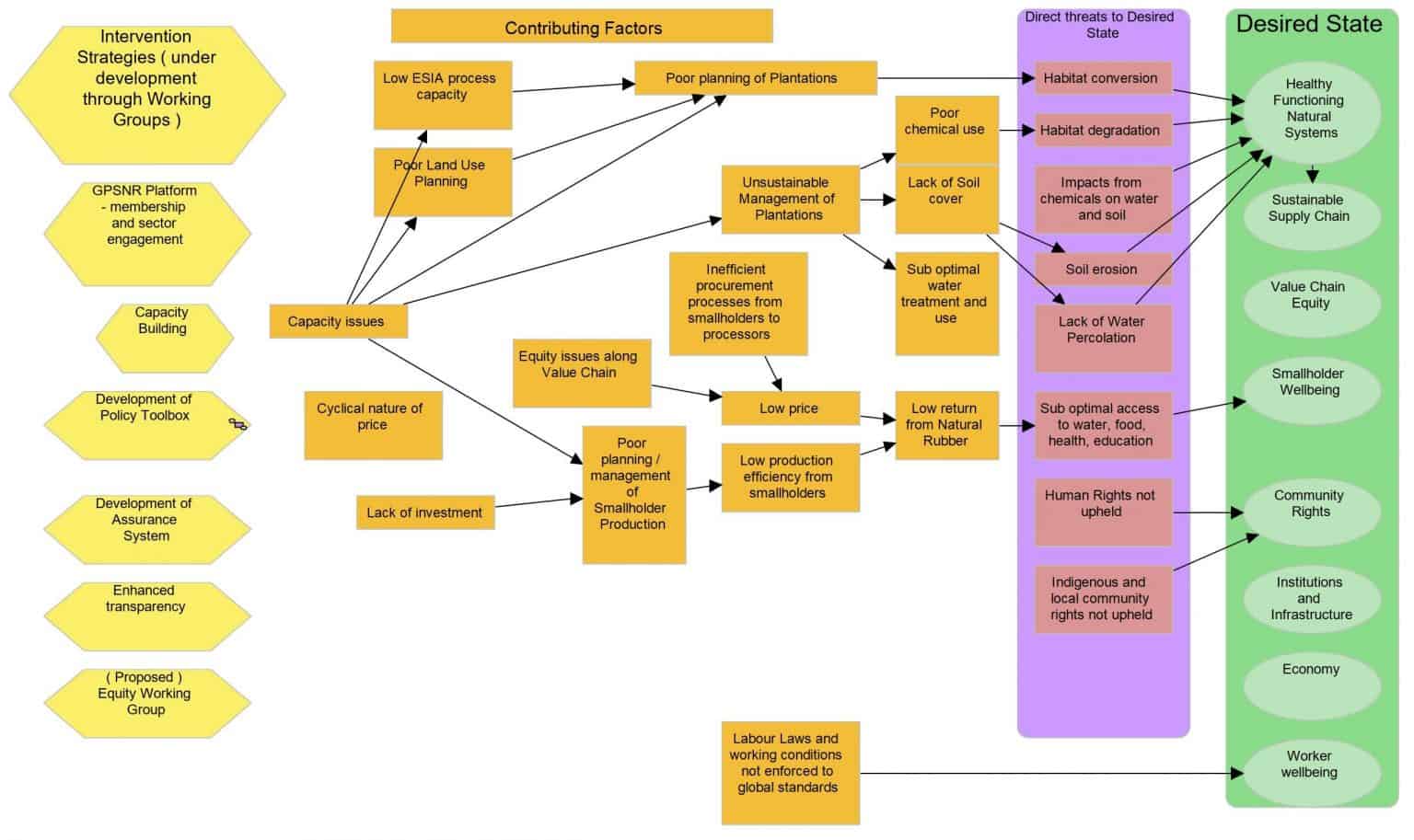
Using the Theory of Change model, the Working Group identified root causes that prevent the natural rubber supply chain from achieving the desired state. Once these root causes were agreed upon, effective strategies could be designed to mitigate them.

Considering that the natural rubber industry and the world around it is not static but changes with time, the Working Group has planned for the Theory of Change to be a living document that GPSNR members will continually update and maintain. This will ensure its relevance and role in realizing the vision of GPSNR.

In addition to the above, the Working Group is drafting the Terms of Reference (ToR) for the Equity sub-Working Group. The sub-Working Group’s focus will be on how we can ensure equity along the supply chain.

‘Policy Toolbox’ Working Group

Working Group members’ comments on the first draft of the top line policy components were consolidated and incorporated into an updated draft. For ease of understanding, it was agreed that the policy components and implementation components would be displayed in separate tables. This would allow members to more easily distinguish the policy commitments they should adopt, and the corresponding actions they should implement.

The Working Group aims to have the top line policy components finalized by the end of January for the Executive Committee’s approval.  

‘Capacity Building’ Working Group

The Working Group has designed the questionnaire on which it will base the interviews of stakeholders conducting capacity building activities in rubber-producing countries. Volunteers from the Working Group as well as the GPSNR Secretariat will contact the previously identified stakeholders and seek their input on past and existing capacity building initiatives, evaluating the success of the activities and exploring the role that GPSNR can play in ensuring that the initiatives fulfill their objectives.

‘Traceability and Transparency’ Working Group

Using the Theory of Change document as an anchor to their discussions, the Working Group was able to analyze how the lack of traceability and transparency in the natural rubber supply chain would constitute a threat to sustainability, and how to tackle the associating challenges. Next, the Working Group will start on the design of pilot studies for tools currently employed to assess supply chain risks and/or achieve supply chain traceability or transparency.
More To Explore

Members

Continuing the Conversation with GPSNR Topic Talks – The Sumatran Rubber Pilot

The GPSNR Topic Talks webinar series is organised by the GPSNR Secretariat and presented by GPSNR members. The webinars cover several themes around sustainability and the global natural rubber supply chain.

The Topic Talks series continued on the 17th of March with Dr. Michael Steuwe from WWF US and Gerald Tan from HeveaConnect presenting on the Sumatran Rubber Pilot.

The Sumatran Rubber Pilot (SRP) is a voluntary, self-financed collaboration of rubber supply chain players and technical experts interested to facilitate the production and trade of transparent and sustainable natural rubber. The participating processing mills, tire makers, civil society organisations, technology providers and financial institutions have three major objectives:

  • Demonstrate how rubber’s downstream can work together to make its upstream more sustainable.
  • Identify, test, evaluate, and report on what it takes to achieve, and how to pay for transparent sustainable natural rubber supply chains.
  • Develop “Proof of Concept” approaches from and for GPSNR discussions on policy requirements and implementation, transparency and traceability, capacity building, and shared responsibility.

Within a few months of the project launch in July 2020, SRP’s four rubber processing factories, managed by the Halcyon Agri and ITOCHU groups, had traced up to 1 year of rubber supplies to the village and/or sub-district of origin based on self-declarations by their supplying dealers. These approximate origins of the rubber sources were filtered through WWF Indonesia’s new environmental risk assessment and management tool which identifies High Conservation Value Areas and High Carbon Stock Forest for the whole island of Sumatra. The results allow processors and their respective downstream supply chains to focus their sustainability work with farmers on priority areas.

The SRP partners are enhancing dealer self-declarations with digital apps such as CropIn and Hamurni to assess farms’ potential environmental, social, equity, labour and legal issues accurately and to address them.

As GPSNR adopts principles and criteria for what constitutes transparent and sustainable rubber, the risk assessment algorithms will be adapted to flag compliant rubber accordingly. This is increasingly important for rubber’s downstream as companies’ Environmental, Social, Governance (ESG) impacts are becoming key evaluation criteria for investors and financiers who will demand the disclosure of the relevant information. In a parallel development, new supply chain laws will require major companies like the world’s car and tire makers to be responsible for the environmental and social impacts of their supply chains. The collection and analysis of detailed data on upstream supply chains will have to become an essential part of doing business and SRP partners are working to respond appropriately to these changes.

While continuing to focus on increasing the resolution of tracing rubber to its origin and collecting the respective data, SRP will now begin finding ways to best address the social, equity, labour, and legal issues that may have come up in supply chain assessments. 

The SRP is a voluntary, open and flexible platform of like minded partners interested in testing a diversity of approaches to achieve supply chain transparency and sustainability, and welcomes interested rubber supply chain actors to reach out and discuss how they might join the collaboration. GPSNR members interested in participating in the SRP should reach out to the GPSNR Secretariat to get involved in the project.

The recording and slide deck from the webinar can be accessed with the links below:

  1. Link to Recording
  2. Link to Slide Deck

Legality Studies for Thailand and Indonesia

GPSNR has completed a pair of legality studies that describe the relevant laws and regulations of Thailand and Indonesia that are relevant to smallholder rubber farmers. This work was produced by the European Forest Institute (EFI) with the financial support of the Global Platform for Sustainable Natural Rubber (GPSNR). These documents were produced in close collaboration with local legal and rubber industry experts contracted by EFI. 

The legality matrix in these studies considers the applicable legislation for smallholders and also outlines typical compliance issues related to land and land-use rights, environmental protection, third parties’ rights, labor rights, human rights, and child labor. In addition, the documents also highlight the key obligations that farmers need to fulfill to ensure compliance with all relevant laws.

If you are a GPSNR member, you can access these by logging on the Members Portal here

If you are not a member and would like to access the studies, please write to us at info@gpsnr.org.


Scroll to Top