
Smallholders Representation Working Group Update – November 2019

Strong, sustainable supply chains can only be achieved if the most fragile player, smallholders, are empowered.  The definition of ‘smallholders’ together with engagement guideline is being finalized with the aim to have a new ordinary membership category that would allow smallholders to express their views, ideas and concerns to the other international players within GPSNR.

Share This Post

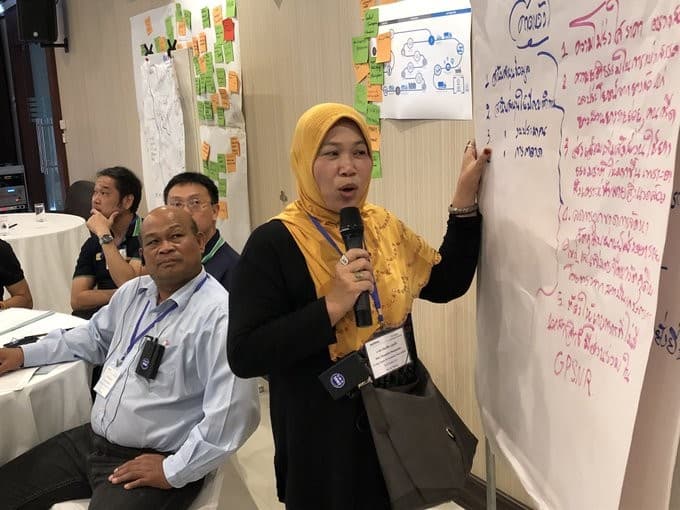
With the input from the workshop in Indonesia, Thailand, Brazil (and soon Cote d’Ivoire and Vietnam), the smallholders representation working group is finalizing the definition of ‘smallholders’ which will be needed to open up a new category of membership. Recognizing the experience and effort that IRSG/SNRi had already invested in this work, Smallholders Representation Working Group invited IRSG to discuss the definition of ‘smallholders’.  

While many countries have their own definition of ‘smallholders’ based on the size of their land, the Smallholders representation Working Group agreed other characteristics of smallholders (such as income provenance, level of dependency on family labour, economic constraints, etc) should also be considered. 

As the definition of ‘smallholders’ are affiliated to the work scope Strategy 2 – Capacity Building Working Group, the Smallholders Representation Working Group members are working closely with Strategy 2 – Capacity Building Working Group members to ensure that there is alignment in definition between smallholders in the natural rubber supply chain and smallholders that will become GPSNR member.

In the meantime, a successful third workshop in Brazil concluded this week, with a series of learnings for GPSNR on the organisation of farmers in the region, and their expectations from the future collaboration with the Platform. The workshop also achieved good progress on the identification of potential candidates for membership in GPSNR, both by single farmers and producers associations.
More To Explore

RubberWay Contributes to Achieving GPSNR Goals

By Nicole Tan, Project Manager, RubberWay

A couple of months ago, RubberWay was proud to introduce its contributions to sustainable natural rubber to members of GPSNR. 

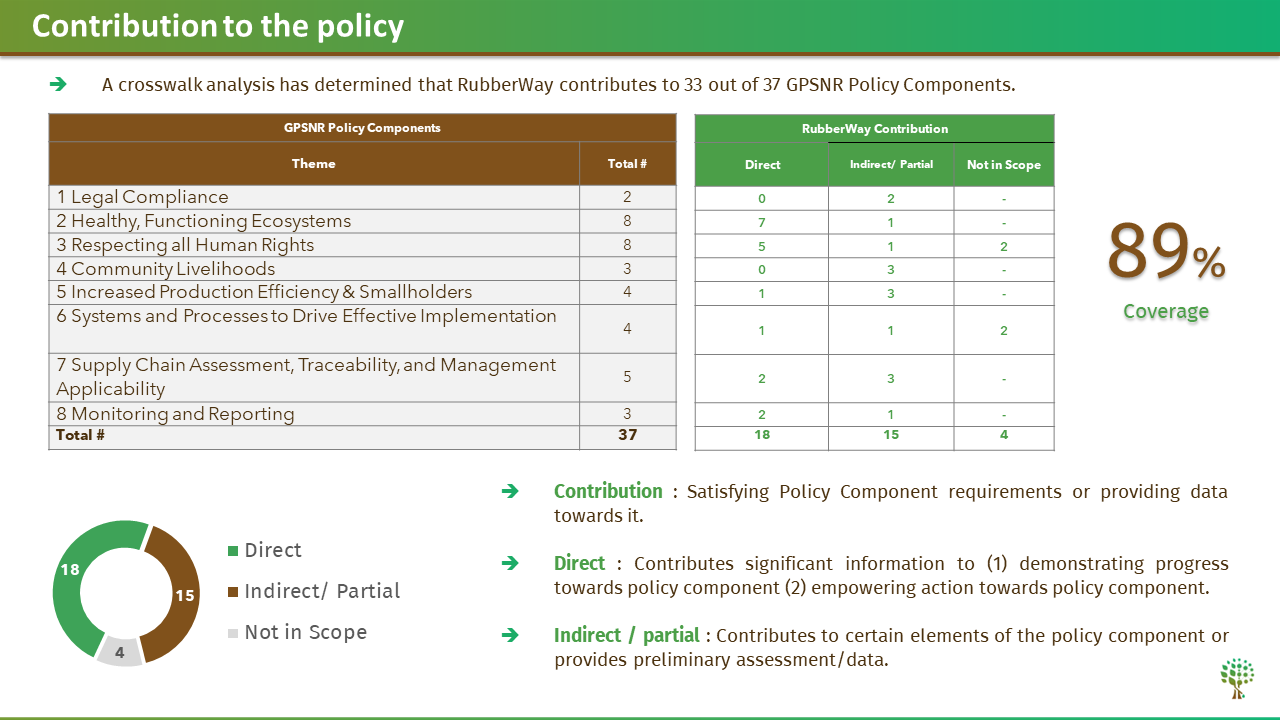
Data obtained through RubberWay contributes to helping users meet the GPSNR Reporting Requirements. A crosswalk analysis done by the RubberWay team showed that it provides 89% coverage of the 37 GPSNR Policy Components, of which 18 Policy Components are directly satisfied by RubberWay while 15 are partially contributed to.


RubberWay meets 33 out of 37 GPSNR Policy Components through direct and indirect contributions.


The webinar hosted by GPSNR gave RubberWay the chance to provide an overview of its solution from the perspective of both tire makers and processors. 

The sharing by tire makers highlighted the motivations for their participation in RubberWay and the ways in which RubberWay’s results have enabled them to engage in efforts on the ground. 

Similarly, natural rubber processors are able to apply data from RubberWay to implement field actions while also using the tool as a channel to facilitate communication directly with smallholders.


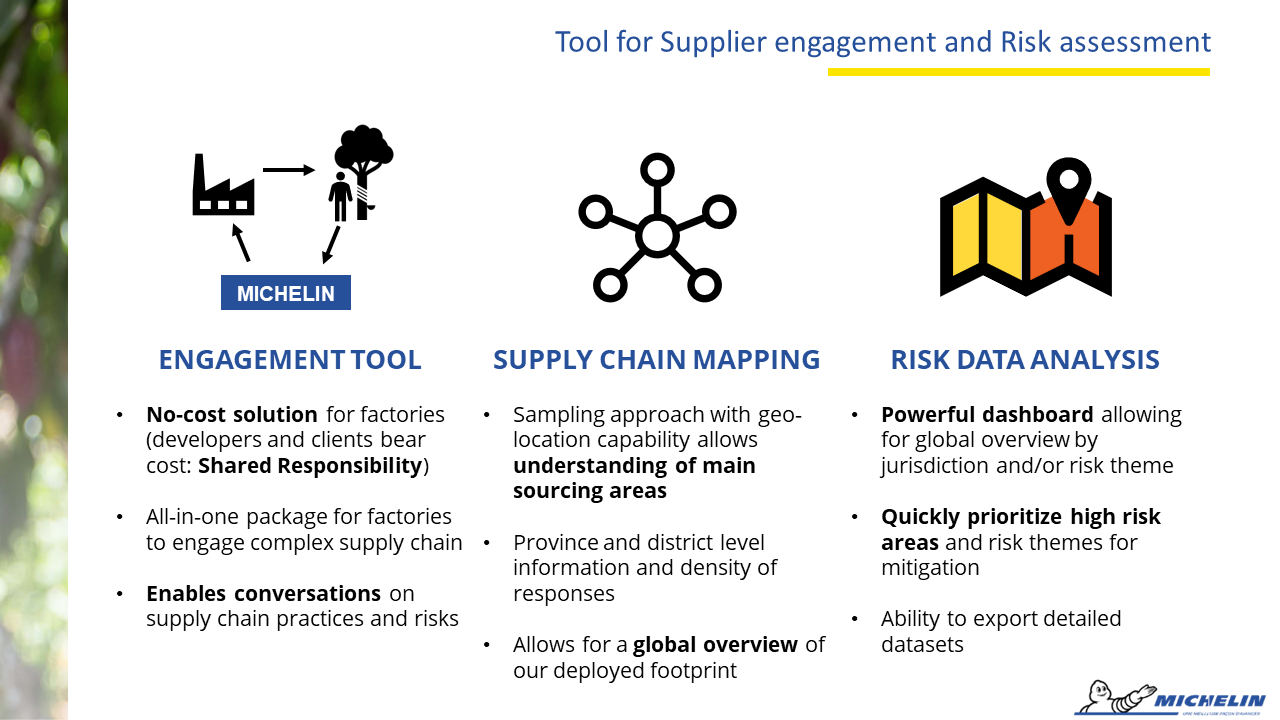
Users are able to utilise data generated through RubberWay to inform risk mitigation measures. RubberWay also provides its users with a channel for supplier engagement. 


More detailed information on how RubberWay contributes to achieving GPSNR’s goals for sustainable natural rubber can be found in the RubberWay white paper. Access to the complete crosswalk analysis is also available upon request.

ABOUT RUBBERWAY

RubberWay is a digital risk mapping solution that helps upstream actors to detect environmental and social risks across the natural rubber supply chain. Risk data obtained through RubberWay generates actionable insights for users like tire makers and processors to drive change towards sustainability within the industry. 

With over 50,000 questionnaires completed to date, the RubberWay dataset is set to increase with growing participation of users, enabling expansive reporting of sustainability risks across sourcing countries globally. 

Find out more about RubberWay here

News

Smallholders Representation Working Group Update – August 2019

Smallholders account for 85% of world rubber production. To come up with sustainable rubber production solutions, it is crucial for GPSNR to include the voice of rubber smallholders into our governance model. Realizing the challenges in language and cultural differences, the power game between different players in the rubber value chain, the perception of and by smallholders, the working group has decided to organize regional workshops. The 5 workshops to be held in Thailand, Indonesia, Vietnam, Africa (TBC) and Latin America (TBC) will be tailor made to ensure that smallholders can play a meaningful role within GPSNR.  A combination of smallholders, smallholder organizations, smallholder representation working group members (reflecting the mix of the group members) and, where possible, a representative of the GPSNR Strategy & Objectives Working Group will come together to join those regional workshops. Main aim of the workshop is to be a 2-way communication platform for conducting research, with the farmer’s needs at the center.

The primary objectives of the workshops will be to:

  • Understand the local needs and motivations of the smallholder farmers;
  • Understand and recommend solutions to the barriers for smallholders and their representative organizations to join and actively participate in the GPSNR;
  • Observe and explain the interaction and chemistry between farmers and representative organizations.

Translation and moderation will be available to ensure a smooth communication.

Those first 5 workshops are to be held between October and November 2019 and possibly extended to other regions in a second step.  

If you are a rubber smallholder or an organization that represents rubber smallholders, promoting the interests of rubber smallholders, having a mission/vision that aligns with GPSNR’s 12 principles, believing in a bottom-up approach as a solution to solve the issues, please feel free to contact the GPSNR Secretariat.  For more information, contact kobrat@gpsnr.org.

Scroll to Top