
GPSNR Working Groups Update: January-February 2023

Share This Post

The strategy and objectives working group

Both the subworking groups under the umbrella of the Strategy and Objectives WG are occupied with some critical milestones. The Risk Subgroup would soon be receiving the final draft for the risk assessment framework by ASI, which it will fine-tune based on the feedback received during the meetings in Singapore and online at the end of January. They are also kickstarting the traceability field trials in Indonesia and Thailand, for which they will soon start evaluating proposals, while hosting some members webinars on different traceability tools available in the market. 

On the other hand, the Assurance Model taskforce is streamlining the category specific KPIs along with the members journey/assurance model blueprint that was finalised during the latest hybrid meetings. You can find more context in the minutes here or reach out for questions on info@gpsnr.org.

The smallholder representation working group: 

Along with the work on the smallholder policy equivalent for which the WG has already sent out an all-member survey and initiating the HCSA-HCVN NR Smallholder Toolkit Field Trials, they are preparing for the decided merger with the capacity building working group. More details on how this will play out can be found here

The policy toolbox working group: 

The group is working on a tender to Crosswalk RR framework with CDP Forest and GRI Reporting, while aligning with the Assurance Model taskforce on the KPI on due diligence. 

The capacity building working group: 

The group is overseeing the pilot agroforestry project in Thailand that kicked off last December, as well as ongoing GAP coaching and disease fighting projects in Indonesia. The group is also working with the newly appointed consultants at Koltiva for the pilot Knowledge Sharing Platform for smallholders. Along with working with the smallholder representation working group on the merger, they continue their tasks of overseeing existing field projects, seeking members’ funding for projects in Côte d’Ivoire and Indonesia.. 

The shared responsibility working group: 

As per the decisions taken on the next steps during the hybrid meetings in January-February, the group is working with the Tiremaker category on streamlining a proposal on shared investment while also completing the deliverables on the other pillars. They are also aligning with the Assurance Model taskforce on how the KPIs will integrate into the Shared Investment mechanism. 
More To Explore

News

PRESS RELEASE: Natural Rubber players adopt policies committed to healthy ecosystems and human rights

Singapore, 24 September 2021: Apollo Tyres, Bridgestone, Continental Tires, Goodyear Tire and Rubber Company, Hankook Tire & Technology, Kumho Tires, Michelin, Nokian Tyres, Pirelli, Sumitomo Rubber Industries, the Toyo Tire Group and the Yokohama Rubber Co. Ltd. are the first companies to have adopted natural rubber policies that are fully aligned with the policy framework of the Global Platform for Sustainable Natural Rubber (GPSNR). 

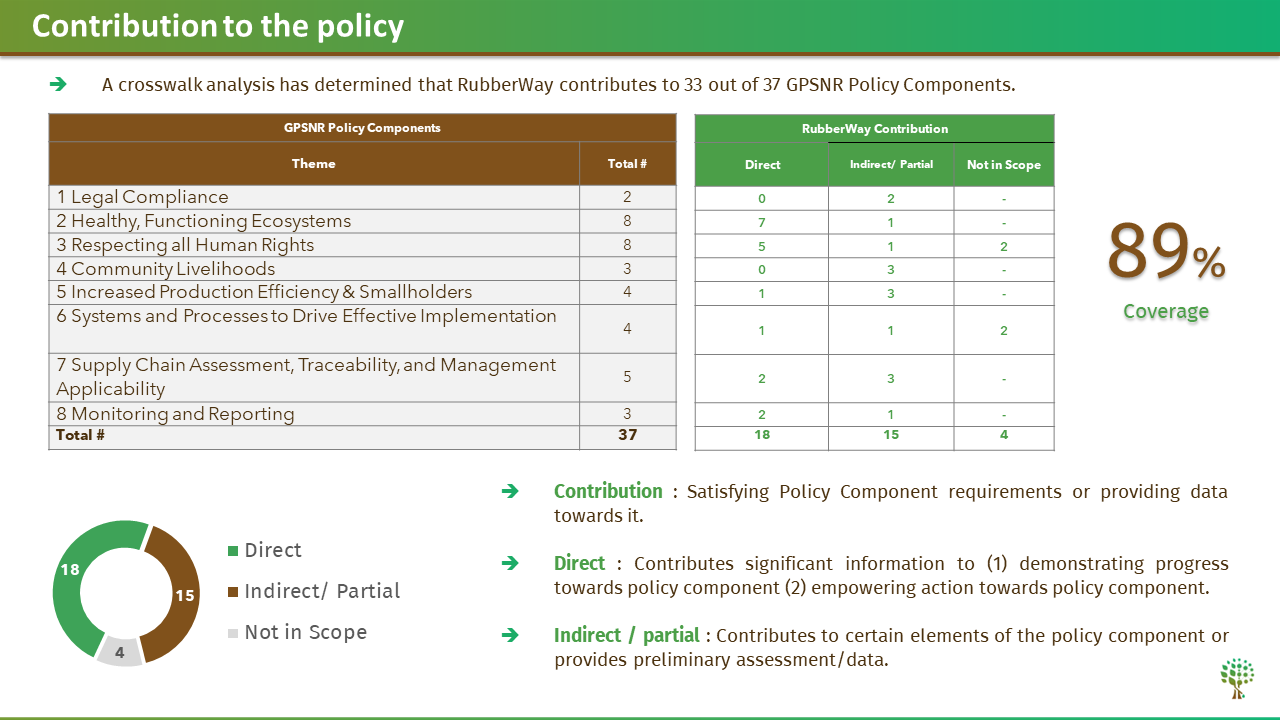
As members of GPSNR, their policies include eight major components: commitment to legal compliance, healthy functioning ecosystems, respecting human rights, community livelihoods, increased production efficiency, supply chain assessment and traceability, monitoring & reporting and driving effective implementation of all these components. According to Sooil Lee, President and CEO of Hankook Tire & Technology, ‘’Together with our supply chain partners, these commitments will help improve the quality of life of the natural rubber cultivators, upgrade quality of natural rubber and minimize environmental impact.’’ 

For Michelin’s Natural Rubber Sustainability Manager Edouard De-Rostolan, ‘’the alignment of commitments among GPSNR members, particularly with regard to the risk-based approach and the continuous improvement model, is a key driver for the platform to fulfill its primary mission, which is to create impacts on the ground in order to enhance the sustainability of the industry as a whole.’’ Pirelli’s Natural Rubber Procurement and Sustainability Manager Ulrich Antoni shared the sentiment, ‘’It’s great to see that more and more GPSNR members have aligned their policies to the GPSNR Policy framework. With the coordinated and concerted effort of GPSNR and all members, the natural rubber industry is directing individual and joint actions towards our shared goals for a sustainable natural rubber future. Pirelli will continue to take a proactive role in the platform and cascade good practices throughout the supply chain, with the ultimate goal of having an impact at the farming level too.’’

The commitment from these tire makers and their active participation within GPSNR reflects on their intent towards implementation.  ‘’In cooperation with the GPSNR Secretariat and stakeholders, we will sincerely implement these policies through our business activities,’’ says Toyo Tires’ Mitch Tamaki. 

To make sure that companies have adequate support to implement these commitments, GPSNR is working on an implementation guidance document and baseline reporting requirements. These will help translate this commitment into implementation. 

‘’All GPSNR members are required to align with the policy framework, and it is heartening to see companies follow through with the process. We are expecting many others to follow suit in the next few weeks.’’ says GPSNR Platform Director Stefano Savi. ‘’The policies serve as a foundation for a structural transformation not just for one company or rubber plantation, but the industry as a whole.’’

The GPSNR policy framework and published policies of  Continental Tires, Hankook Tire & Technology, Michelin, Nokian Tyres, Pirelli, Sumitomo Rubber Industries, the Toyo Tire Group and Yokohama Rubber can be found here. The rest of the policies will be published shortly. 

-Ends-

About GPSNR:  

GPSNR is an international membership driven platform set up to define sustainability for the natural rubber value chain. It brings together various stakeholders to a common ground based on fairness, equity and environmental sustainability. GPSNR member companies account for almost 50 per cent of the global natural rubber volume.  

More on sustainablenaturalrubber.org 

For more information, please contact: 

Bani Bains 

Communications Manager 

Email: bani.bains@gpsnr.org 

Ph: +65 97268165

News

Updates from the Working Groups

Strategy and Objectives Working Group

The study on Human Rights and Labour Rights’ Risk Mapping in the Global Natural Rubber Value Chains conducted by independent consultants James Griffiths & Associates Sàrl has been submitted to the Working Group. The full study will be published on the GPSNR website shortly, and the document will be open to stakeholders for comments.

Meanwhile, the Strategy and Objectives Working Group has started to engage with the rest of the Working Groups on aligning with the Theory of Change, and developing platform KPIs. 

The Equity sub-Group has collected comments from the Strategy and Objectives Working Group on the proposed definition of equity. The sub-Group is also exploring engaging consultant James Griffiths to conduct research into equity risks along the natural rubber supply chain, with the plan to have the findings of this study feed into the definition. The sub-Group is currently in the process of establishing an operational plan to define the various workstreams, processes, timelines, and  responsibilities for the Living Income study. The first phase of the study will involve collecting existing benchmark data and doing desk research on national poverty lines, minimum wages, and other relevant information. For greater alignment with the Capacity Building Working Group’s scope, the Equity sub-Group has decided to focus on the same four countries: Côte d’Ivoire, Indonesia, Myanmar and Thailand. 

‘Policy Toolbox’ Working Group

The proposed Policy Components and Baseline Reporting Requirements are open for member consultation until 3 July 2020. Find out more here

‘Capacity Building’ Working Group

The regional sub-Groups described the various findings and recommendations in a presentation to the larger Working Group at the end of May. Eight initiatives were proposed to be shared across the four focus countries, each corresponding to a critical issue identified through stakeholder interviews. These eight initiatives are: access to pure certified (re)planting material, promote the CO2 compensation scheme, promote value rubber wood, improve access to finance, disease fighting, dissemination of Good Agricultural Practices (GAP), income diversification, and improve reach and quality of extension services. Depending on the initiatives recommended for each country, three priority actions have been suggested, forming the basis for a 3-year programme.

The sub-Group for Thailand organized a call with some of Thai smallholder members to seek their opinion on the proposed initiatives. The discussion proved to be a fruitful one, with the smallholders providing advice and suggesting alternative initiatives for the sub-Group to consider. The subgroup for Côte d’Ivoire, which has a smallholder member who is a representative from a local producer association in participation, has also contextualized the proposed initiatives to the local conditions of smallholders and industrial plantations.

The other sub-Groups are also planning to get smallholder members’ input on the capacity building initiatives for their respective countries of focus.

‘Traceability and Transparency’ Working Group

The Working Group has started discussions on risk assessment, and will be linking up with the Policy Toolbox Working Group as well as consultant James Griffiths on the results of the social risks study.

The terms of reference for the two pilot proposals have been finalized after several rounds of additional revision. The documents will be submitted soon to the Executive Committee. 

Smallholders Representation Working Group

The Working Group continues to plan and prepare for the smallholders programme prior to the General Assembly. In particular, terms of reference are being drafted for a professional facilitator to manage the smallholder workshop sessions for the pre-GA programme.

Scroll to Top