
Smallholders Representation Working Group Update – October 2019

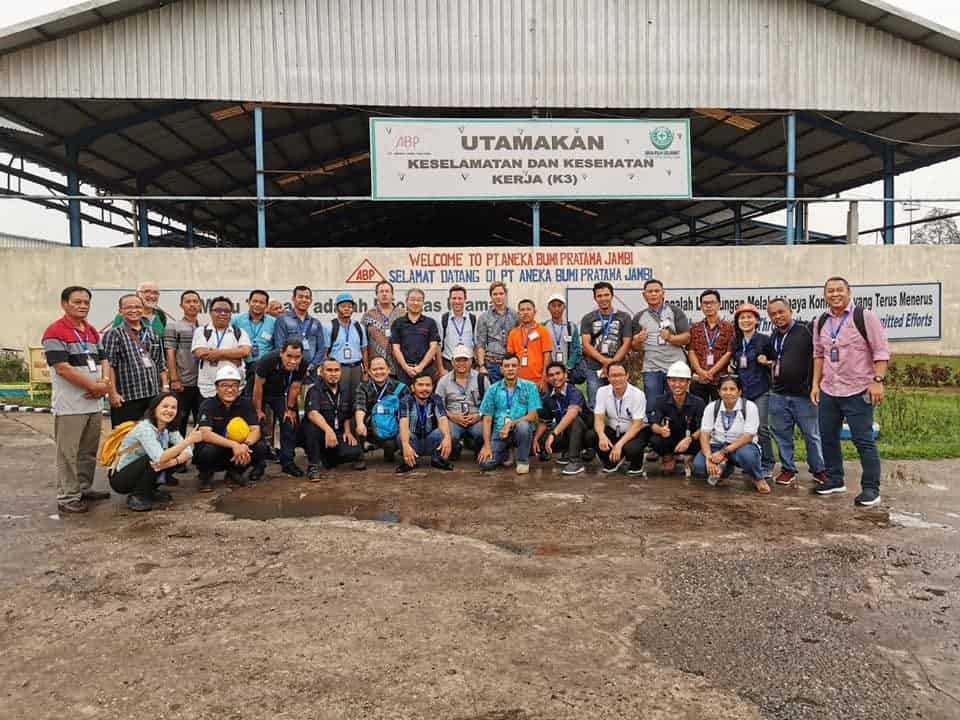
Two workshops have been successfully held. More than 20 rubber smallholders from all over Indonesia - Kalimantan, South Sumatra, West Sumatra and Jambi gathered during the workshop in October 7th - 9th. The workshop in Thailand just finished with a fruitful discussion on collaboration opportunities between rubber smallholders and GPSNR.

Share This Post

Several challenges of sustainable natural rubber production were brought up and discussed among rubber farmers and GPSNR members, but front and foremost was the issue of livelihoods and future of labour. After the field visit and 3 days workshop, the rubber farmers both in Indonesia and Thailand agreed that to solve such issues, smallholders should be put at the center of the solution.  They agreed that including smallholders’ representatives in the new governance model is the way forward to achieve this.  As for the criteria of the organizations, apart from having a personnel with extensive knowledge around rubber from cultivation, transportation to processing, the farmers also said that it is important that any representing organization should have a democratic governance. The smallholders also pointed out to a few farmers from different regions that could directly represent smallholders in GPSNR.  A few organization names were also proposed which will then be followed up by Smallholders representation working group to ensure active engagement for further collaboration.

“I am happy to hear that the downstream of natural rubber users like tire makers wish to establish a direct relationship with the upstream natural rubber producers like us. Personally I believe that sustainable supply chain will work only when every actor in the chain work together to find potential solutions together.” said one rubber smallholder in Thailand. Smallholders also emphasised on the importance for engagement to be long term if results are to be achieved.

The dates for the last 3 smallholder workshops have been confirmed and will be held in Brazil (20 – 21 Nov), Cote d’Ivoire (26 – 28 Nov) and Vietnam (16 – 18 Dec) respectively. The aim of the workshops is to gain a better understanding of smallholders, how smallholders can be meaningfully represented within GPSNR and to further explore the future of sustainable natural rubber production from a smallholders perspective at local level.

We will keep you posted on our progress in our upcoming newsletters. Stay tuned !
More To Explore

News

GPSNR Working Groups Update: December 2021

What a year! All our working groups successfully overcame the challenges of remote working and time-zone coordination, while moving the needle on sustainability in natural rubber. Here are their updates for December 2021:

Strategy and Objectives Working Group

The group has finalized the Theory of change, which is currently in the process of being designed for public communications. They have also published the Environmental Risk Study, which can be found here.  Currently, the group is working on developing the RFP for the Economic Risk Study, which will be published and worked on in 2022. The group is also working on developing next steps for itself based on the finalized Theory of Change.

Smallholder Representation Working Group

In 2021, the working group onboarded 39 new smallholders at GPSNR. In 2022, they will be focussing on mapping out the possibility of smallholder onboarding workshops in Columbia, Ghana, Liberia and Malaysia, which are countries with a relatively lower representation of smallholders within GPSNR. From January 2022, they will also be busy with developing a Smallholders Policy Framework. 

Policy Toolbox Working Group

The group saw a major milestone in the approval of the reporting requirements at the 2021 General Assembly. In 2022, they will be busy developing guidance for thereporting requirements and a transparency roadmap before the reporting cycle begins in mid-2022. At the same time, the group continues to refine the Implementation Guidance before the General Assembly of 2022. 

Capacity Building Working Group

The group recently hosted a webinar on GPSNR’s Good Agricultural Practices (GAPs) before the 2021 General Assembly, and published two RFPs for the assessment of the Knowledge Sharing Platform and GAP coaching for Indonesia respectively. In the next few months, it will focus on kickstarting the Thailand national sub-working group, advancing agroforestry implementation plans for GPSNR as well continuing to advance capacity building implementation in Indonesia and Ivory Coast. 

Traceability and Transparency Working Group

The Traceability and Transparency working group has requested members’ input on the traceability benchmark and will work on refining it based on the feedback received. You can take a look at the draft benchmark here and give your feedback here before 31st December. 

Shared Responsibility Working Group

The working group has discussed and explored solutions to address the root causes identified for each of the three focus areas of Shared Responsibility. It has also identified a consultant to support the development of a shared responsibility framework. In 2022, the group will draft activities and framework for Shared Responsibility for integration into other processes such as the Implementation Guidance and align with other working groups. 


Empowering Smallholder Farmers: The Path to Deforestation-Free Rubber Supply Chains to Meet the EUDR

On Wednesday, 19 April 2023, the European Union approved the upcoming Deforestation-Free Regulation (EUDR) to prevent companies from placing products linked to deforestation onto the EU market. As part of the wider vision of the EU Green Deal, it will demand companies who import rubber or rubber-based products (e.g., tires) to verify that their supply chain is deforestation-free. It’s a push towards an era of environmental accountability, yet it also sparks debates about the path forward for the rubber industry.

The EUDR requires companies to have traceability to the farm level, including geo-location data and proof of land legality. According to the regulation, every plot below 4 hectares requires at least a GPS point coordinate, while plots above 4 hectares must have a polygon.

Fulfilling these traceability requirements is no small feat. There is concern from the industry that smallholder farmers may be unintentionally excluded from global sustainable supply chains. Ensuring smallholder farmer inclusion requires a holistic sustainability approach.  There is no doubt that the rubber industry has begun moving towards sustainable rubber sourcing through combined industry efforts like the Global Platform for Sustainable Natural Rubber (GPSNR). However, the reality is that most imported rubber to the EU currently does not meet the regulatory requirements as the industry lacks traceability to the farm level. As 85% of the global natural rubber supply is supplied by approximately 6 million smallholder farmers, the implications of this regulation could be far-reaching and severe, particularly for these smallholder farmers.

However, there is a lot of hope.

Firstly, even though it might seem challenging, traceability to the farm level is doable – even for the rubber industry. This has been demonstrated in a GPSNR-funded farmer training and coaching project primarily focused on supporting smallholders to apply Good Agriculture Practices (GAP). Koltiva, the company I am working for and who was selected to be the implementing partner for this project, has mapped more than 4,000 farmers and their farms to help them to prepare for the EUDR in less than a year.

Secondly, we believe that traceability to the farm is scalable. In our work with clients in 51 countries, we were able to map almost 1 million smallholder farmers through our KoltiTrace platform. Platforms such as KoltiTrace allow companies to map and verify their supply chain, including transaction traceability from Seed to Tire and deforestation-free analysis.

Finally, EUDR could have a long-term positive impact on smallholder farmers. Currently, many rubber farmers do not have proper land titles. Due to the EUDR geolocation requirements, many smallholders will, for the first time, have access to a map of their own plantation, allowing them to legalize their land.

And it doesn’t stop there. Smallholders have largely been invisible in global supply chains. Traditional development programs have tried to engage them, but they have not reached the expected results. Many smallholders still have no access to knowledge, no access to capital,  and soon will also be excluded from the carbon economy.

I believe that it’s possible to bridge these gaps. Traceability to farm level and digitalizing the first mile of agricultural value chains can lay the foundation for holistic sustainability interventions. Enabled by technology and data, the sector can equip farmers with critical knowledge, improve their access to finance, actively support farmers to apply low-carbon practices and enable them to reap the benefits of the growing carbon economy.

While traceability cannot be achieved overnight, the rubber industry is in a unique position. At GPSNR, the major industry players are sitting at one table. Through combined efforts and data-sharing agreements of shared supplier data, the rubber industry can become a leading example of how to meet the EUDR.


About the Author:
Luca Fischer is Koltiva’s Program Manager, leading Koltiva’s boots-on-the-ground implementation projects in the rubber sector globally. He bridges the gap between the client, product, and field teams.

Luca has over five years of work experience in sustainable sourcing, smallholder livelihood, and climate-smart agriculture development. He graduated with an M.Sc. in Sustainable Resource Management from the Technical University of Munich, Germany.

About Koltiva (click here for more information)
Established in 2013, Koltiva is a leading agritech company for enterprises to make their global supply chains traceable, inclusive, and climate-smart. Backed by Koltiva’s human-centered technology with boots-on-the-ground professional service, Koltiva supports some of the largest multinational companies by digitizing and verifying global supply chains, focusing on enhancing traceability, inclusiveness, and sustainability. Koltiva combines triple-tech (AgriTech, FinTech, and ClimaTech) to improve producers’ outcomes and profitability while building more sustainable supply chains.

Scroll to Top