
By 2050, the number of cars in the world is expected to more than double as urban population growth and rising incomes lead to increased demand for mobility. This has led to louder calls for a more environmentally friendly, energy efficient transport sector.
But what’s been missing from the conversation on sustainable transport so far is a key material that cars and other vehicles literally run on: rubber.
Around 70 per cent of the world’s supply of natural rubber is used to manufacture the wheels that move cars and enable airplanes to take off and land. In the last two decades, the consumption of natural rubber, which is primarily produced in the world’s tropical regions, has been increasing at a steady rate of 5 per cent every year.
Ideal climate and soil conditions in Thailand, Malaysia, Indonesia and Vietnam have made Southeast Asia the epicentre of global rubber production. Ninety per cent of the 13.960 million tonnes of rubber tapped last year came from this part of the world. The last 10 years have also witnessed the expansion of industrial rubber practices in Cambodia and Laos, after land in China and Vietnam began to deteriorate as a result of large-scale rubber production.
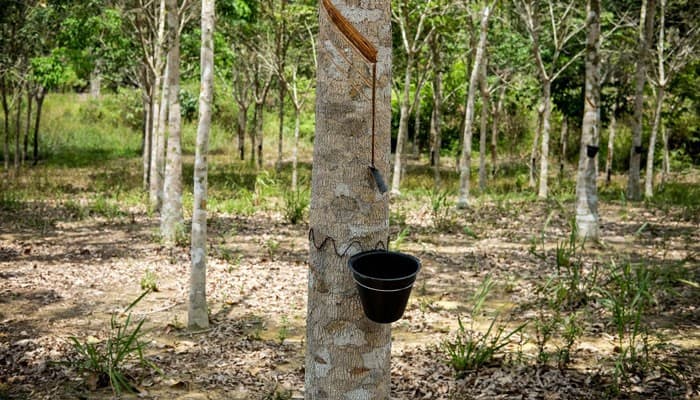
On a recent trip to Bintan, an Indonesian island located an hour from Singapore’s shores, Eco-Business got a first-hand look at the reality of smallholder rubber farming in Asia and the challenges of charting a sustainable path for rubber.
Although natural rubber has not received as much attention as fellow tropical commodity palm oil, it creates a similar set of social and environmental problems, from contributing to rapid deforestation to a history of land grabs and human rights violations in the Mekong.
However, unlike palm oil, which is mainly produced in large estates owned by big, family-owned corporations, close to 85 per cent of global rubber is produced by smallholders in Asia, making traceability a major issue in the industry’s quest for sustainability.
“Natural rubber is a crucial element of tyre production, driving the importance of its sustainability,” William Dusseau, manager of technical relations at Cooper tyre and rubber company, told Eco-Business. “A coordinated, universal and standard industry approach is the way to drive solutions in establishing and promoting sustainable natural rubber practices.”
He added that the launch of the Global Platform on Sustainable Natural Rubber (GPSNR), which took place last Thursday at the World Rubber Summit in Singapore, was a significant step in developing and maintaining sustainable rubber standards.
Members of the new platform include major brand tyre companies such as Cooper, Michelin, Pirelli, and Bridgestone and global car manufacturers including BMW Group, Ford Motor Company and General Motors.
GPSNR also includes international non-profit and civil society organisations such as Mighty Earth, Birdlife International and World Wide Fund for Nature (WWF).
According to Jean Bakouma, head of the Forest Program at WWF-France, since the rubber value chain is primarily driven by buyers, tyre manufacturers hold the greatest leverage for improving both the socioeconomic and environmental performance of natural rubber production.
“A robust sustainability policy that is thoroughly implemented by tyre manufacturers must consider sustainable natural rubber as a natural and responsible way to protect forests with high conservation value and high carbon stock, as well as foster other environmental services,” he said.