
(Closed) Request For Proposal – GPSNR-RFP-A02-024-Pilot Agroforestry Workshops for Smallholders

Share This Post

1. Introduction

The Global Platform for Sustainable Natural Rubber (GPSNR) is an international multi-stakeholder, voluntary membership initiative seeking to lead improvements in the socioeconomic and environmental performance of the natural rubber value chain. Members of the platform include tire manufacturers, rubber producers and processors, vehicle makers, NGOs, and smallholder natural rubber producers. 

As of June 2022, GPSNR has 135 smallholder members from 10 countries. Smallholder members on the Platform have consistently advocated for the Platform to implement initiatives on agroforestry and were a catalyst for GPSNR’s commitment on agroforestry announced at COP26 in Glasgow[1].

To advance engagement with smallholders on agroforestry, GPSNR is seeking to hire a consultant to develop coaching materials on rubber agroforestry systems, and to conduct a pilot series of “Introduction to Agroforestry” workshops for smallholders in two to three countries in 2022.

Proposed programmes should be implemented in line with GPSNR environmental and social commitments and values, based on the GPSNR Policy Framework[2].


[1] GPSNR Announcement on Agroforestry: https://t.co/9aXbZeZpeS
[2]GPSNR Policy Framework: https://gpsnr.dev.zippisite.com/policy-framework/

2. Objectives and Deliverables     

Objectives

  1. To collate and prepare global, country, and region-specific peer-reviewed evidence and best-practice materials on agroforestry for natural rubber systems
    1. Content on environmental, economic feasibility of rubber agroforestry systems
    2. Where feasible, collated material to be disseminated to GPSNR smallholder members and their communities even where workshops are not planned for in 2022 
    3. Materials would be translated by GPSNR under a separate budget
  2. To conduct pilot workshops for GPSNR smallholder members and their communities, including active integration of women, youth, and minority representation, to introduce agroforestry concepts and practices, and provide guidance and answers for the following questions:
    1. What is possible to grow in your region or specific location, and how can this be achieved? Possible considerations include:
      1. Appropriate farm design
      2. Cultivation practices
      3. Cost estimation
    2. What is the market availability, demand, and potential economic/financial model and value chain of recommended crops, or of particular products, in your region?
    3. How can agroforestry investments benefit smallholders economically, environmentally, and socially? 

Deliverables

GPSNR has identified the following countries where materials, and workshops, should be prioritised in 2022:

  1. Cambodia: strong enthusiasm from smallholders, NGOs, and other partners to organise and kickstart agroforestry in the country, where little to none have been implemented at present 
  2. Indonesia: agroforestry possibilities and practices would vary widely across the country’s major rubber-producing regions; there is strong interest from smallholders as well; critical to blend or merge more traditional concepts such as jungle rubber with evidenced-based and structured forms of agroforestry
  3. Thailand: a well-organised and budding agroforestry movement is taking root especially in southern Thailand (termed “sustainable natural rubber” by smallholders and the Rubber Authority of Thailand); workshops could further provide a boost to smallholders in the region and country
  4. Next tier of countries: Cote d’Ivoire, Vietnam, Sri Lanka, Myanmar 

The consultant may propose other priority countries in their proposal and justify their choice of countries based on metrics of their own construction.

The proposal should include key details such as the following:

  • Methodology of content and curriculum development
  • Proposed teaching or coaching pedagogy and approach for the workshops
  • List of local partners or experts, if any, that could be engaged for the workshops
  • Target number of smallholders in each country

Future Plans

In addition to the pilot series of workshops in 2022 in at least two countries, the consultant should present an outline to consider how the series of pilot “Introduction to Agroforestry Workshops” can be expanded (in terms of countries, content, level of engagement etc.) beyond 2022.

3. TENDER EVALUATION FACTORS

GPSNR will rate proposals based on the following factors:

  1. Responsiveness to the requirements set forth in this Request for Proposal

  2. Relevant past performance/experience/accreditation of the bidder on agroforestry and agricultural production

  3. Samples of work (e.g., previous training or coaching programmes in target countries)

  4. Technical expertise/experience of bidder and bidder’s staff

  5. Proposed timeline of operations

GPSNR reserves the right to award to the bidder that presents the best value to GPSNR as determined solely by GPSNR in its absolute discretion.

4. Expected Timelines

The work shall begin by July 2022 and the various phases shall be completed in accordance with the approximate timeline below:
ActivityDue Date
RFP publication3 June 2022
Submission deadline for proposals1 July 2022
Contract Award8 July 2022
First Workshops ConductedSeptember 2022
Second Workshops ConductedOctober 2022
If Proposed: Third Workshops ConductedNovember 2022
Final Review and Project ConclusionDecember 2022

Consultants should detail a project timeline with milestones that are approximately in line with the above timeline.

Consultants will also provide fortnightly or monthly progress updates to the GPSNR Capacity Working Group, or on an as-needed basis.

5. Budget

The Platform is anticipating that the total budget of no more than 35,000 EUR be allocated to the project. The approximate expected breakdown for each Stage is as such:

Bidders should outline their expected budget expenditure in the proposal.

Payment terms shall be proposed by the bidder and discussed with GPSNR, in line with each Stage of the project.

6. Evaluation Factors

The proposal should include the following:

  1. A workplan that outlines all key activities in line with the stated Objectives and Deliverables
  2. Timeline and key stages of operations
  3. Budget, including detailed breakdown of expected manpower, logistics, and costs
  4. Description of past work and proof of technical expertise on natural rubber agroforestry systems is highly critical for this RFP
  5. A list of project team members with their roles in the project and associated qualifications

More To Explore

Tender

Request for Proposal – Drafting of a Shared Responsibility Framework (GPSNR-RFP-A02-015)

INTRODUCTION AND BACKGROUND

The Global Platform for Sustainable Natural Rubber (GPSNR), is an international Multi-Stakeholder, voluntary membership initiative seeking to lead improvements in the socioeconomic and environmental performance of the natural rubber value chain. Development of the GPSNR was initiated by the CEOs of the World Business Council for Sustainable Development (WBCSD) Tire Industry Project (TIP) in 2019. Members of the platform include tire manufacturers, rubber suppliers and processors, vehicle makers and NGOs.  Representatives from each of these stakeholder groups have contributed to the development of the Singapore-based platform and the wide-reaching set of priorities that define GPSNR strategy and objectives.

Through a process led by the GPSNR Shared Responsibility Working Group the consulta should help the Platform draft a framework that defines shared responsibility among GPSNR members in the Natural Rubber supply chain supported by actionable solutions. All this work will be based on a problem and root case analysis exercise already validated by the Working Group.  

The consultant is expected to develop a cross walk to assess where there is overlap/alignment between the SR policy and other GPSNR policies including member commitments, but also the statues and future assurance model. In addition, the consultant should support the engagement with other working groups in the process of developing the framework so that alignment also occurs simultaneously.

The consultant will collect the information via desktop study and information provided by the Working Group/Secretariat. Regular contact and updating to the Shared Responsibility Working Group together with the Secretariat will be required.  It is estimated that there will be the need for at least one face to face meeting in the U.S. over the course of the project. Travel plans shall be made by the consultant.

Submission Guidelines & Requirements

The following submission guidelines & requirements apply to this Request for Proposal:

  1. Proposals will only be accepted from individuals or firms with experience relevant to this project.
  2. Examples of previous relevant work should be provided as well.
  3. A technical proposal must be provided that is not more than 4 pages. This technical proposal must provide an overview of the proposed solution as well as resumes of all key personnel performing the work. In addition, the technical proposal should provide a proposed schedule and milestones, as applicable.
  4. A price proposal must be provided that is not more than 1 pages. This price proposal should indicate the overall fixed price for the project as well as hourly rates and an estimated total number of days.
  5. Proposals must be signed by a representative that is authorized to commit bidder’s company.
  6. Proposals must be received prior to 2nd December 2021 to be considered. Proposals should be submitted to stefano.savi@gpsnr.org for consideration. GPSNR anticipates shortlisting at least two individuals or firms to have more in-depth discussions with, and will make an award to one of these “down-selected” individuals or firms.
Project Timelines
The Request for Proposal timeline is as follows:

RFP opens online

Wednesday, 24 November 2021

RFP closes

Monday, 6 December 2021

WG select consultant during WG meeting

Thursday, 9 December 2021 (Tentative)

First draft delivered by consultant and presented to WG members

Week of January 10th

Round of review and approval by WG before members consultation

Week of January 17th

Members Consultation

From January 24 to February 5

Framework update and responding to consultation, WG approves revisions

February 7 to February 12

Working Group to Draft resolution with consultant support and send to Executive Committee for approval

February 14 to February 16

Resolution approved by EC, and sent to members

Monday, 28 February 2022

General Assembly

End March/ early April 

Budget

The Platform is anticipating that a total budget of no more than 25,000 USD be allocated to this engagement with an additional amount available to support planned and approved travel. 

Payment terms shall be:

  • 20% at the signing of the contract
  • 30% at the midpoint date to be agreed upon and memorialized in the contract based on the submitted work plan
  • 50% on delivery of the final report

The allocation of the payment shall be based on the net amount after travel expenses are incurred and documented.

Evaluation Factors

GPSNR will rate proposals based on the following factors, with cost being the most important factor:

  1. Responsiveness to the requirements set forth in this Request for Proposal;
  2. Relevant past performance/experience;
  3. Samples of work;
  4. Cost, including an assessment of total cost of ownership;
  5. Technical expertise/experience of bidder and bidder’s staff;
  6. The ability to collect information at the global and local level.

GPSNR reserves the right to award to the bidder that presents the best value to GPSNR  as determined solely by GPSNR in its absolute discretion. 


Download RFP

(Closed) Request For Proposal – GPSNR-RFP-A02-019 Guidance and Tools for GPSNR’s Reporting Requirements

Introduction & Background

The Global Platform for Sustainable Natural Rubber (GPSNR) is an international multi-stakeholder, voluntary membership initiative seeking to lead improvements in the socioeconomic and environmental performance of the natural rubber value chain. Members of the platform include tire manufacturers, rubber producers and processors, vehicle makers and NGOs.

In December 2021, GPSNR members approved Reporting Requirements that would allow member companies to report on their progress implementing their commitments under the Policy Framework. With the approval of the reporting requirements, ordinary member companies shall report annually on the questions included in the Reporting Requirements for the member’s reporting category.

GPSNR members are required to submit data for the previous year according to the following reporting timelines:
• Category A and Category B: Industrial Producers or Processors and Traders of Raw Materials: on or before 30 June
• Category C: Manufacturers and Traders of Processed Material: on or before 30 September
• Category D: OEMs and End Users: on or before 31 December.

To support GPSNR members in fulfilling their obligations under the Reporting Requirements, the platform is calling for consultants to develop a systemic view of the reporting process, inclusive of developing supporting documents and reporting templates for members to facilitate reporting, and exploring the potential user interface and portal design for data submission to ease the integration and consolidation of reported information from various GPSNR member categories.

Reporting scope and materiality are topics for consultant’s review and suggestion based on the GPSNR reporting requirement.

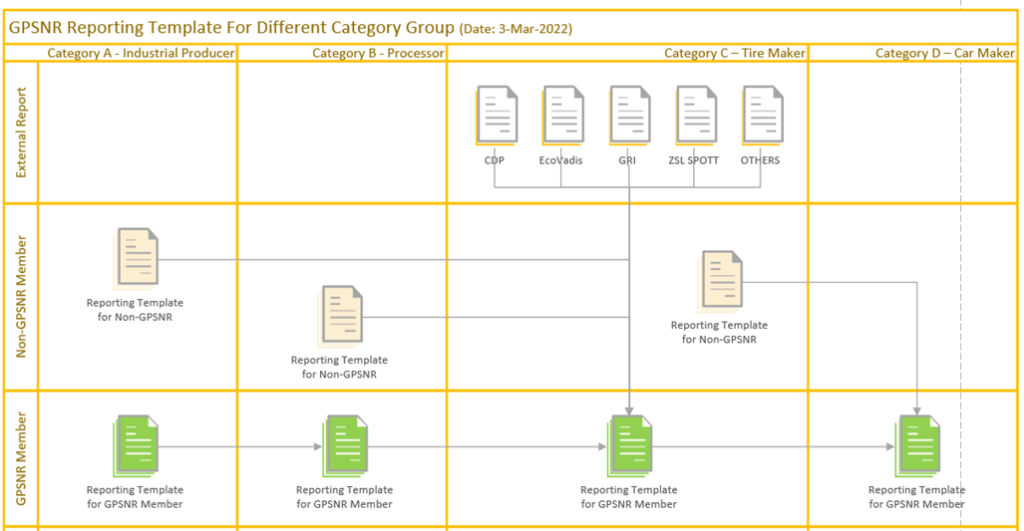
The reporting process should cover the following scenarios (non-exhaustive list):
(i) tier-1 supplier is disclosed to GPSNR
(ii) tier-1 supplier is not disclosed to GPSNR
(iii) members with suppliers across different category groups that are not GPSNR members
(iv) members with external reports that may substantiate the GPSNR reporting requirement
(v) how the information is consolidated at GPSNR level at the end of each category reporting cycle

Figure below is taking one example of tire maker category member reporting on NR supply chain scope to illustrate the potential complexity of the reporting process.

The expected documents to be developed should include:

  • A guidance document for each reporting category outlining the appropriate methodology and reporting format for each question, with reference to necessary definitions. One example of reporting segment that requires guidance is Policy Component 2.5 and 2.6 for member categories C and D.
  • Standardized reporting templates which may utilize word documents, excel spreadsheets, or other appropriate reporting formats.

The documents developed should ensure that data can be consolidated easily across the supply chain with an understanding that the information will be passed downstream. Where appropriate, the requested data should align with data gathered by other reporting schemes to reduce the reporting burden (including, but not limited to, CDP, Ecovadis, ZSL SPOTT, GRI, FSC, PEFC, SNR-i).

The reporting user interface which includes ability for member to upload supporting evidence (e.g., documents, photos etc) and portal design should also enable easy intake by the Secretariat for data analysis, verification and reporting. The ability to design integration with Salesforce is a plus.

Submission Guidelines & Requirements

The following submission guidelines & requirements apply to this Request for Proposal:

  1. Proposals will only be accepted from individuals or firms with experience relevant to this project.
  2. Examples of previous relevant work should be provided as well.
  3. A technical proposal must be provided that should be around 6 pages in length. This technical proposal must provide an overview of the proposed methodology as well as resumes of all key personnel performing the work. In addition, the technical proposal should provide a proposed schedule and milestones, as applicable.
  4. A price proposal must be provided that is not more than 1 page. This price proposal should indicate the overall fixed price for the project as well as daily rates and an estimated total number of days.
  5. Proposals must be signed by a representative that is authorized to commit bidder’s company.
  6. Proposals must be received prior to 14th of March to be considered. Proposals should be submitted to stefano.savi@gpsnr.org and aidan@gpsnr.org for consideration.
  7. GPSNR anticipates shortlisting at least two individuals or firms to have more in-depth discussions with, and will make an award to one of these “down-selected” individuals or firms.


Project Timelines

The Request for Proposal timeline is as follows:

Request for Proposal Issuance   4 Mar 2022
Proposal submitted by consultant to stefano.savi@gpsnr.org   14 Mar 2022
Selection of Consultant /
Notification to Unsuccessful Bidders
18 Mar 2022
Contract Award 22 Mar 2022
Work to commence no later than   23 Mar 2022
Specific work-plan agreed upon with GPSNR’s Policy Toolbox Working Group (WG1) 24 Mar 2022
1st deliverable: first draft of guidance on GPSNR Reporting Requirement content and reporting template for PPTs (category A & B), both GPSNR and non-GPSNR. 18 Apr
2022
Final draft of guidance on content for PPTs 25 Apr 2022
2nd deliverable: first draft of guidance on GPSNR Reporting Requirement and reporting template for category C & D, both GPSNR and non-GPSNR. 13 May 2022
Final draft of guidance on content for category C & D 20 May 2022
3rd deliverable: first draft proposal for a streamline reporting process, user interface and portal design to integrate and consolidate the reporting information from all GPSNR member categories 24 Jun
2022
The final draft proposal submitted to WG1 7 Jul 2022

Budget

The Platform is anticipating that a total budget of no more than 30,000 SGD. If the consultant deems that travel plans are required to execute this project, these should be included in the proposal (along with any additional budgetary requirements).

Payment terms shall be:

●       20% at the signing of the contract
●       30% at the midpoint date to be agreed upon and memorialized in the contract based on the submitted work plan
●       50% on delivery of the final report

Evaluation Factors

GPSNR will rate proposals based on the following factors, with cost being the most important factor:

  1. Cost
  2. Responsiveness to the requirements set forth in this Request for Proposals
  3. Relevant past performance/experience
  4. Technical expertise/experience of bidder and bidder’s staff
  5. The ability to collect relevant information at the global and local level

GPSNR reserves the right to award to the bidder that presents the best value to GPSNR as determined solely by GPSNR in its absolute discretion.

Scroll to Top