

GPSNR Working Groups Update: February 2022

Share This Post

All GPSNR working groups have a large chunk of work ahead of them. Here are all their updates: 

Strategy and Objectives Working Group

After completing the intensive task of publishing the Theory of Change, the strategy and objectives group is working on developing its own next steps based on this Theory of Change. In the same spirit, the group has also updated its own Terms of Reference and membership. It is now focused on developing the RFP for the Economic Risk Study, which will be published soon. Currently, they are developing GPSNR’s approach to managing and evaluating risk (commonly known as the risk-based approach in meetings!). 

Smallholder Representation Working Group

Apart from initiating outreach to smallholders with a view to organise onboarding workshops in countries such as Liberia, Ghana, Malaysia and Colombia, the group is focussed on its newly formed task force to develop the GPSNR Smallholders Policy Framework. The first meeting of this task force will be in March 2022. The group is also preparing for the first Smallholders International Call of the year in March 2022.

Policy Toolbox Working Group

This group has already recruited new members for three of its subgroups: Transparent reporting roadmap, Implementation Guidance and RR Guidance & Tools. In the coming months, they will be developing guidance for the reporting requirements and a transparency reporting roadmap before the reporting cycle begins in the middle of 2022. 

At the same time, the group continues to refine a major part of the assurance model: the Implementation Guidance, which it aims to have ready before the General Assembly of 2022. Additionally, this group is busy finalising the compliance panel’s operational guidance.

Capacity Building Working Group

As we begin a year of implementation in Thailand, this group is working on reviewing and finalising strategy and approach for Capacity Building in Thailand, including the integration with Agroforestry Task Force workstream based on discussions with the Rubber Authority of Thailand on 24 February 2022.

The working group is also continuing to develop and implement capacity building plans for Indonesia and Ivory Coast, and will soon appoint service providers for GAP Coaching in Indonesia

Traceability and Transparency Working Group

Having received members’ input on the traceability guidance, representatives from the working group are now finalizing the benchmark based on the feedback.

Shared Responsibility Working Group

The Shared Responsibility working group has completed the first draft of the Shared Responsibility (SR) framework, and has presented the same to the Executive Committee. The consultant is now working on incorporating feedback from the Executive Committee into this draft.
More To Explore

Members

GPSNR Working Groups Update: March 2021 (Members Version)


Strategy and Objectives Working Group

The S&O Working Group has received inputs to the platform Theory of Change from the Smallholders Representation, Capacity Building, and Traceability and Transparency Working Groups. A task team from the S&O Working Group will now work to synthesize these different contributions into a single document. This compiled Theory of Change template will then be developed into the platform Theory of Change through a workshop which will involve representatives from all the working groups.

The Equity Sub-Working Group completed a summary of the Living Income studies that the platform commissioned in 2021 and presented the summary through a webinar. The webinar recording and slides can be found here. The reports are also available here on the member’s portal. The Equity Sub-Working Group will now work to develop recommendations on how GPSNR can address priority risks and boost equity in the value chain.

‘Policy Toolbox’ Working Group

The Policy Toolbox Working Group has selected a combined consultant team of Proforest and Are We There Yet to lead the development of the Implementation Guidance for GPSNR. The development is expected to be a consultative process that concludes with a set of draft guidance that will be ready by July 2021.

To facilitate consultation on the Implementation Guidance, the Working Group will set up category-specific focus groups that members are encouraged to join. The focus groups will meet twice to review the draft guidance and provide feedback and inputs to improve the document. Each focus group is only expected to meet twice and members are only required to spend a few hours before each meeting reviewing the draft documents. The focus groups will be set up in the following manner:

Focus Group 1
Growers
Traders of Raw Materials

Focus Group 2
Processors
Traders of Processed material

Focus Group 3
Tire makers and other manufacturers

Focus Group 4
End users (incl. car makers and other downstream stakeholders).

In line with the assessment of policy documents against the policy framework, the Secretariat has collated company policy documents that were submitted and will proceed to review the policy documents submitted for review. The Secretariat has received responses from all 29 ordinary member companies that were required to submit documents and will spend the next month assessing the submissions.

‘Capacity Building’ Working Group

The Capacity Building Working Group has created three separate task forces that will work on working group tasks. The first task force will focus on developing mechanisms to measure impacts of capacity building activities, the second task force will develop a strategy to attract and recognize GPSNR members’ funding of capacity building activities, and the final task force will develop systems to ensure that the national sub-groups tasked with implementing capacity building activities in each country remain aligned with the broader working group. In addition to the Good Agricultural Practices Task Force, the Working Group now has four Task Forces that will work to deliver on their tasks in the coming months.

‘Traceability and Transparency’ Working Group

The Traceability and Transparency Working Group will continue to meet in its sub-groups to develop recommendations on minimum benchmarks for traceability tools and data sharing in the platform. With the submission of the Working Group’s input to the Theory of Change, the Working Group is pleased to announce that its first sub-group has completed the assigned tasking and will no longer meet.

Smallholder Representation Working Group

The Smallholder Representation Working Group has now onboarded smallholders from Indonesia and Vietnam into the Working Group. The Working Group has also divided into two groups within the working group. The first sub-working group will work to develop a strategy to onboard smallholders from countries that are not represented in GPSNR yet. The second group will work to deepen engagement with smallholders who are already members of the platform and also develop strategies to improve representation among minority groups in countries that are already represented in GPSNR

News

Continuing the Conversation with GPSNR Topic Talks – The Sumatran Rubber Pilot

The GPSNR Topic Talks webinar series is organised by the GPSNR Secretariat and presented by GPSNR members. The webinars cover several themes around sustainability and the global natural rubber supply chain.

The Topic Talks series continued on the 17th of March with Dr. Michael Steuwe from WWF US and Gerald Tan from HeveaConnect presenting on the Sumatran Rubber Pilot.

The Sumatran Rubber Pilot (SRP) is a voluntary, self-financed collaboration of rubber supply chain players and technical experts interested to facilitate the production and trade of transparent and sustainable natural rubber. The participating processing mills, tire makers, civil society organisations, technology providers and financial institutions have three major objectives:

  • Demonstrate how rubber’s downstream can work together to make its upstream more sustainable.
  • Identify, test, evaluate, and report on what it takes to achieve, and how to pay for transparent sustainable natural rubber supply chains.
  • Develop “Proof of Concept” approaches from and for GPSNR discussions on policy requirements and implementation, transparency and traceability, capacity building, and shared responsibility.

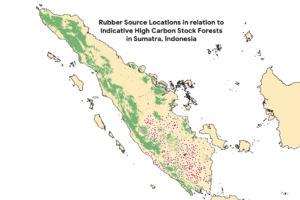
Within a few months of the project launch in July 2020, SRP’s four rubber processing factories, managed by the Halcyon Agri and ITOCHU groups, had traced up to 1 year of rubber supplies to the village and/or sub-district of origin based on self-declarations by their supplying dealers. These approximate origins of the rubber sources were filtered through WWF Indonesia’s new environmental risk assessment and management tool which identifies High Conservation Value Areas and High Carbon Stock Forest for the whole island of Sumatra. The results allow processors and their respective downstream supply chains to focus their sustainability work with farmers on priority areas.

The SRP partners are enhancing dealer self-declarations with digital apps such as CropIn and Hamurni to assess farms’ potential environmental, social, equity, labour and legal issues accurately and to address them.

As GPSNR adopts principles and criteria for what constitutes transparent and sustainable rubber, the risk assessment algorithms will be adapted to flag compliant rubber accordingly. This is increasingly important for rubber’s downstream as companies’ Environmental, Social, Governance (ESG) impacts are becoming key evaluation criteria for investors and financiers who will demand the disclosure of the relevant information. In a parallel development, new supply chain laws will require major companies like the world’s car and tire makers to be responsible for the environmental and social impacts of their supply chains. The collection and analysis of detailed data on upstream supply chains will have to become an essential part of doing business and SRP partners are working to respond appropriately to these changes.

While continuing to focus on increasing the resolution of tracing rubber to its origin and collecting the respective data, SRP will now begin finding ways to best address the social, equity, labour, and legal issues that may have come up in supply chain assessments. 

The SRP is a voluntary, open and flexible platform of like minded partners interested in testing a diversity of approaches to achieve supply chain transparency and sustainability, and welcomes interested rubber supply chain actors to reach out and discuss how they might join the collaboration. GPSNR members interested in participating in the SRP should reach out to the GPSNR Secretariat to get involved in the project.

Scroll to Top