


Platform Updates for August

Share This Post

Baseline Reporting Requirements Pilot Testing

The Baseline Reporting Requirements, developed by the Policy Toolbox Working Group, is a document that indicates certain qualitative and quantitative sustainability data to be reported to the Secretariat. Back in June, we invited GPSNR members to volunteer to be part of a pilot testing for these Baseline Reporting Requirements. Since then, we have had 12 member companies coming forward to contribute their time and efforts to the exercise. These member companies consist of processors, tire makers and one car maker. As part of the pilot testing, each company was given access to a secure reporting platform where they could input the necessary reporting data.  

The Secretariat has conducted in-depth interviews with ten of the volunteer members so far. Following this, all feedback and data received will be reviewed, with the view to refine the Baseline Reporting Requirements in preparation for the formal launch in the near future.

Strategy and Objectives Working Group

The Working Group has commenced an extension of the study on Human Rights and Labour Rights’ Risk Mapping in the Global Natural Rubber Value Chains conducted by independent consultants James Griffiths & Associates Sàrl. This extension will see the consultant preparing an Annex to the main report that focuses on “equity issues” in the global natural rubber value chain. The objective of this extension is to understand current levels of equity (or inequity) along the natural rubber supply chain and identify where these could pose a threat to ecological, social and economic sustainability.

The report will also touch on how GPSNR’s current definition of “equity” compares to definitions used by others in related sectors or related risk assessments, providing suggested revisions to GPSNR’s definition where appropriate.

The Equity sub-Group published four Requests for Proposals (RFPs) in mid August, for studies on the Living Income Gap in the global natural rubber value chain. These initial studies will focus on collecting information and metrics from four countries: Côte d’Ivoire, Indonesia, Myanmar and Thailand. The deadline for submission of proposals is over. The Secretariat has received several proposals and will be evaluating them before presenting them to the sub-Working Group for consideration.

‘Traceability and Transparency’ Working Group

The two Requests for Proposals (RFPs) that the Working Group has been developing were also published in mid August. The deadline for submission of proposals was last week.

The first RFP is for a study that will assess the methodologies of existing traceability and transparency tools and how they match up against the traceability and transparency requirements of GPSNR members. 

The second RFP is for a study that will compare existing and currently under-development GIS databases and mapping tools along with their mapping approaches through research and interviews.

The Secretariat has received several proposals and is in the process of evaluating them. The Working Group will make the final decision thereafter.
More To Explore

News

GPSNR Working Groups Update: October 2020

In our last issue, we explored the road ahead for GPSNR’s Working Groups following the outcome of the second General Assembly. In this update, we check in on each Working Group to see where they are in their respective journeys.

Strategy and Objectives Working Group

The Strategy and Objectives Working Group has already started working on a proposal for increased Working Group alignment within the Platform. The Working Group is also finalizing the Request for Proposal (RFP) for a study on environmental impacts, and risks, in the natural rubber value chain. With its intended focus on biodiversity and ecosystem services, this study will complement the previously commissioned social risks study (conducted by independent consultants James Griffiths & Associates Sàrl). 

The Living Income Gap studies for Indonesia and Thailand, initiated by the Equity sub-Group, are expected to be delivered to the sub-Group in November. 

‘Policy Toolbox’ Working Group

The Policy Toolbox Working Group has drafted revised Terms of Reference (ToR) that will cater to the work they now have to develop following the approval of the Policy Components at the General Assembly on 23 September 2020. The next phase of work will see the Policy Toolbox Working Group developing implementation guidance for each stakeholder group, as well as future reporting requirements that will build on the baseline reporting requirements and align with the policy implementation guidance. The revised ToR will be discussed further at the Executive Committee level before being approved. 

The Policy Components were approved as part of a resolution for the endorsement of a GPSNR policy framework for natural rubber production and sourcing for ordinary member companies. A booklet containing the Policy Components can be found here.

‘Capacity Building’ Working Group

The Working Group’s latest discussion was centered around its restructuring, and touched on considerations for a revised ToR to accommodate the shift in focus from developing strategies to operationalizing them. The Working Group has also kickstarted discussions around the initiation process for one of the capacity building strategies, namely the identification and gathering of Good Agricultural Practices.

‘Traceability and Transparency’ Working Group

The Working Group will soon be reviewing Traceability and Transparency Tools Comparison study to develop next steps as well as recommendations to the Executive Committee.

Download the October 2020 Working Groups Update Slide Deck for more details on the progress of each Working Group.

RubberWay Contributes to Achieving GPSNR Goals

By Nicole Tan, Project Manager, RubberWay

A couple of months ago, RubberWay was proud to introduce its contributions to sustainable natural rubber to members of GPSNR. 

Data obtained through RubberWay contributes to helping users meet the GPSNR Reporting Requirements. A crosswalk analysis done by the RubberWay team showed that it provides 89% coverage of the 37 GPSNR Policy Components, of which 18 Policy Components are directly satisfied by RubberWay while 15 are partially contributed to.


RubberWay meets 33 out of 37 GPSNR Policy Components through direct and indirect contributions.


The webinar hosted by GPSNR gave RubberWay the chance to provide an overview of its solution from the perspective of both tire makers and processors. 

The sharing by tire makers highlighted the motivations for their participation in RubberWay and the ways in which RubberWay’s results have enabled them to engage in efforts on the ground. 

Similarly, natural rubber processors are able to apply data from RubberWay to implement field actions while also using the tool as a channel to facilitate communication directly with smallholders.


Users are able to utilise data generated through RubberWay to inform risk mitigation measures. RubberWay also provides its users with a channel for supplier engagement. 


More detailed information on how RubberWay contributes to achieving GPSNR’s goals for sustainable natural rubber can be found in the RubberWay white paper. Access to the complete crosswalk analysis is also available upon request.

ABOUT RUBBERWAY

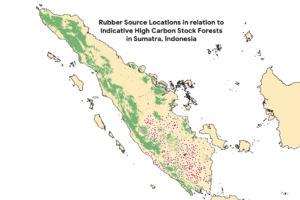
RubberWay is a digital risk mapping solution that helps upstream actors to detect environmental and social risks across the natural rubber supply chain. Risk data obtained through RubberWay generates actionable insights for users like tire makers and processors to drive change towards sustainability within the industry. 

With over 50,000 questionnaires completed to date, the RubberWay dataset is set to increase with growing participation of users, enabling expansive reporting of sustainability risks across sourcing countries globally. 

Find out more about RubberWay here

Scroll to Top