

Preparing Smallholders for their Role in GPSNR

Share This Post

Following the announcement that the GPSNR General Assembly (GA) will take place in September, the Smallholders Representation Group has quickly adapted its plans around onboarding smallholder members prior to the GA. With restrictions around COVID-19 necessitating a virtual format for the GA, likewise the sessions involving smallholders would follow suit.

The onboarding will be conducted via a series of national and international calls starting from late July until the end of September. There will be a total of 3 calls amongst smallholders at the national level, and another 3 calls at the international level. 

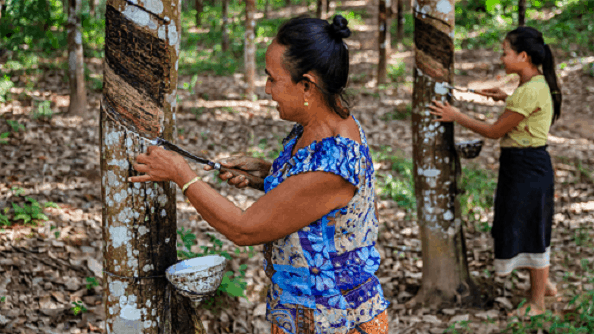
The first national calls have already been conducted for all seven countries: Brazil, Côte d’Ivoire, Ghana, Indonesia, Myanmar, Thailand and Vietnam. During this first call, the smallholders were introduced to the video conference platform with a quick tutorial on its functions. Next, they were given an update on developments and projects within GPSNR before learning more about the upcoming GA, including the onboarding schedule, the process for Executive Committee elections and an overview of the resolutions. 

The Country Champions are providing immense support through coordination of the calls, conducting the calls in the local language and in some cases reaching out to the smallholders individually to help them overcome the barriers of using new technology.

The Working Group will be engaging an experienced facilitator who will be able to foster relationships as well as trigger and encourage discussion amongst the smallholders  in an international and multilingual setting. A Request for Proposal was posted on the GPSNR website and social media channels, and the Secretariat is supporting the Working Group in finalizing the selection of proposals.  

The next national call will see smallholders sharing about themselves and their work in natural rubber production, an activity designed to assist them each in articulating their thoughts and vision as potential election candidates for the Executive Committee.

More To Explore

News

Updates from the Working Groups

Strategy and Objectives Working Group

The study on Human Rights and Labour Rights’ Risk Mapping in the Global Natural Rubber Value Chains conducted by independent consultants James Griffiths & Associates Sàrl has been submitted to the Working Group. The full study will be published on the GPSNR website shortly, and the document will be open to stakeholders for comments.

Meanwhile, the Strategy and Objectives Working Group has started to engage with the rest of the Working Groups on aligning with the Theory of Change, and developing platform KPIs. 

The Equity sub-Group has collected comments from the Strategy and Objectives Working Group on the proposed definition of equity. The sub-Group is also exploring engaging consultant James Griffiths to conduct research into equity risks along the natural rubber supply chain, with the plan to have the findings of this study feed into the definition. The sub-Group is currently in the process of establishing an operational plan to define the various workstreams, processes, timelines, and  responsibilities for the Living Income study. The first phase of the study will involve collecting existing benchmark data and doing desk research on national poverty lines, minimum wages, and other relevant information. For greater alignment with the Capacity Building Working Group’s scope, the Equity sub-Group has decided to focus on the same four countries: Côte d’Ivoire, Indonesia, Myanmar and Thailand. 

‘Policy Toolbox’ Working Group

The proposed Policy Components and Baseline Reporting Requirements are open for member consultation until 3 July 2020. Find out more here

‘Capacity Building’ Working Group

The regional sub-Groups described the various findings and recommendations in a presentation to the larger Working Group at the end of May. Eight initiatives were proposed to be shared across the four focus countries, each corresponding to a critical issue identified through stakeholder interviews. These eight initiatives are: access to pure certified (re)planting material, promote the CO2 compensation scheme, promote value rubber wood, improve access to finance, disease fighting, dissemination of Good Agricultural Practices (GAP), income diversification, and improve reach and quality of extension services. Depending on the initiatives recommended for each country, three priority actions have been suggested, forming the basis for a 3-year programme.

The sub-Group for Thailand organized a call with some of Thai smallholder members to seek their opinion on the proposed initiatives. The discussion proved to be a fruitful one, with the smallholders providing advice and suggesting alternative initiatives for the sub-Group to consider. The subgroup for Côte d’Ivoire, which has a smallholder member who is a representative from a local producer association in participation, has also contextualized the proposed initiatives to the local conditions of smallholders and industrial plantations.

The other sub-Groups are also planning to get smallholder members’ input on the capacity building initiatives for their respective countries of focus.

‘Traceability and Transparency’ Working Group

The Working Group has started discussions on risk assessment, and will be linking up with the Policy Toolbox Working Group as well as consultant James Griffiths on the results of the social risks study.

The terms of reference for the two pilot proposals have been finalized after several rounds of additional revision. The documents will be submitted soon to the Executive Committee. 

Smallholders Representation Working Group

The Working Group continues to plan and prepare for the smallholders programme prior to the General Assembly. In particular, terms of reference are being drafted for a professional facilitator to manage the smallholder workshop sessions for the pre-GA programme.

Members

Following the Conversation with GPSNR Topic Talks! (Members Version)

The GPSNR Topic Talks series is organised by the GPSNR Secretariat and presented by GPSNR members. The presentations cover several themes around sustainability and the global natural rubber supply chain.

The series kicked off on 27 October with a presentation by Philippe Thaler from CIRAD, on the implications of EU legislation on imported deforestation. View the webinar recording or download the slide deck from this webinar using the links provided. 

The second webinar’s theme was on smallholder solutions and featured two separate presentations. “A landscape-level approach to inclusion and capacity building for rubber smallholders” was presented by Rizki Permana from SNV, Widyantoko Sumarlin from Kirana Megatara, and Tony Hill from Proforest. Speaking from experience with the Kelola-Sendang project in South Sumatra, the presenters explained how SNV, with Proforest support, worked with rubber smallholder groups in the jurisdictional initiative, which helped to forge new links between the smallholders and a crumb rubber factory buyer in the Kirana group. 

Next, “Exploring Smallholder Solutions in the Rubber Sector – The Processing and Sale of Rubberwood to Support Smallholder Financing in Indonesia” was presented by Amy Smith from WWF, Gerald Tan from HeveaConnect, with Renée Corstens and Remco Geervliet from Financial Access. This presentation shared the findings of a study which analyzed the potential of rubberwood to serve as a mechanism to support smallholder financing in Indonesia. You can view the webinar recording or download the slide deck for this webinar using the links provided.

The next theme is Assurance and smallholders, and how we can learn from existing schemes. PEFC’s CEO Ben Gunneberg presented a webinar last night, elaborating on PEFC’s approach to standard-setting and certification. He also showcased PEFC’s current collaborative projects with their national members and companies to support smallholder producers, and how these will benefit GPSNR members and the work GPSNR is engaged in. You can view the webinar recording or download the slide deck for this webinar using the links provided.

Continuing with the same theme of Assurance and smallholders, FSC will be presenting on 8 December, an overview of smallholder certification solutions. Members may register for the webinar in the subsequent section of this article.

We are also pleased to announce an addition to the Topic Talks lineup: ‘REDD+, are carbon credits impacts overstated?’. This new presentation, jointly organized with GIZ and which will be held on 10 December, puts the spotlight on reducing emissions from deforestation and forest degradation (REDD+) with an introduction to the REDD+ methodology, followed by a discussion with the authors of a recently published study, “Overstated carbon emission reductions from voluntary REDD+ projects in the Brazilian Amazon”. Members may register for this Topic Talk in the subsequent section of this article.


Assurance and Smallholders: Learning from Existing Schemes Part 2

“FSC Smallholder Certification Solutions”

8 December | 7PM (GMT+8)

Click here to register

Presented by: FSC

The presentation will cover FSC’s solutions for smallholders to become certified. First, an overview of the evaluation of certification solutions for smallholders will be given. FSC’s existing solutions will be covered, with a focus on the benefits for FSC Group Certification. Next, solutions in the pipeline will be covered, addressing the impact of pilot projects and highlighting success stories.

REDD+, are carbon credits impacts overstated?  

10 December | 3PM (GMT+8)

Click here to register

Jointly Organized by: GIZ 

Presented by: GIZ and authors of the study

Using REDD+ projects to offset carbon emissions through avoided deforestation and the financial support of local communities is popular but also highly debated. Especially, voluntary REDD+ projects are regularly criticized as inefficient or even greenwashing. This presentation will provide an introduction to the REDD+ methodology. The authors of a recent critical study, “Overstated carbon emission reductions from voluntary REDD+ projects in the Brazilian Amazon” will then present their findings and suggestions as a basis for discussion.

Scroll to Top