

Proposing National Strategies for Capacity Building

Share This Post

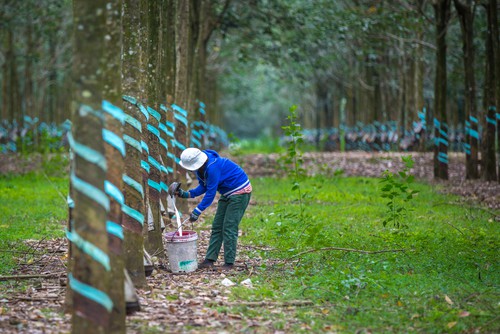
Following several rounds of further consultation amongst its members, the Capacity Building Working Group has finalized proposals for capacity building strategies for the four previously identified focus countries: Côte d’Ivoire, Indonesia, Myanmar and Thailand. Within each of these proposals, the Working Group has defined key strategic approaches to best allow for immediate engagement and implementation. 

Each proposal sets out the issues that have been identified as threatening the sustainable production of natural rubber, underlying causes for these issues, as well as a main objective. Within each proposal, the Working Group has suggested various strategic approaches, providing a rationale for chosen actions, and proposing impacts and resources required. While the Working Group recognizes that the issues do not represent the full list of challenges that stand in the way of national rubber production becoming sustainable, it highlights that the focus is on strategic approaches that allow for immediate engagement and implementation.

These proposals have been submitted to the Executive Committee for review and approval, while the Working Group concurrently addresses final concerns around the proposed strategy around a CO2 compensation scheme.   

Looking ahead, detailed implementation plans and timelines will have to be developed upon approval of the proposed strategies. These are issues that the Working Group will be exploring in the weeks to come.
More To Explore

News

GPSNR Working Groups Update: March 2022

All GPSNR working groups have a large chunk of work ahead of them. Here are all their updates: 

Strategy and Objectives Working Group

The group has made good progress by establishing the new risk task force that will evaluate the exact scope of GPSNR’s risk based approach. It has also got its new Terms of Reference approved by the Executive Committee, and is now working on contracting a consultant for the Economic Risk Study and conducting a gap analysis of GPSNR’s current activities based on the platform’s Theory of Change.

Smallholder Representation Working Group

Having published the RFP to develop the GPSNR Smallholders Policy Framework equivalent, the group is focussing on the first Smallholders International Call of the year in March 2022, workshops in Liberia and Malaysia, and on developing country-specific smallholder engagement activities with smallholders and Country Champions.

Policy Toolbox Working Group

This group is continuing discussions among its three new subgroups: Transparent reporting roadmap, Implementation Guidance and RR Guidance & Tools. In the coming months, they will finalize guidance for the reporting requirements and share it with companies

At the same time, they are working with the smallholder representation working group on the Smallholder Policy Framework equivalent.

Capacity Building Working Group

After publishing the GAPs as living documents in English and Bahasa and selecting SNV-Proforest and Koltiva as consultants to work on the GAPs coaching in Indonesia, the working group continues to develop capacity building plans for Indonesia, Thailand and Ivory Coast.

They are also seeking your inputs for GPSNR’s knowledge sharing platform, which you can provide here.

Traceability and Transparency Working Group

Having finalized the traceability and transparency primer, the WG will wind down its operations.

Shared Responsibility Working Group

The Shared Responsibility has completed a review of the Shared Responsibility Framework, incorporating feedback from the Executive Committee. The Working Group will present an updated proposal to the EC as the next step, with a view to prepare a resolution at the 2022 General Assembly.

News

Preparing Smallholders for their Role in GPSNR

Following the announcement that the GPSNR General Assembly (GA) will take place in September, the Smallholders Representation Group has quickly adapted its plans around onboarding smallholder members prior to the GA. With restrictions around COVID-19 necessitating a virtual format for the GA, likewise the sessions involving smallholders would follow suit.

The onboarding will be conducted via a series of national and international calls starting from late July until the end of September. There will be a total of 3 calls amongst smallholders at the national level, and another 3 calls at the international level. 

The first national calls have already been conducted for all seven countries: Brazil, Côte d’Ivoire, Ghana, Indonesia, Myanmar, Thailand and Vietnam. During this first call, the smallholders were introduced to the video conference platform with a quick tutorial on its functions. Next, they were given an update on developments and projects within GPSNR before learning more about the upcoming GA, including the onboarding schedule, the process for Executive Committee elections and an overview of the resolutions. 

The Country Champions are providing immense support through coordination of the calls, conducting the calls in the local language and in some cases reaching out to the smallholders individually to help them overcome the barriers of using new technology.

The Working Group will be engaging an experienced facilitator who will be able to foster relationships as well as trigger and encourage discussion amongst the smallholders  in an international and multilingual setting. A Request for Proposal was posted on the GPSNR website and social media channels, and the Secretariat is supporting the Working Group in finalizing the selection of proposals.  

The next national call will see smallholders sharing about themselves and their work in natural rubber production, an activity designed to assist them each in articulating their thoughts and vision as potential election candidates for the Executive Committee.

Scroll to Top